

Astro Review
Astro works best in scenarios that require a consistent anonymous identity, especially in or around Eastern Europe.
3-Minute Summary
Astro is an Armenia-based proxy service established in 2018. It sells residential, mobile, and rotating datacenter proxies.
From what we’ve experienced, Astro is best suited for small to medium businesses that manage multiple accounts on social media and other platforms. You might also have a better experience if you live in Russian-speaking countries, as both the service and proxy network cater to this region.
Astro’s main strength lies in flexibility – whether we’re talking about features or pricing. You can buy as little as 100 MB of traffic with or without monthly commitments. The rates are way above the market average, and they don’t scale well. There’s also some confusion with multiple payment gateways that duplicate payment methods.
The proxies can come from your chosen city or ISP, include only a certain type of IP (such as mobile or datacenter), and rotate whenever you wish. There’s even an option to use them as a VPN for mobile devices and to avoid passive fingerprinting techniques. The number of available locations is limited, especially when using mobile IPs.
Our tested residential proxy network connected successfully nearly 99% of the time. However, it was slow outside of Europe and smaller compared to most alternatives, with only ~30k IPs in the US. The majority of the proxies came from Russia and neighboring countries.
The user experience was adequate, though sometimes confusing. Astro has a similar system to Bright Data’s zones, only here you buy ports with their own traffic allowance. Each sticky IP you want to use at the same time requires a new port. You can track usage statistics via the dashboard or a functional API.
The customer support works 10AM-2AM GMT +4, can be reached through multiple channels like Telegram or live chat, and generally replies fast.
General Information
- Country: Armenia
- Founded: 2018
- Employees (LinkedIn): 0
- Proxy networks: Residential, mobile, datacenter
- Price range: Premium
- Starting price: $0.37
- Payment methods: Credit card, SeverPay, cryptocurrencies
- Trial: $3
Astro was founded in 2018 together with the creators of Airsocks – a provider of mobile addresses for multi-accounters, traffic arbitrageurs, and gray-hat SEO specialists. At first, the new service offered residential and datacenter IPs to avoid overlap. But gradually, its line-up expanded with mobile proxies and pushed the older brand out.
Today the traces of Airsocks remain only in closed BlackHatWorld threads and an outdated Multilogin review. In its place, we have Astro. The brand has changed owners but its goal remains the same – to sell you some proxies.
Like the predecessor, Astro puts a big emphasis on multiple account managers and SEO specialists. It has partnerships with AdsPower, Multilogin, Duoplus, and others. There are also multiple Russian-speaking forum threads where you can read people’s impressions about the service.
There’s little information about it on the English-speaking web when we first reviewed it in 2022. In early 2026, the situation has improved, though we still wouldn’t call Astro a very visible provider.
Nowadays, Astro highlights ethical proxy usage, boasting about its KYC and AML procedures. That said, we don’t really know how the company sources IPs. And it doesn’t help to find zero employees on LinkedIn – the only traces lead to hidden LinkedIn members.
The market’s reaction to Astro is generally positive, as reflected by the Reviews.io feedback. However, some users have been critical about the size of the IP pool, which shows the pains of building one’s own proxy network. Around 4/5 of the latest reviews were in Russian, indicating Astro’s main audience.
Astro Proxy Networks
Unlike some other providers that are transitioning to web scraping APIs, Astro remains a proxy purist. That’s because its main demographic works with specialized software like antidetect browsers and has little use for such APIs.
You can choose from three proxy types: datacenter, residential, and mobile proxies. Unlike many other providers, Astro has no clear distinction between them. You buy all the services using the same approach: by creating a port and choosing an IP type, among other settings.

Pool Size & Coverage
- Advertised pool size: 50 million
- Locations (March 2026): 82 countries (residential), 27 (mobile), 59 (datacenter)
- Filtering: Random, country, city, ISP
- Other filters: Operating system
At 50M IPs, Astro’s advertised proxy pool is among the larger in the market. We’ll see if that’s the case in our benchmarks below.
The list of available locations is, however, much small than what you’d expect. Even the residential proxy network hovers around 100 countries. Though in theory you can choose cities and ISPs, the available options will disappoint you. We found the biggest variety in Russia, while only two cities were listed in the US and only one in France.
It’s interesting that the datacenter proxies also let you specify ISPs like Amazon, Hetzner, and OVH.
One unique feature is the ability to choose an OpenVPN profile to emulate different operating systems. For example, you can opt to receive IPs associated with Windows, Mac computers, Android phones, or even Mikrotik routers.
Astro claims that it only lets one client access a proxy at a time. In other words, you won’t have to share that IP address with anyone else while you use it. Some providers don’t have this restriction. It’s a trade-off between keeping the proxy pool more accessible and preserving the IPs.
Features
- Rotation: Every request, customizable sessions, rotation by link
- Protocols: HTTP, HTTPS, SOCKS5
- Concurrency: Up to 250 connections per port
- Traffic: Plan based
- Authentication: Credentials, IP whitelist
- Sub-users: ✅
All three proxy types rotate. This is a necessity with residential and mobile IPs, and a design choice with datacenter proxies. The good thing is that you can adjust the rotation frequency however you want: there’s an entry box that accepts any number over one minute. Alternatively, you can rotate proxies every connection request or by opening a link.
Astro supports both authentication methods, all three major connection protocols (though SOCKS5 is likely without UDP), and sub-users with their own traffic allowances.
The 250 connection-per-port limit may be problematic for some usage scenarios, namely web scraping; we’ll get to why shortly.
Integration Examples
- Basic request: USERNAME:[email protected]:10120, USERNAME:[email protected]:10019…
- Using filters: Configurable through the dashboard
- Using sessions: Configurable through the dashboard
Astro uses gateway servers to connect you to its proxy networks. However, this isn’t a conventional setup: you’ll need to generate individual ports on the dashboard, each with its own configuration and slightly different gateways.
Your rotation and location settings don’t fully reflect in the username, nor the gateway address. As such, you’ll have to rely on the dashboard a lot. This may sound confusing, so here’s an example of what it looks like in practice:
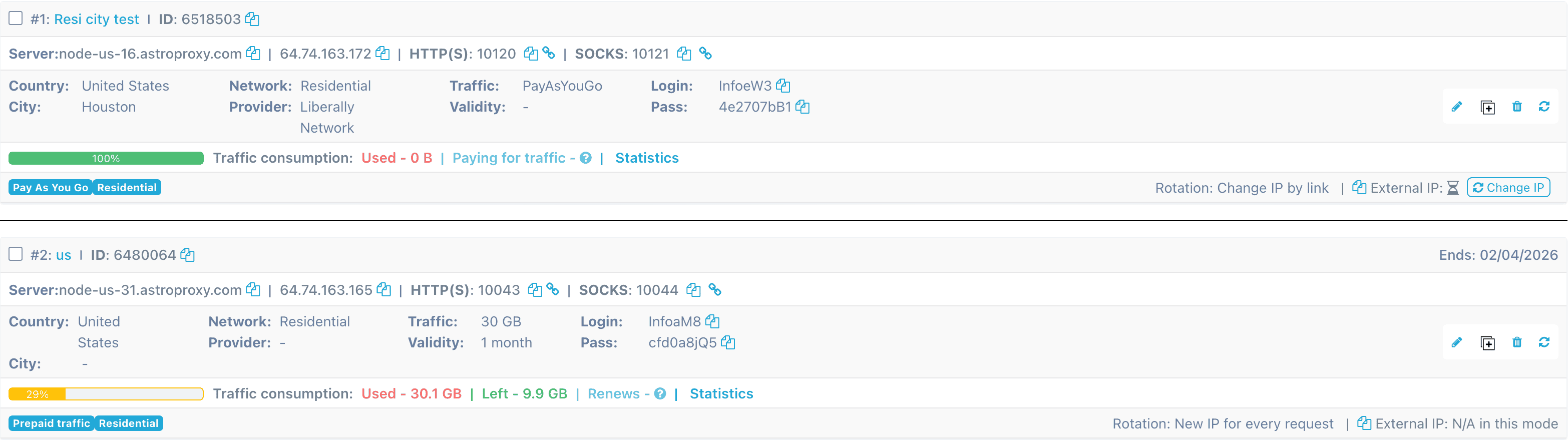
At first, the system looks manageable. Things start getting complex once the list of ports grows. For example, to use 100 proxies with sticky sessions, you’ll need to create the same number of ports. And remember than 250 connection-per-port limit? Well, if you need fast IP rotation to scrape at scale, one port also won’t be enough.
Pricing Plans
- Model: PAYG, subscription
- Format: Traffic + ports
- Modifiers: City targeting (x1.5)
- Starting price: $0.37
- Trial: $3
Astro bases its pricing on monthly plans. The provider’s model consists of two elements: traffic and ports. A port costs $0.30 for all three proxy types – after generating one, you assign traffic to it.
For example, you may want multiple ports for accessing IPs in two different countries or using several sticky sessions at once. Or, you can have one port for residential proxies in France, and a second port for datacenter IPs. In many ways, these ports resemble Bright Data’s zones.
The traffic options range between 100 MB and 300 GB per port. As such, the entry price is very low, sometimes even under a dollar.
If you don’t like monthly plans, there’s an option to pay as you go. All three proxy types support it. The traffic doesn’t expire, but it also carries a heftier rate. On the bright side, it reduces the cost of a port to $0.10 instead of $0.30.
Astro starting rates (monthly subscription)
| Datacenter | Residential | Mobile | |
| 1 GB | $3.65 | $7.30 | $13.14 |
| Price per port | $0.30 | $0.30 | $0.30 |
Astro’s model is interesting for its flexibility, but it also has several issues. For one, paying for each port can get expensive if you work with many accounts. After deleting one, you get money back for unused traffic but not the port’s creation cost.
Another issue is that Astro doesn’t scale very well. You can get at most 20% off when checking out, and then up to 25% on top when buying extra traffic within 30 days. For the full 45% discount, you’d need to spend over $3,000.
Even then, you’ll pay $4/GB for residential proxies, which is the starting price for premium competitors. The mobile and especially datacenter proxy rates are pricier still.
Enabling city targeting multiplies the rates by x1.5. For some reason, ISP selection comes free of charge.
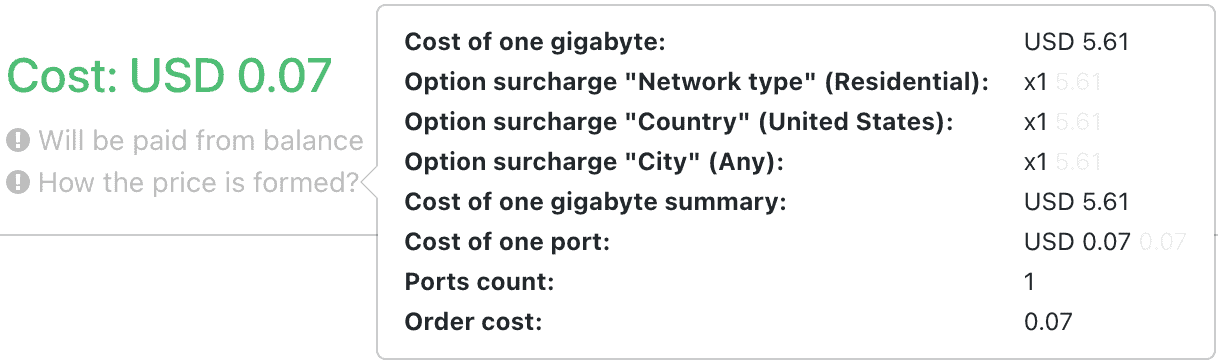
There’s one detail that’s easy to miss, which can markedly reduce the price: Astro charges either for upload OR download traffic, whichever is bigger. The vast majority of providers count both.

Astro lets you try the service for free. This is pretty generous considering that you can simply buy 100 MB of data for peanuts. To claim the trial, you need to contact the customer support on one of multiple channels.
Performance Benchmarks
We last tested Astro’s residential proxies in February 2026.
Pool size & coverage
| Gateway | Requests | Unique IPs | Residential %* |
| Global | 3.6M over 21 days | 404,259 | 94.72% |
| US | 1.2M over 14 days | 29,823 | 86.18% |
| UK | 560k over 14 days | 5,827 | 96.28% |
| EU | 1.2M over 14 days | 34,676 | 97.20% |
| Brazil | 560k over 14 days | 24,472 | 96.00% |
| India | 560k over 14 days | 32,129 | 98.80% |
| Australia | 140k over 7 days | 11,462 | 95.11% |
* IP2Location database, Usage type data point (ISP, ISP/MOB, MOB IPs)
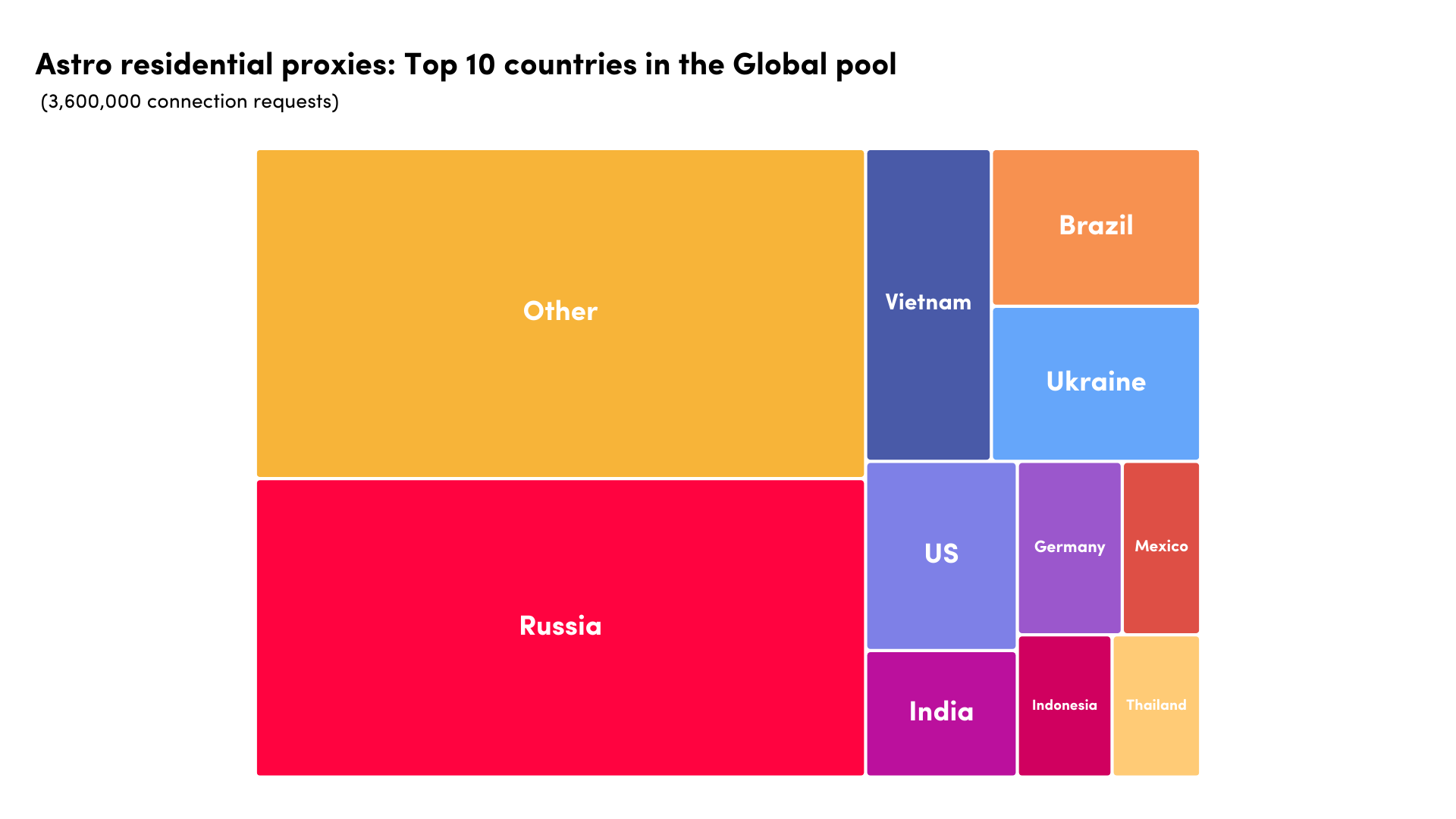
Contrary to what the advertised number claims, Astro’s residential proxy network was actually small. This was especially noticeable in the UK, but even the US pool had roughly 20 times fewer IPs compared to top alternatives. This rules out Astro for bigger web scraping or ad verification projects.
Infrastructure performance
Requests: Same as the pool test (140k to 3.6M per location)
Target: Nearest server of a global CDN (~6 KB response size)
| Gateway | Our server location | Avg. success rate | Avg. response time |
| Global | DE | 99.30% | 1.61 s |
| US | US | 88.59% | 1.80 s |
| UK | DE | 99.75% | 0.77 s |
| EU | DE | 99.74% | 0.90 s |
| Brazil | US | 97.70% | 2.93 s |
| India | SG | 99.75% | 1.76 s |
| Australia | SG | 99.71% | 5.00 s |
Comparison with other providers
On the bright side, we were able to connect to Astro’s residential proxies nearly without fail. The infrastructure was evidently working well during the testing period.
The drawback was speed – Astro took its time to connect in all locations outside of Europe. Its lack of speed was especially noticeable in Australia, where downloading a 6 KB page in ideal conditions took a whopping five seconds.
Performance with popular targets
Requests: ~2,600 per target
Location: US (both the gateway and our server)
| Avg. success rate | Avg. response time | |
| Amazon | 99.49% | 4.78 s |
| Google | 75.05% | 7.44 s |
| 96.91% | 9.13 s | |
| Total | 90.48% | 7.12 s |
Comparison with other providers

A real-world scenario confirmed out synthetic benchmarks: Astro’s residential proxies had a great success rate, but they weren’t very fast.
How to Use Astro
This section explores Astro’s usage policies, dashboard, and customer support.
Registration
To register with Astro, you’ll need to enter an email address, a password, and agree to several usage policies. After confirming the email, you’ll be able to access the dashboard.
Alternatively, you can register with a Gmail account.
As soon as you register, Astro will offer you a trial, which can be claimed by contacting its customer support via social media.
KYC & Usage Policies
It’s possible to use Astro without verification, but you’ll get limited access to the proxy network. The provider doesn’t really specify what limited access means – we only know that KYC may be requested at any point, and that some websites will be unavailable without it.
Verification is carried out by Sumsub, a relatively popular identity verification service. It involves two levels:
- Phone verification to get a free test with limited access.
- Identity verification which requires an ID and a selfie. It gives complete access to the service.
In any case, Astro prohibits fraud, carding, mail spam, money laundering, and penetration testing (in order words, DDoS). We couldn’t find a list of blocked domains; after encountering one, you can contact Astro’s customer support to unblock it.
Overall, there are quite a few guardrails in place, though the provider can be opaque about them.
Dashboard
Like most proxy vendors nowadays, Astro offers its clients a dashboard for setting up proxies, paying, and keeping track of things. Unless you’re a developer looking to control proxies programmatically, this is where you’ll spend most of your time interacting with Astro.
The dashboard is translated into popular languages like English and Chinese.
The dashboard is well made and includes all the necessities. After you first register, there’s a brief 3-step intro which focuses on granting you a free trial. Then you’re left on your own – which isn’t necessarily a bad thing, but some of the interactions are pretty complex.
Astro lets you change the password, set up 2FA, and Telegram notifications. However, there’s no way to manually delete the account. If you like to keep on top of things, there’s a separate page with activity logs.
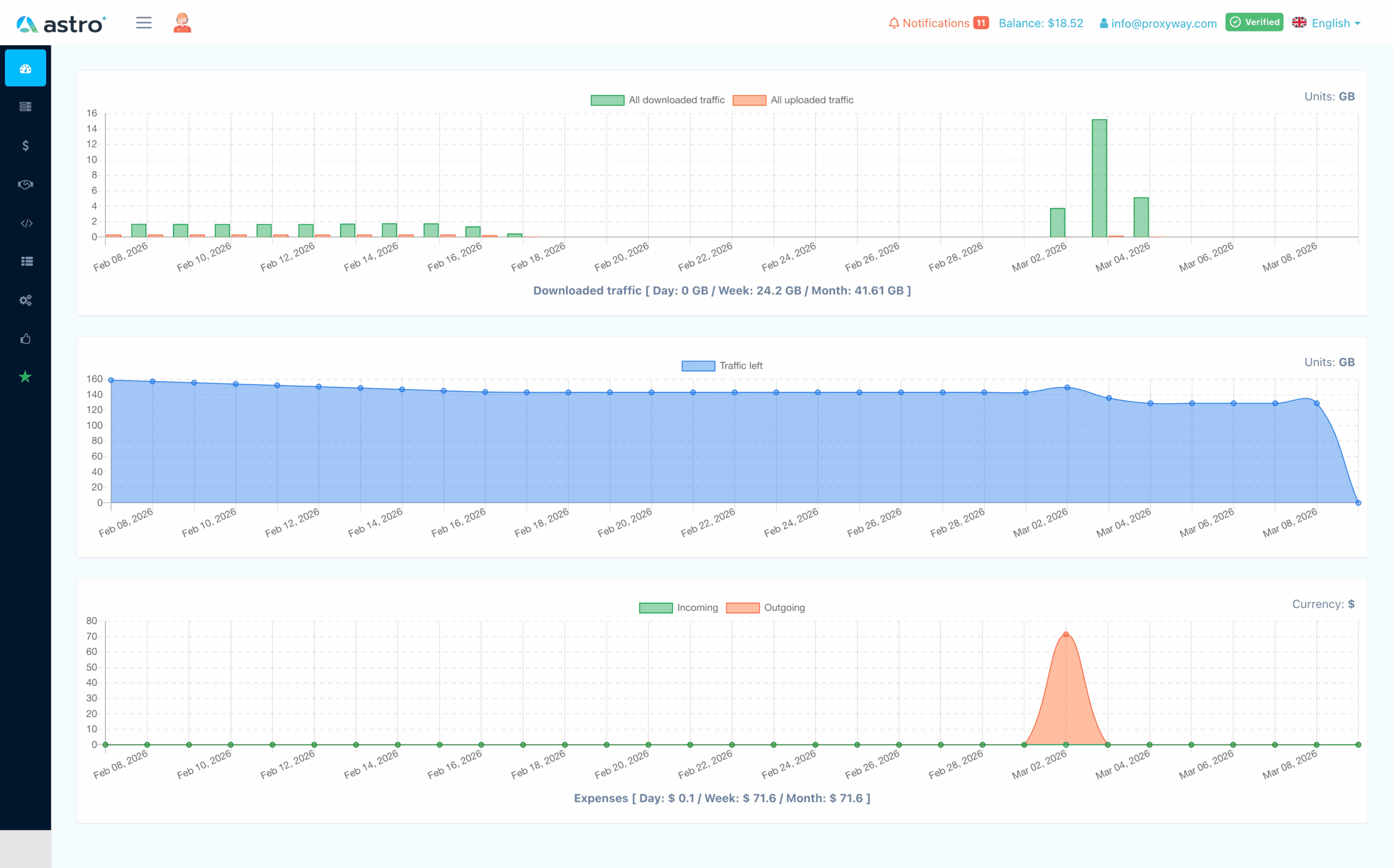
Astro’s home page is dedicated to usage monitoring and not much else.
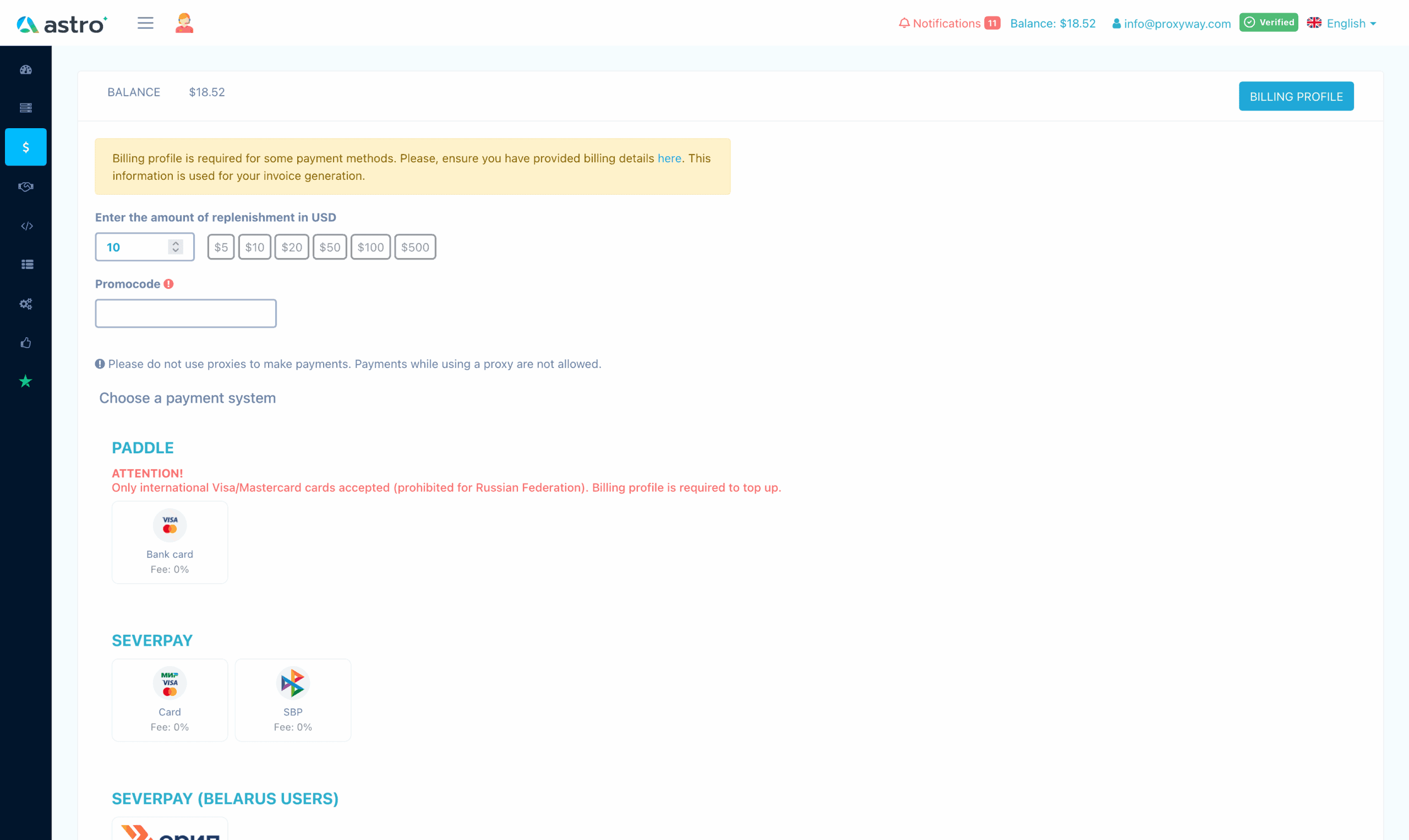
Astro’s dashboard includes a wallet. You can add and store money in it without buying a particular plan. The feature also lets you auto-renew expiring plans without charging your card again.
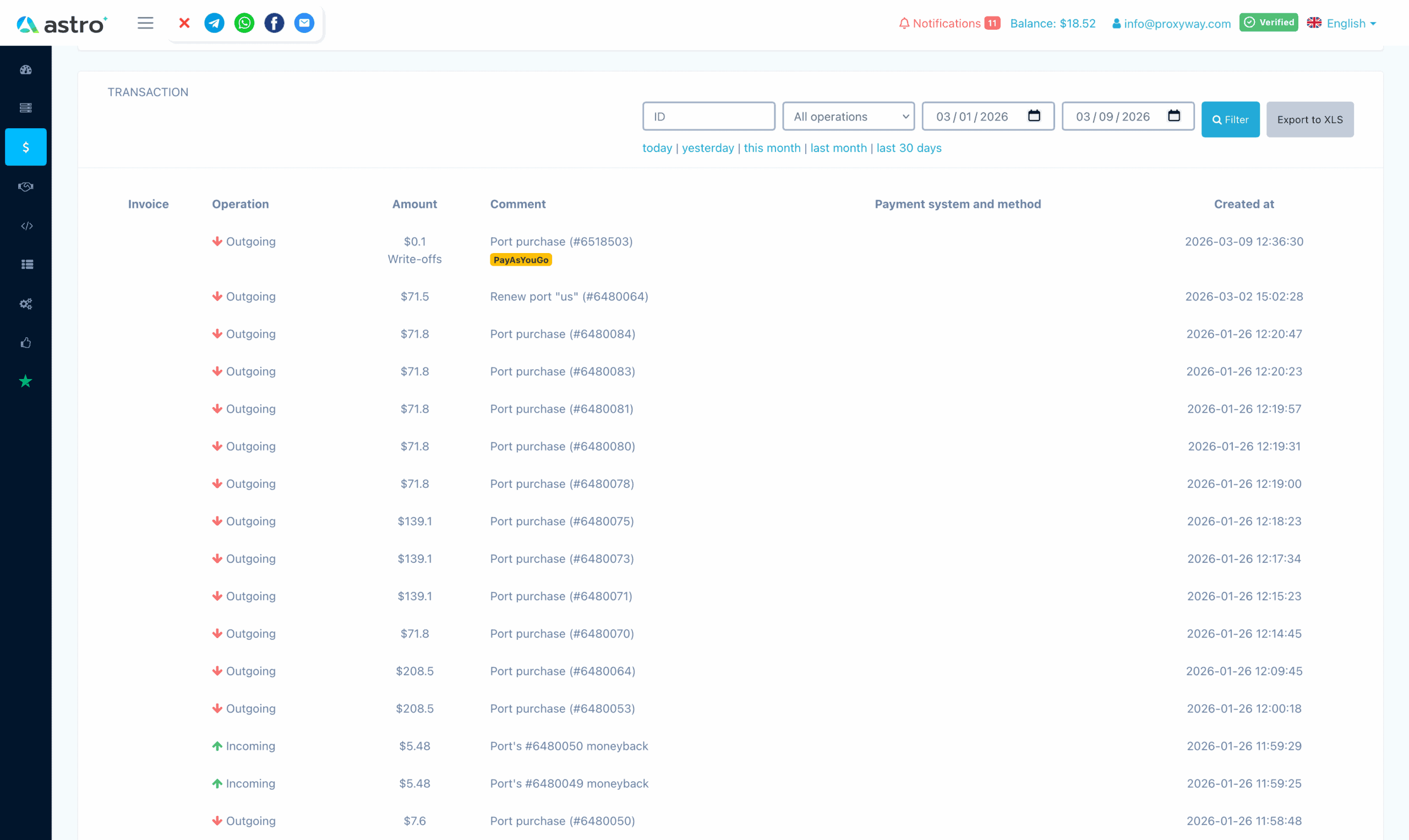
After entering an amount, you can choose from multiple payment systems, some of which have duplicate payment options. At the bottom, there’s the transaction history; you can filter it by date and export entries to an Excel file.
The button is easy to miss, but Astro lets you set up either individual or company billing profiles. It uses this information to generate invoices, which we couldn’t really find on the dashboard.
Astro supports team roles, though nothing really happened when we entered another email.
And while there are no real sub-users, the provider’s system allows to easily separate activities by port. Each port can get its own name, category, and traffic allowance. They share the same credentials, but the different gateway servers and ports they receive almost functions as credentials on their own.
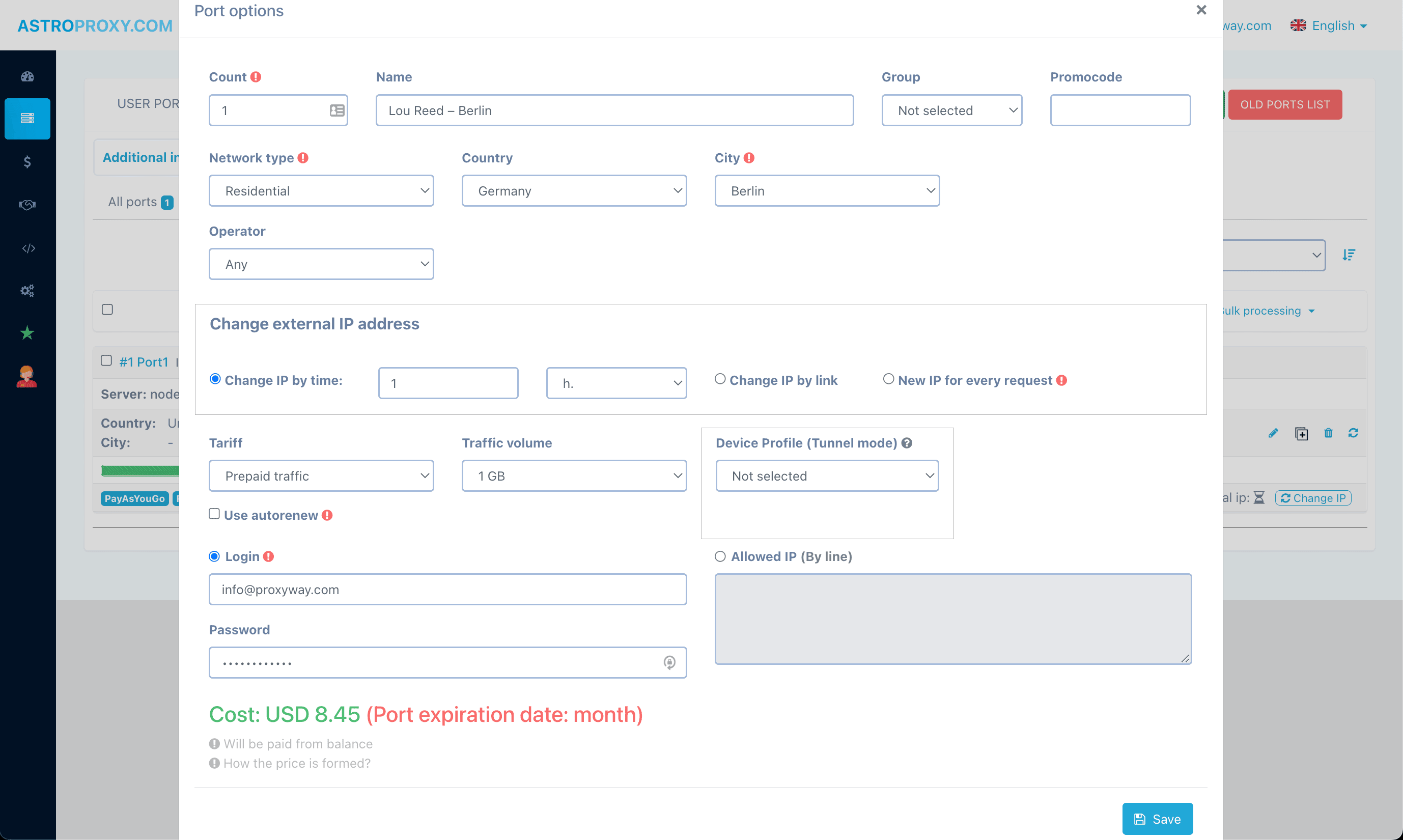
The proxy setup uses one system for all three IP types. It kind of resembles Bright Data’s zones. You first order a port and get a page full of options. They include the network type (residential, mobile, etc.), location, rotation frequency, traffic volume and payment type (monthly or credit), and authentication options (credentials or IP whitelisting).
You pay for each separate port from your wallet. The system automatically adjusts the price based on your choices before ordering. For example, this is how I’d buy 1 GB of residential proxies in Berlin that rotate every hour:
After creating the ports you need, you can filter, sort, move, renew, and otherwise manage them from the main page. You can always edit a port, but the options are more limited than during the creation process. The only thing you can’t change is the credentials assigned to the account – they’re generated automatically for each port.
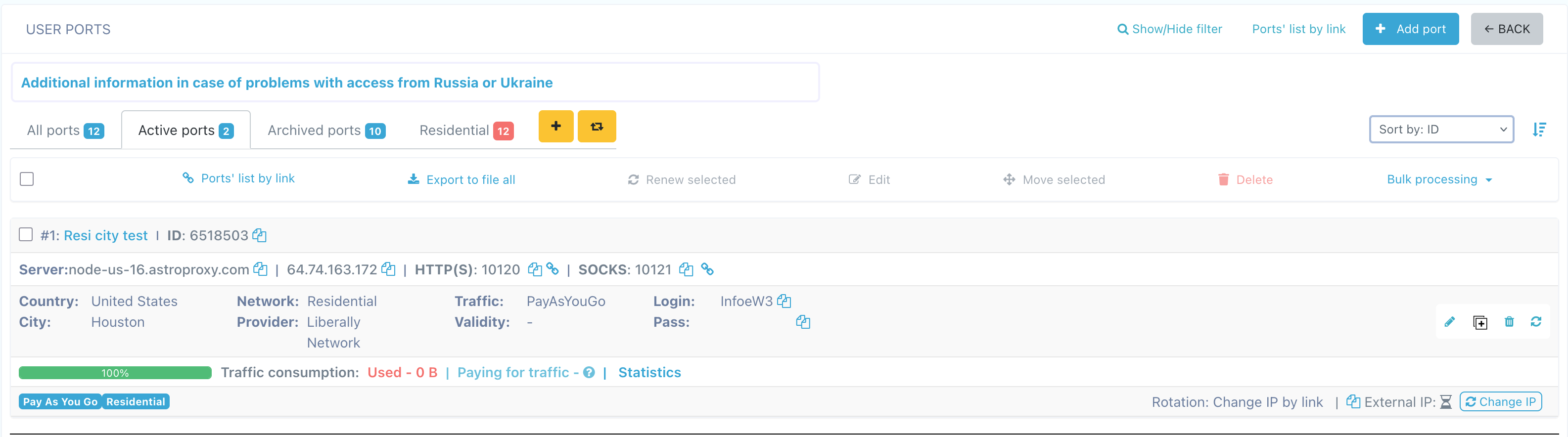
Finally, you can export ports into a file, or open the list in a new tab. The first option is more useful because you can select which ports to export. Also, opening them in a new file adds both HTTP and SOCKS formats, so you’ll need to remove every second line.
Because all the plans are traffic based, Astro offers usage statistics. There are two ways to access them. The first – via the dashboard’s main page. It contains three very basic graphs showing traffic use and remaining balance. You can’t filter them by date or even proxy type.
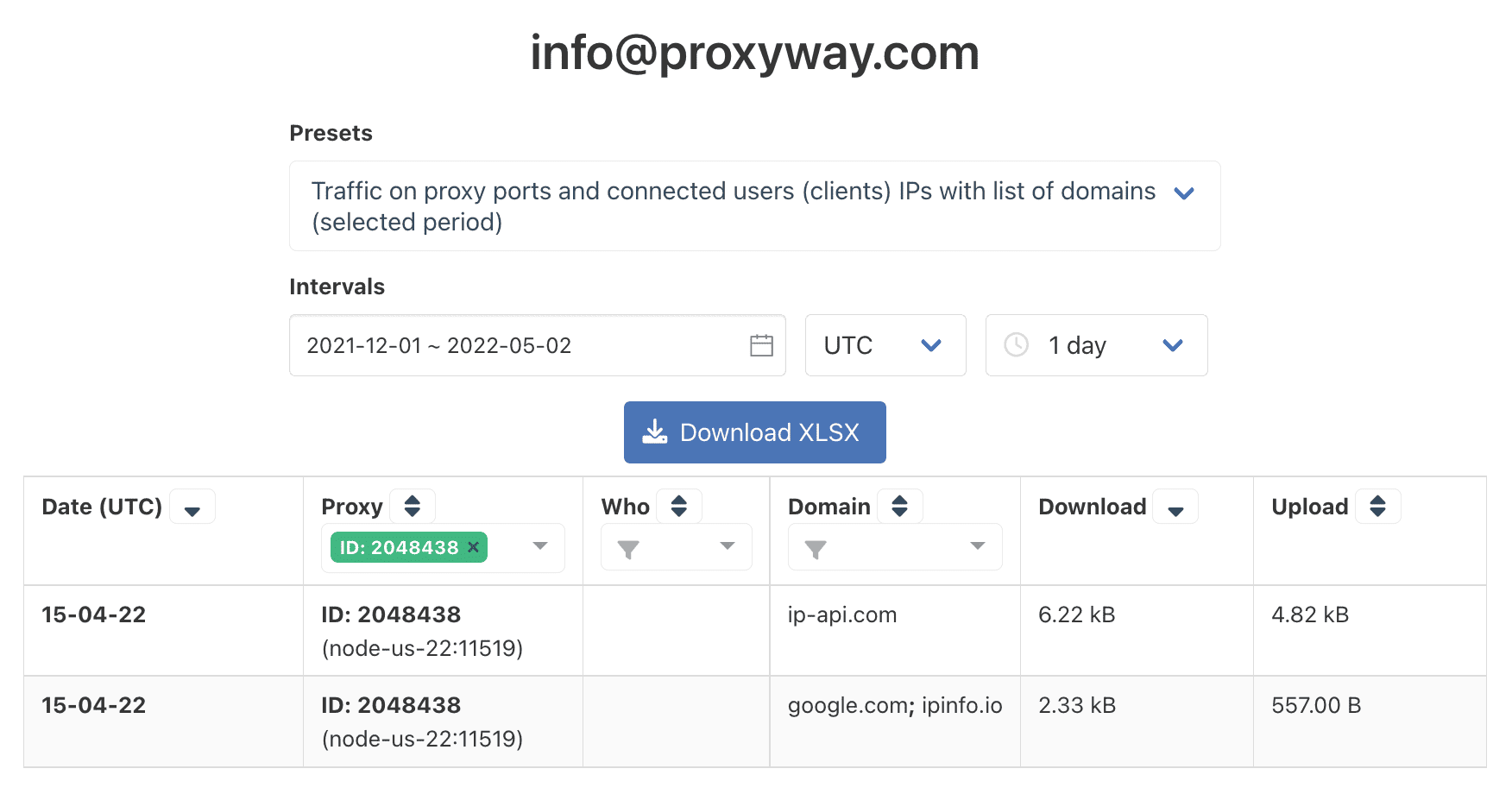
The second option is to open the statistics under each individual port. This method is more informative: you can filter data usage by date, ports, whitelisted IPs, see which websites were accessed and how much traffic they consumed.
API Access
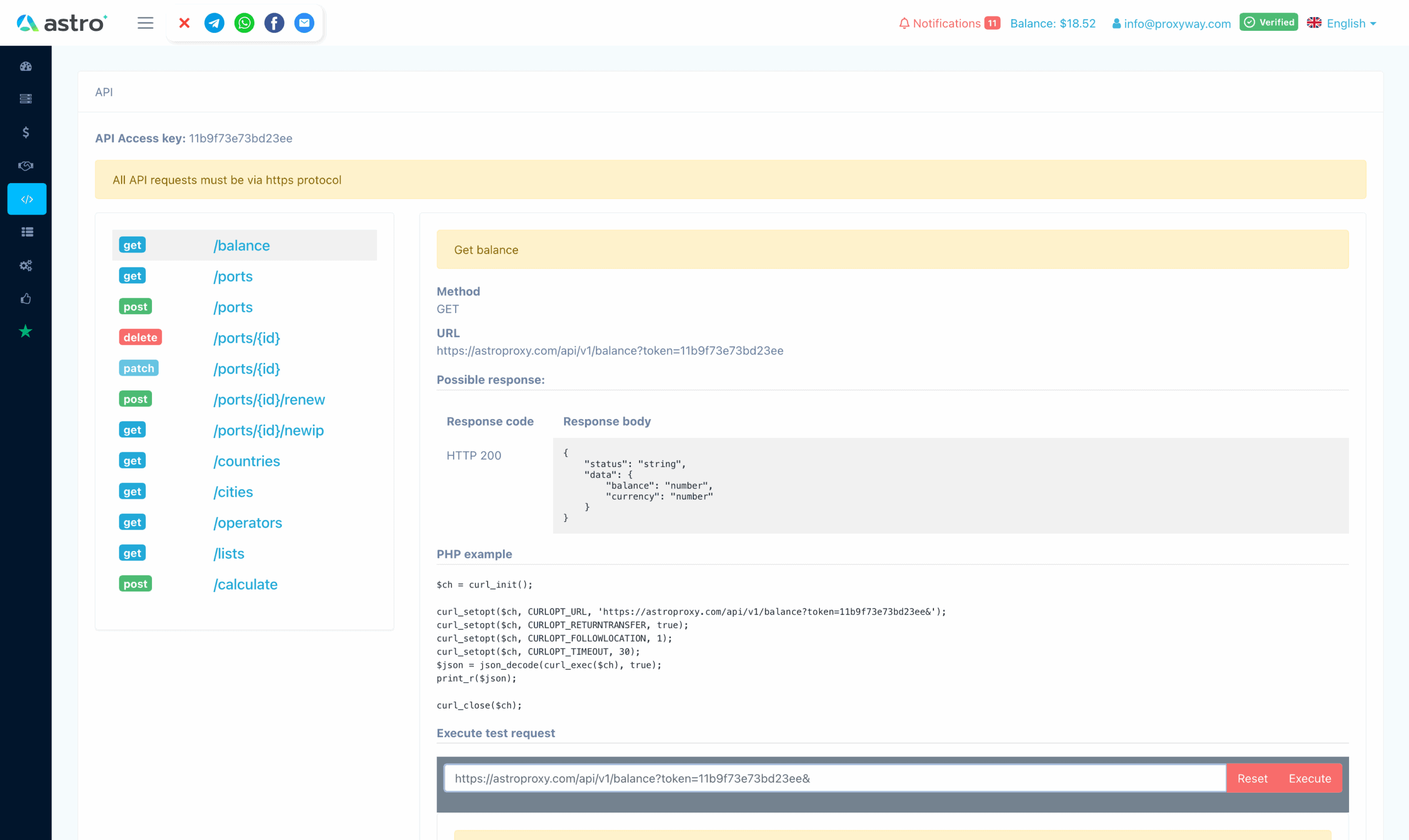
Astro provides comprehensive API functionality for interacting with the service programmatically: you can check the balance, create, edit, delete, and top up ports, and get a list of locations. What you can’t do is add money to the main wallet.
Documentation
Astro’s FAQ will be your source of information for many things. It’s able to answer the basic questions well, and quite a few entries delve into technical details for setting up and using proxies for social media purposes.
The websites provides some integration guides, but they mostly involve antidetect browsers. Otherwise, you’ll have to figure it out by yourself or contact support for help.
Hands-On Support
Astro’s customer support is available by email, multiple chat platforms (Telegram, WhatsApp) Facebook, and live chat.
The working hours are 10AM to 2AM GMT+4. So, they cover 16 out of 24 hours every day – which is good for Europeans less so for countries on the other side of the globe.
We tried contacting the support via Telegram, at around 10:00 GMT. After leaving our email, the reply came within two minutes. The support agent was more or less able to answer my questions, at times quoting Astro’s FAQ.
Overall, Astro’s customer support left a favorable impression. There are things to improve, but the provider is on a good track to compete with the major services.
Conclusion
Astro is a curious case. The provider is highly specialized for multiple-account management, even if its website would like you to believe otherwise. Its features and many design decisions support this use case very well.
For something like web scraping, you’d do better elsewhere. Astro’s residential proxy pool is small, slow, and inconvenient to access. Unfortunately, the same applies to tasks requiring precise location targeting, as advanced filters here are available mostly for show. That is, unless you need proxies in Russia – then, Astro will do just fine.
Astro Alternatives

Decodo has larger proxy networks, a great user experience, and lower rates. It’s one of the best mid-range options you can get.

Like Astro, SOAX offers ASN and city-level filtering for its residential & mobile proxies – together with better performance and a much larger pool.

IPRoyal manages its own proxy pool, and its traffic never expires. There’s no ASN filtering, but you may not always need it.
