Byteful (ex Ping Proxies) Review
Byteful is an ex sneaker proxy provider gone general purpose. If that tells you anything, it’s that these guys know how to source performant proxy servers. But Byteful didn’t go the usual route, just switching up the marketing and pretending to have changed – it’s been seriously investing both into the proxy networks and the platform. For this, we gave Byteful our Newcomer of the Year award in 2026.
So, now we a have mid-market provider that’s passionate about the tech and competes with the likes of SOAX and Decodo. Can Byteful’s residential and ISP proxies keep up, or maybe even beat the competitors? We tested them to find out!
Use the code PROXYWAY10 to get 10% off.
Three-Minute Human Summary
- Byteful sells both proxy pools from home devices and lists of dedicated server IPs. The provider claims to source proxies in-house but provides little concrete information about its processes.
- Byteful’s residential proxy network offers a variety of filters (including city, ISP, and several optimization modes), sub-users, and a special optimization engine that should reduce traffic use. The datacenter and ISP proxies cover a handful of locations and are best suited for limited-scale use.
- We found Byteful’s pools to be among the larger in the market, while its infrastructure performance rivaled and often even beat top competitors. It’s particularly impressive that even the slowest proxies took under a second to respond. The prices are competitive and include never-expiring traffic.
- Byteful’s management tools are great, with surprisingly detailed usage statistics, online IP counts, a feature-rich programmatic API, and sub-users that can span multiple products (for example, have residential traffic and specific ISP proxies assigned to them).
- Overall, we consider Byteful one of the stronger mid-market options currently on the market, capable of standing its ground against more established providers like SOAX or Infatica.
News about Byteful
-
By Adam Dubois
- Provider News
-
- Provider News
-
- Provider News
General Information
- Country: UK
- Founded: 2020
- Employees (LinkedIn): 5-10
- Proxy networks: Residential, mobile, datacenter, ISP
- Supporting tools: Proxy checker
- Price range: Mid-market
- Starting price: $2.5
- Payment methods: Credit card, Apple & Google Pay, cryptocurrencies
- Trial: 1 GB
Byteful is a UK-based provider of proxy servers. Its founder, Timur Gok, incorporated the company in 2020, after receiving a scholarship from his university. By that time, he had already been servicing the sneaker scalping market for three years. Byteful was called Ping Proxies before rebranding in April 2026.
So, Byteful started off specialized. It had a few good years before the market burst (you can read an interview with Timur covering this topic here). The provider had to choose what to do next; and like many other companies in its shoes, it decided to become a general-purpose proxy vendor.
However, Byteful approached this challenge in an unconventional way. Instead of simply cutting prices and calling it a day, Byteful opted to build a proper platform, with in-house infrastructure and (at least partially) its own residential IP sourcing methods.
The latter are documented well but in rather vague terms. According to the provider, it “partners with SDK providers and peer payment applications which compensate developers and end-users for their participation in the network.” The website avoids mentioning specific apps or partners. To alleviate concerns, the company imposes a KYC procedure and strict usage policies.
With fewer than 10 members on LinkedIn, Byteful is far from big. What it may lack in marketing, the provider compensates in tech: in a short timeframe, it introduced advanced observability tools, features like HTTP3 support, and a proprietary bandwidth optimization technology.
The competitive environment for mid-market providers is extremely tough these days. But Byteful is surely doing its darndest to carve out a place in it.
Byteful Proxy Networks
Byteful currently offers all four types of proxy servers: residential, mobile, dedicated ISP (static residential), and dedicated datacenter. Use the tabs to learn about their features, pricing, and performance in more detail.
🏠 Residential Proxies
Residential proxies are fast becoming Byteful’s main product. They come from the phones, laptops, and other devices of home users.
- Advertised pool: 35M IPs
- Countries: 150+ with state, city, ASN/ISP, ZIP targeting
- Rotation: Every request, sessions up to seven days
- Other features: Pool size & speed filters, Smartpath engine
- Starts from: $3.25 for 1 GB. Scaling pay as you go
- Advertised proxy pool: 35 million IPs
- Countries: 150+
- Integration method: Gateway address (gateways in East & West Coast US, NL, SG)
- Filtering
- Random: ✅
- Country: ✅
- City: ✅
- ASN/ISP: ✅
- Other: State, ZIP code, optimize for overall performance / speed / pool size
- Rotation
- Every request: ✅
- Sticky sessions: ✅ (as long as available, custom timeframes up to 7 days)
- Session behavior: New IP after disconnect
- Protocols
- HTTP: ✅
- HTTPS: ✅
- SOCKS5: ✅ (with UDP)
- Authentication
- Credentials: ✅
- IP whitelist: ❌
- Sub-users: ✅
- Concurrency: Unlimited threads & ports
- Traffic: Plan based
- Other: Smartpath traffic optimization engine
Like most residential proxy networks, Byteful uses gateway servers. The provider doesn’t list where these servers are located; in our tests, connections from Europe were routed through the Netherlands, while everything else went through a gateway in the US.
In reality, there were over 1.5 million IPs online when we checked – we know this because the provider transparently showed this on the dashboard. The amount updates with the filters you add, even cautioning about the pool’s size if you go too granular.


Aside from the usual targeting modes, there are also performance presets. You’re given three options to choose from: a balanced default, only the fastest proxies, or all the IPs Byteful can muster, even at the expense of quality.
There are several rotation settings to choose from, including fast rotation and sessions. However, you won’t be able to choose rotation behavior upon failure, such as holding onto a proxy even after it goes offline.
When we were writing this review, Byteful had HTTPS entry and HTTP3 protocol support in beta. Both features are situational, but they surely have their uses.
Only authentication by credentials is supported. On the bright side, you’re free to create sub-users with their own usernames and traffic allowances.
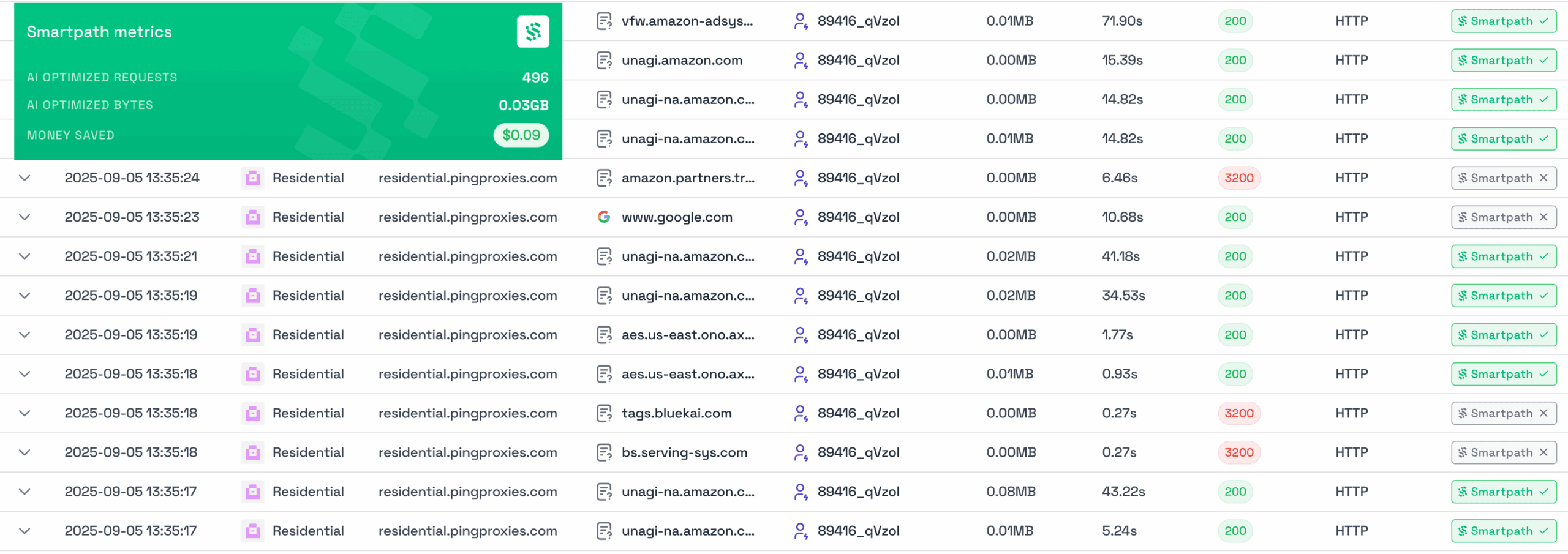
The last but surely not the least feature is Smartpath. If turned on, it analyzes your traffic and routes some of the requests through datacenter proxies without impact the success rate. These requests cost nothing.
Byteful claims that Smartpath can reduce traffic use by up to 60%. However, it’s not ideal for quality-dependent use cases like ad verification and mostly impacts browser-based scenarios. In our small-scale test, the feature saved 30 MB over 500 requests, which is pretty good.
- Model: Monthly subscription with non-expiring traffic
- Format: Traffic
- Modifiers: ❌
- Top-ups: Manual
- Starting price: $3.25 for 1 GB
- Trial: 1 GB
Byteful offers a subscription-based pricing model for its residential proxy service. In reality, you can get anywhere from 1 GB – this traffic never expires and remains available even after unsubscribing. So, it’s more like scaling pay-as-you-go, similar to IPRoyal.
The public plans reach 5 TB of data, giving us a good view into rates at various scales.
| 1-24 GB | 25-99 GB | 100-249 GB | 250-499 GB |
| $3.25 | $3 | $2.75 | $2.50 |
| 500-999 GB | 1,000-2,999 GB | 3,000-4,999 GB | $5,000+ GB |
| $2.25 | $1.95 | $1.85 | $1.75 |
One inconvenience is that we couldn’t set up automatic traffic top-ups, even if there’s wallet functionality.
Pound for pound, Byteful costs more than mid-market alternatives like Decodo or IProyal everywhere but in the lowest pricing ranges.
We last tested Byteful’s residential proxies in April 2026, for our annual proxy market report.
Pool size & composition
| Gateway | Requests | Unique IPs | Residential %* |
| Global | 3.6M over 21 days | 1,909,605 | 98.58% |
| US | 1.2M over 14 days | 509,885 | 99.14% |
| UK | 560k over 14 days | 159,111 | 98.7% |
| EU** | 1.2M over 14 days | 383,612 | 98.81% |
| Brazil | 560k over 14 days | 397,499 | 99.08% |
| India | 560k over 14 days | 416,278 | 98.11% |
| Australia | 140k over 7 days | 30,575 | 98.34% |
* IP2Location database, Usage type data point (ISP, ISP/MOB, MOB IPs)
** Combines Germany, France, Spain, Italy, the Netherlands.
Top 10 countries in the Global pool

Comparison with other providers
Byteful’s residential proxy pool was among the larger ones. While not quite on the level of Oxylabs or Decodo, it occupied a top five position in high-demand locales.
Infrastructure success rate
Requests: Same as the pool test
Target: Nearest server of a global CDN
| Gateway | Avg. success rate |
| Global | 99.69% |
| US | 99.08% |
| UK | 99.51% |
| EU | 99.87% |
| Brazil | 99.69% |
| India | 99.59% |
| Australia | 99.58% |
Comparison with other providers
The infrastructure performed very well – less than 1% of our requests failed before reaching the target.
Infrastructure response time
Requests: 6 KB page size – same as the pool test, 2 MB page size – 5,000
Target: Nearest server of a global CDN
6 KB page size
| Gateway | Avg. | Median | P95 |
| Global (🇩🇪 -> any IP) | 0.41 s | 0.33 s | 0.81 s |
| US (Ashburn -> 🇺🇸 IP) | 0.53 s | 0.42 s | 0.96 s |
| UK (🇩🇪 -> 🇬🇧 IP) | 0.35 s | 0.31 s | 0.62 s |
| EU (🇩🇪 -> 🇩🇪/🇪🇸/🇫🇷/🇮🇹/🇳🇱 IP) | 0.34 s | 0.29 s | 0.58 s |
| Brazil (Ashburn -> 🇧🇷 IP) | 0.64 s | 0.57 s | 0.98 s |
| India (Singapore -> 🇮🇳 IP) | 0.51 s | 0.45 s | 0.87 s |
| Australia (Singapore -> 🇦🇺 IP) | 0.47 s | 0.35 s | 0.89 s |
2 MB page size
| Gateway | Avg. | Median | P95 |
| Global (🇩🇪 -> any IP) | 4.45 s | 1.93 s | 16.67 s |
| US (Ashburn -> 🇺🇸 IP) | 4.13 s | 1.52 s | 15.41 s |
Comparison with other providers
6 KB page size, average response time
Byteful’s latency was among the lowest we’ve benchmarked. Its proxies were actually the fastest to respond without any pool filters applied. Furthermore, even the slowest requests (P95) completed within one second in all locales. Impressive.
- Basic request: USERNAME:[email protected]:8363
- Using filters: USERNAME_c_us_city_san_francisco_asn_7018_smartpath_m_size:
[email protected]:8976 - Using sessions: USERNAME_s_ID_ttl_TIME:[email protected]:8363
Byteful’s residential proxies always use one gateway address. Filters and sessions are configured through the username, by appending them as parameters.
One interesting feature is that Byteful uses ports between 8,000 and 8,999 for access, which are randomized when generating proxy lists on the dashboard. Choosing one over the other has no real impact, as it’s possible to generate as many sessions as you want on one port and different session IDs.
We were told that such setup was chosen to avoid possible (though highly improbably) I/O limits on the provider’s end. For us, the customers, all it does is make proxy management a little less convenient.
📱 Mobile Proxies
Mobile proxies are Byteful’s newest proxy network sourced from the devices of real people. They’re associated with mobile carriers and work best with strictest or mobile-first targets.
- Advertised pool: 6M IPs
- Countries: 100+ with state, city, ASN/ISP targeting
- Rotation: Every request, sessions up to seven days
- Other features: Pool size & speed filters, Smartpath engine
- Starts from: $4.25 for 1 GB. Scaling pay as you go
- Advertised proxy pool: 6 million IPs
- Countries: 100+
- Integration method: Gateway address (gateways in East & West Coast US, NL, SG)
- Filtering
- Random: ✅
- Country: ✅
- City: ✅
- ASN/ISP: ✅
- Other: State, ZIP code, optimize for overall performance / speed / pool size
- Rotation
- Every request: ✅
- Sticky sessions: ✅ (as long as available, custom timeframes up to 7 days)
- Session behavior: New IP after disconnect
- Protocols
- HTTP: ✅
- HTTPS: ✅
- SOCKS5: ✅ (with UDP)
- Authentication
- Credentials: ✅
- IP whitelist: ❌
- Sub-users: ✅
- Concurrency: Unlimited threads & ports
- Traffic: Plan based
- Other: Smartpath traffic optimization engine
Byteful’s mobile proxy pool is smaller than the residential one. The advertised number likely shows observed monthly IPs – when we checked the dashboard in August 2026, we saw under 300k proxies available; around 30 countries had over 1,000 IPs in them.
Otherwise, this product is functionally identical to Byteful’s residential proxies: you get precise filters that can be combined together, multiple rotation options, and broad protocol support. You don’t get IP whitelisting.
- Model: Monthly subscription with non-expiring traffic
- Format: Traffic
- Modifiers: ❌
- Top-ups: Manual
- Starting price: $4.25 for 1 GB
- Trial: ❌
Byteful’s mobile proxies run on a monthly subscription pricing model. However, it’s a very low-stakes approach: you’re free to cancel anytime and use that traffic for as long as you want. If you run out, you can buy more.
Byteful’s public rates conveniently scale up to five terabytes of data, so you can check if they’re in your price range. Anything more, and you’ll most likely want to engage in a custom sales process.
| 1-24 GB | 25-99 GB | 100-249 GB | 250-499 GB |
| $4.25 | $3.85 | $3.45 | $3.10 |
| 500-999 GB | 1,000-2,999 GB | 3,000-4,999 GB | $5,000+ GB |
| $2.80 | $2.55 | $2.40 | $2.25 |
Byteful’s rates are similar to other providers in its price range, such as Evomi or ProxyEmpire.
We last tested Byteful’s mobile proxies in April 2026, for our annual proxy market report.
Pool size & composition
| Gateway | Requests | Unique IPs | Mobile %* |
| Global | 1.2M over 14 days | 371,704 | 97.18% |
| US | 560k over 14 days | 90,398 | 99.81% |
| UK | 280k over 14 days | 57,445 | 99.32% |
| EU** | 280k over 14 days | 127,881 | 94.84% |
| Brazil | 280k over 14 days | 105,942 | 99.44% |
| India | 280k over 14 days | 164,563 | 99.49% |
| Australia | 140k over 7 days | 9,220 | 98.66% |
* IP2Location database, Usage type data point (ISP/MOB, MOB IPs)
** Combines Germany, France, Spain, Italy, the Netherlands.
Byteful’s mobile proxy network was average in size, with nearly 100k unique IPs in the US. For comparison, this was more than Infatica or SOAX could muster with the same testing parameters.
Infrastructure success rate
Requests: Same as the pool test
Target: Nearest server of a global CDN (~6 KB page size)
| Gateway | Avg. success rate |
| Global | 99.59% |
| US | 98.98% |
| UK | 99.52% |
| EU | 99.87% |
| Brazil | 99.54% |
| India | 99.62% |
| Australia | 99.73% |
We found the infrastructure to work nearly impeccably, with a slight dip in the US-filtered pool. Other than that, we have no qualms with it.
Infrastructure response time
Requests: Same as the pool test
Target: Nearest server of a global CDN (~6 KB page size)
| Gateway | Avg. | Median | P95 |
| Global (🇩🇪 -> any IP) | 0.48 s | 0.36 s | 1.03 s |
| US (Ashburn -> 🇺🇸 IP) | 0.49 s | 0.40 s | 0.85 s |
| UK (🇩🇪 -> 🇬🇧 IP) | 0.40 s | 0.35 s | 0.61 s |
| EU (🇩🇪 -> 🇩🇪/🇪🇸/🇫🇷/🇮🇹/🇳🇱 IP) | 0.43 s | 0.38 s | 0.76 s |
| Brazil (Ashburn -> 🇧🇷 IP) | 0.63 s | 0.58 s | 0.95 s |
| India (Singapore -> 🇮🇳 IP) | 0.57 s | 0.53 s | 0.99 s |
| Australia (Singapore -> 🇦🇺 IP) | 0.44 s | 0.35 s | 1.06 s |
The most impressive aspect of Byteful’s mobile proxies was their response time – no other provider we tested in early 2026 completed requests faster. There were, of course, exceptions; but in general, this is likely the fastest mobile proxy network on the market.
- Basic request: USERNAME:[email protected]:8363
- Using filters: USERNAME_c_us_city_san_francisco_asn_7018_smartpath_m_size:
[email protected]:8976 - Using sessions: USERNAME_s_ID_ttl_TIME:[email protected]:8363
Byteful’s mobile proxies use the same entry point all the time. To configure proxies, you simply add parameters to the username. This way, you can weave quite lengthy strings together.
What does change is port numbers. We don’t really like it because to create hold an IP, you’ll still need to append session IDs to the username regardless.
🏢🏠 ISP Proxies
ISP proxies can be considered Byteful’s former headliner that now has to share the spotlight with the residential service. The provider claims to manage operations in-house, which should add to reliability.
Compared to huge residential IP pools, it’s more of a boutique service – not very large but rather focused on quality.
- Formats: Dedicated list
- Countries: 18 in three continents
- Rotation: Static
- Starts from: $2.5 for 1 IP
- Formats: Dedicated list
- Pool size: Based on purchased IPs (150k in total)
- Countries (August 2026): 15 in three continents
- Integration method: IP list
- Targeting
- Country: ✅
- State: ❌
- City: ❌
- ISP/ASN: ❌
- Distribution: One country per plan, random subnets
- Replacement:
- Rotation: ❌
- Traffic: 200 GB/IP/mo fair usage policy
- Concurrency: Unlimited
- Protocols
- HTTP: ✅
- HTTPS: ✅
- SOCKS5: ✅ (with UDP)
- Authentication: Credentials
- Sub-users: ✅
- Other:
Full supported country list (August 2026)
| Datacenter | ISP | |
| Americas | Argentina, Brazil, Canada, Chile, Colombia, Mexico, Peru, United States, Venezuela | Brazil, Canada, Colombia, United States |
| Europe | Albania, Austria, Belgium, Bulgaria, Croatia, Czech Republic, Denmark, Estonia, Finland, France, Germany, Greece, Hungary, Ireland, Italy, Latvia, Lithuania, Luxembourg, Netherlands, Norway, Poland, Portugal, Romania, Serbia, Slovakia, Slovenia, Spain, Sweden, Switzerland, Turkey, Ukraine, United Kingdom | Austria, Belgium, Bulgaria, Croatia, Czech Republic, Denmark, Estonia, Finland, France, Germany, Greece, Hungary, Ireland, Italy, Latvia, Lithuania, Luxembourg, Moldova, Netherlands, Norway, Poland, Portugal, Romania, Serbia, Slovakia, Slovenia, Spain, Sweden, Switzerland, Ukraine, United Kingdom |
| APAC | Australia, Hong Kong, India, Indonesia, Japan, South Korea, Malaysia, New Zealand, Philippines, Singapore, Thailand, Vietnam | Australia, Hong Kong, Japan, New Zealand, Singapore, South Korea, Taiwan Province, Thailand |
| Middle East & Africa | Botswana, Egypt, Israel, Morocco, Mozambique, Namibia, Qatar, Saudi Arabia, South Africa, Zimbabwe | Turkey |
Byteful advertises a pool of over 150k ISP proxies. On one hand, this is a lot; on the other hand, IPRoyal controls 500k IPs and Bright Data over a million.
In the autumn of 2025, the proxies came from 15 countries: the US, Central and Western Europe, as well as Southeast Asia. Each location had between 150 and ~2k available IPs when we checked – this information is transparently provided during purchase.

- Model: Subscription (month, quarter, year)
- Format: Per pay IP
- Modifiers: ❌
- Starting price: $2.5 for 1 IP
- Trial: ❌
To buy Byteful’s ISP proxies, you’ll need to choose a subscription duration and how many IPs you want. Both factors will impact the rates: a yearly subscription costs 15% less, and quantity discounts reach 36% at 1,000 IPs.
All locations cost the same, and there are no rigid plans: you’re free to select any number of IPs up to 1,000. Here’s the full pricing logic per unit:
| 1 IP | 2-24 IPs | 25-99 IPs |
| $3.50 | $3 | $2.85 |
| 100-249 IPs | 250-999 IPs | 1,000+ IPs |
| $2.75 | $2.50 | $2.25 |
The prices aren’t cheap. Byteful’s former colleagues in the sneaker niche, Hype Proxies and Bart Proxies, charge half as much at 100 IPs. At the same time, these rates aren’t far off the market average when it comes to quality proxies.
We last tested Byteful’s 100 US ISP proxies in August 2025.
Basic analysis
| /24 subnets | Location | ASNs |
| 6 | MaxMind: US (100%) IP2Location: US (100%) | Spectrum (75%), Spirit (15%), Astound (5%), Windstream (5%) |
We received IPs from six subnets, which is good for 100 proxies. IP databases linked all of them to US networks. Three quarters were associated with Spectrum, a major ISP; Astound and Windstream can be considered mid-sized providers, while Spirit is a smaller regional company.
IP quality
Residential percentage: IP2Location database, Usage type data point (ISP, ISP/MOB, MOB IPs)
| Residential % | Matching ASN & organization | Matching ASN & org location |
| 100% | 60% | 90% |
All 100 IPs were identified as residential. Furthermore, 60 of them came directly from Spectrum, which is a rare feat with ISP proxies. 10 of the proxies, however, were associated with organizations in Poland and Ukraine, despite having an American ASN.
Infrastructure performance
Requests: 70,000 over 7 days
Target: Nearest server of a global CDN (~6 KB page size)
Our server location: US
| Avg. success rate | Avg. response time |
| 99.80% | 0.17 s |
Byteful’s infrastructure was reliable throughout days of testing, failing fewer than 150 requests out of 70,000. It was also responsive, though not quite as instant as the providers which hold their infrastructure in Ashburn. For the vast majority of use cases, the difference is small enough not to matter.
Download speed
Target: Hetzner’s 100 MB Ashburn benchmark
Proxies tested: 10
| Avg. without proxies | Average | Median | Slowest IP |
| 62.37 MB/s | 47.15 MB/s | 37.65 MB/s | 0.97 MB/s |
The servers that hosted these proxies had wide pipes, letting us download packets at 40 MB/s and more on average. The slowest IP barely reached one meg, but that was the only outlier. Overall, these ISP proxies were really fast.
Performance with popular targets
Requests: ~2,600 per target
Location: US (both the gateway and our server)
| Avg. success rate | Avg. response time | |
| Amazon | 100% | 2.30 s |
Comparison with other providers

We only had the chance to test Amazon, but Byteful’s ISP proxies didn’t disappoint – every single one of our requests completed successfully.
🏢 Datacenter Proxies
Byteful sells datacenter proxies in static lists. The service is small – in August 2026, each of the six locations had fewer than 1,000 IPs available.
- Formats: Dedicated list
- Countries: New York, Miami, Germany
- Rotation: Static
- Starts from: $20 for 10 IPs ($2/IP)
A full review isn’t available for this product yet 🙁
How to Use Byteful
Registration
To register with Byteful, you’ll have to enter your email, full name, and password. The provider will then send you a confirmation code. Alternatively, you can use a Google account to speed up the process.
It’s a little annoying that Byteful’s website only has a button for signing up, so every subsequent sign-in (and you will have to sign in, as sessions expire) requires an extra step.
KYC & Usage Policies
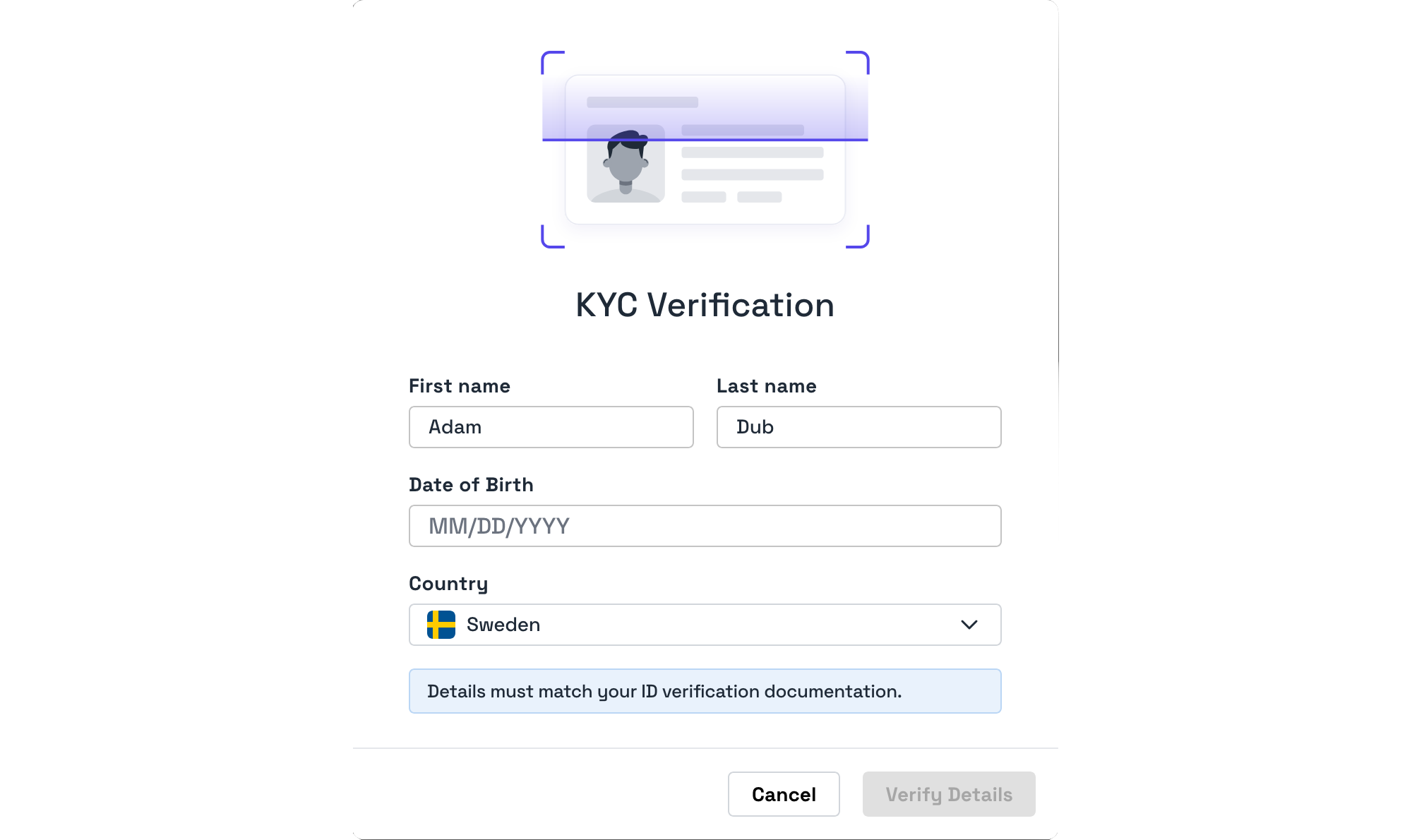
Byteful has a KYC procedure carried out by Idenfy. While it’s primarily necessary for resellers and large customers, there’s a catch – you’ll have to verify yourself to get a trial.
Otherwise, KYC gets triggered upon accessing sensitive domains, tripping up the automated risk system – and sometimes, just randomly. Once that happens, you’ll have to provide personal or business details, usage information, and maybe a proof of identity.
When it comes to usage policies, Byteful blocks government websites, banking and financial services, payment processors, and mailing. Two unusual mentions are NSFW websites and unspecified select e-commerce stores.
Finally, the provider blocks SERP scraping on Google when using its static proxy networks.
If you encounter a forbidden domain, you can request to whitelist it.
Dashboard
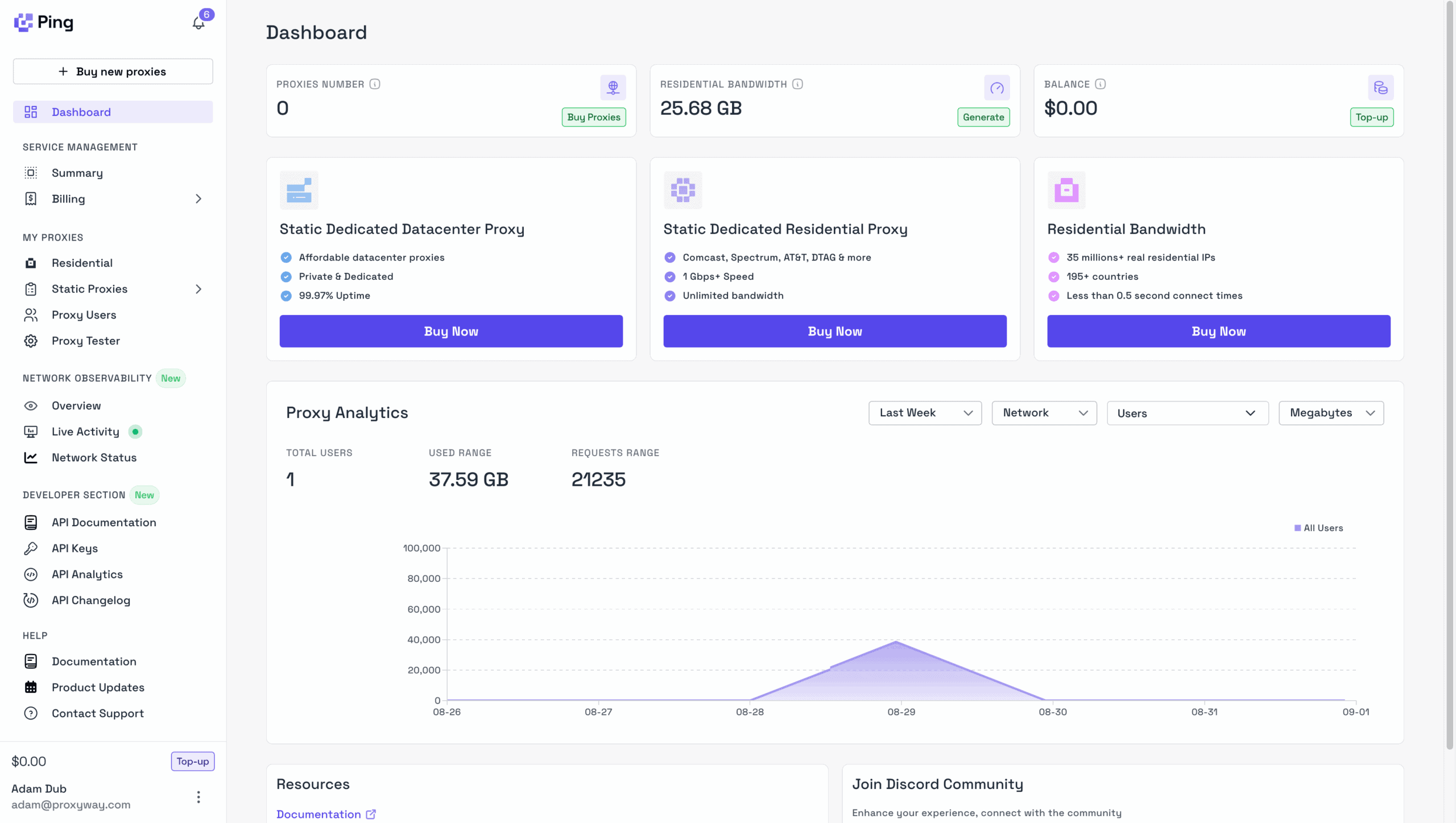
Byteful has a fully-featured dashboard where you can buy a plan, set up proxies, track usage, and interact with support. The dashboard is available only in English.
Byteful’s dashboard is divided into clear categories: one shows your active products, the second is for managing users and proxy lists, another for tracking use. The last includes billing information and general account settings.
The main page neatly ties the different sections together, showing your current services, main usage stats, and pointing to useful resources.
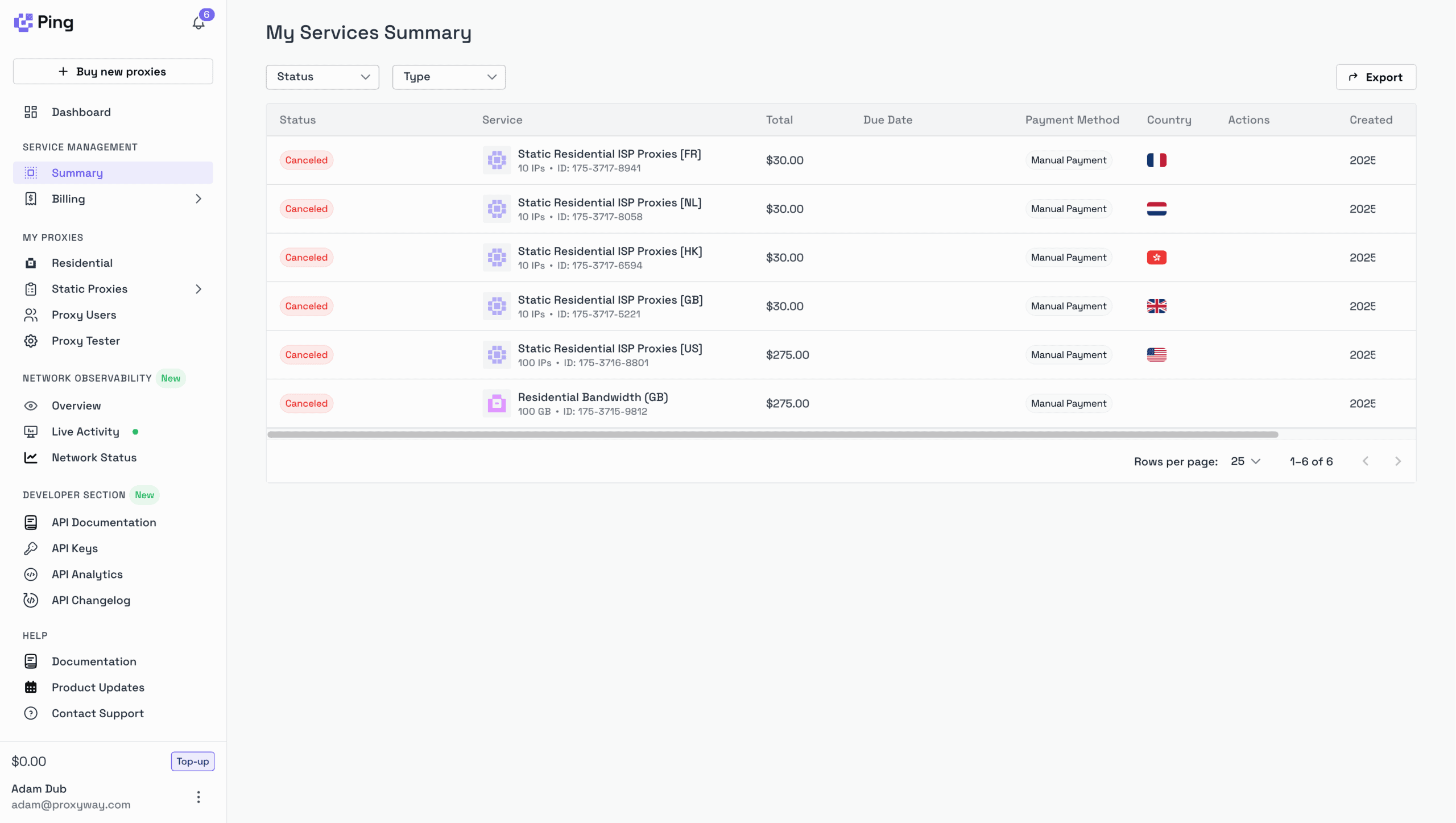
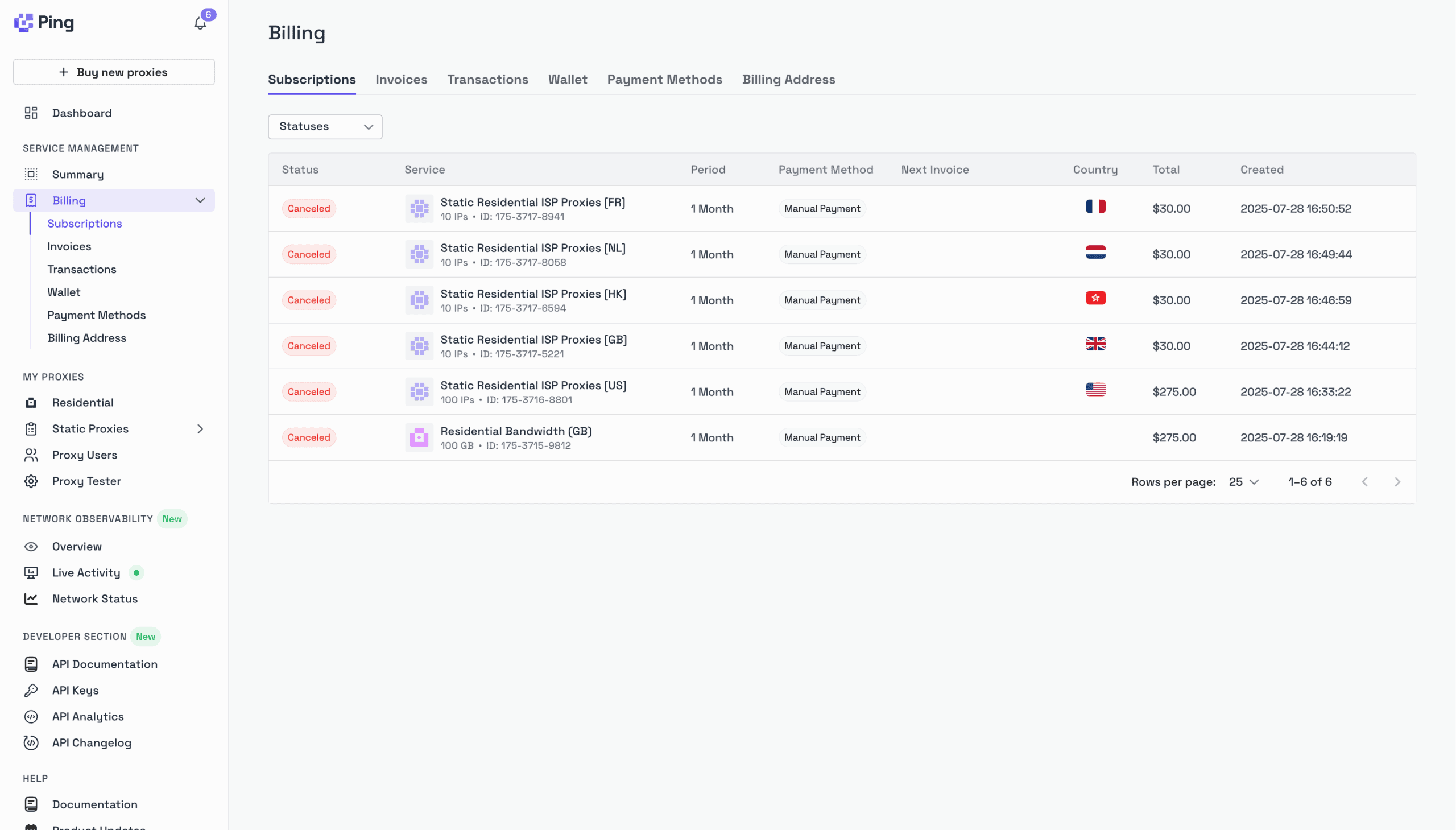
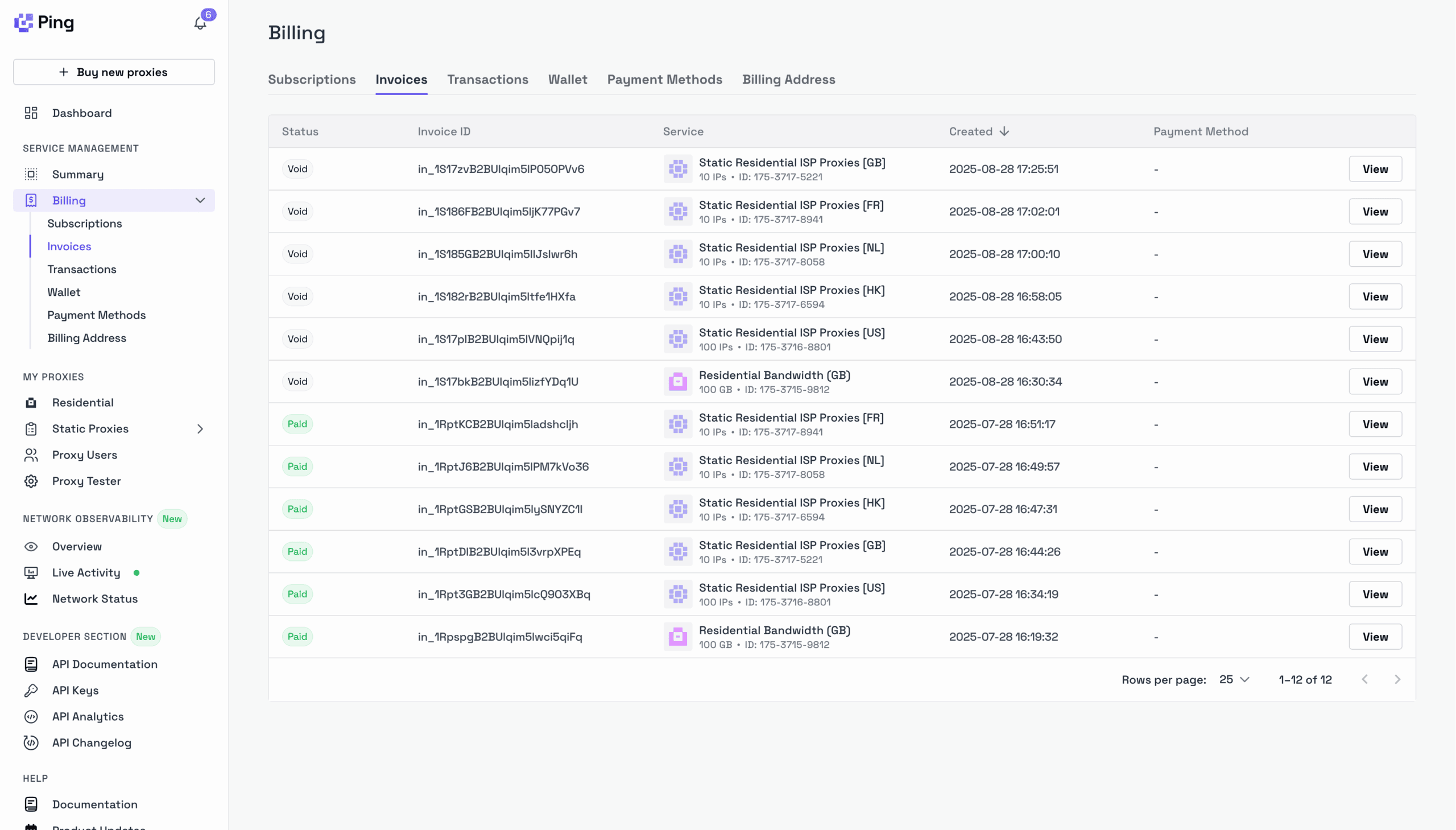
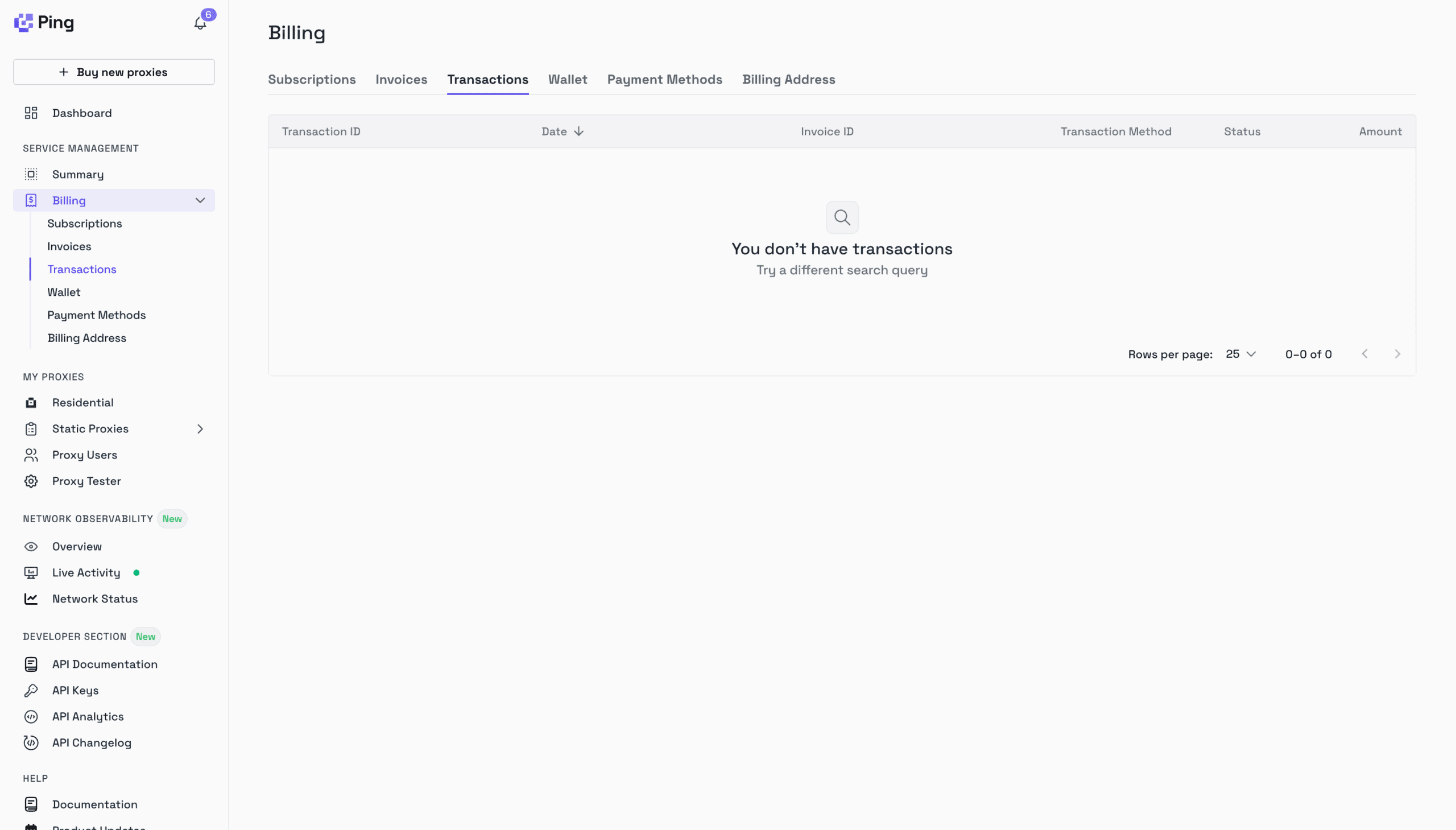
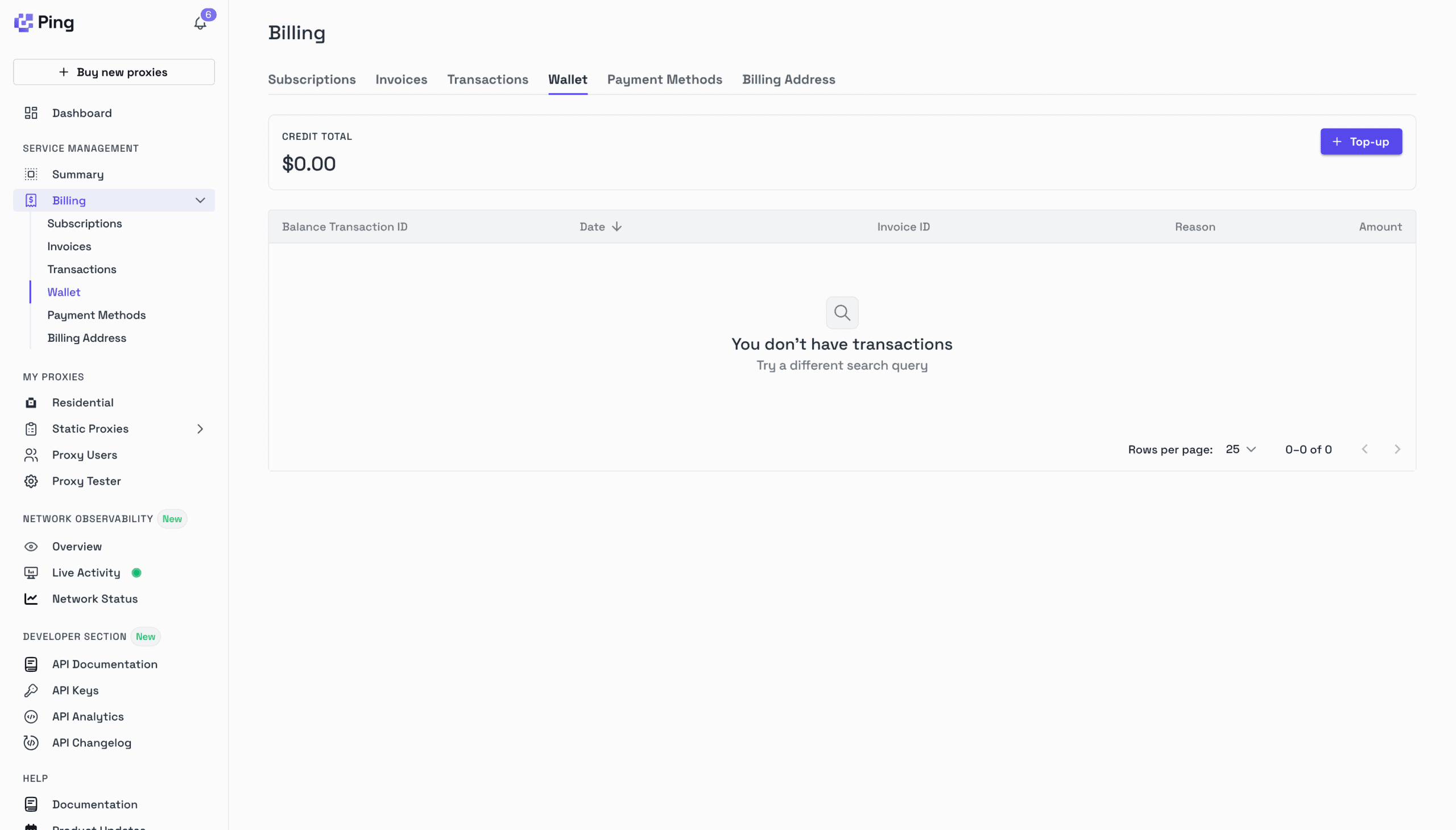
Byteful’s subscription management features won’t leave you wanting. You’ll be able to save your payment and card details, and there’s wallet functionality to reduce the amount of transactions necessary. You’ll also find pages with your active and expired services, invoices, and transactions.
Platform access
Byteful’s dashboard doesn’t support team roles, meaning that larger organizations may find it uncomfortable.
The dashboard lets you change the password, set up optional two-factor authentication, and log out (but not view) all active sessions. You won’t be able to delete the account by yourself.
Proxy access
The provider’s residential proxies include a useful widget for generating lists based on filters. The only thing that’s lacking is code samples for quickly checking the configuration for cURL or several tools. Byteful prefers that you use its proxy tester, which has online and installable versions.
The static proxies appear in a separate list. You can filter it by package, proxy type, country, or search for individual IPs.
Sub-users are configured in a separate window, with the option to select a name, password, and assign allowances to multiple products. Consequently, one sub-user can be configured to access both residential and, say, 50 of your 100 ISP proxies.
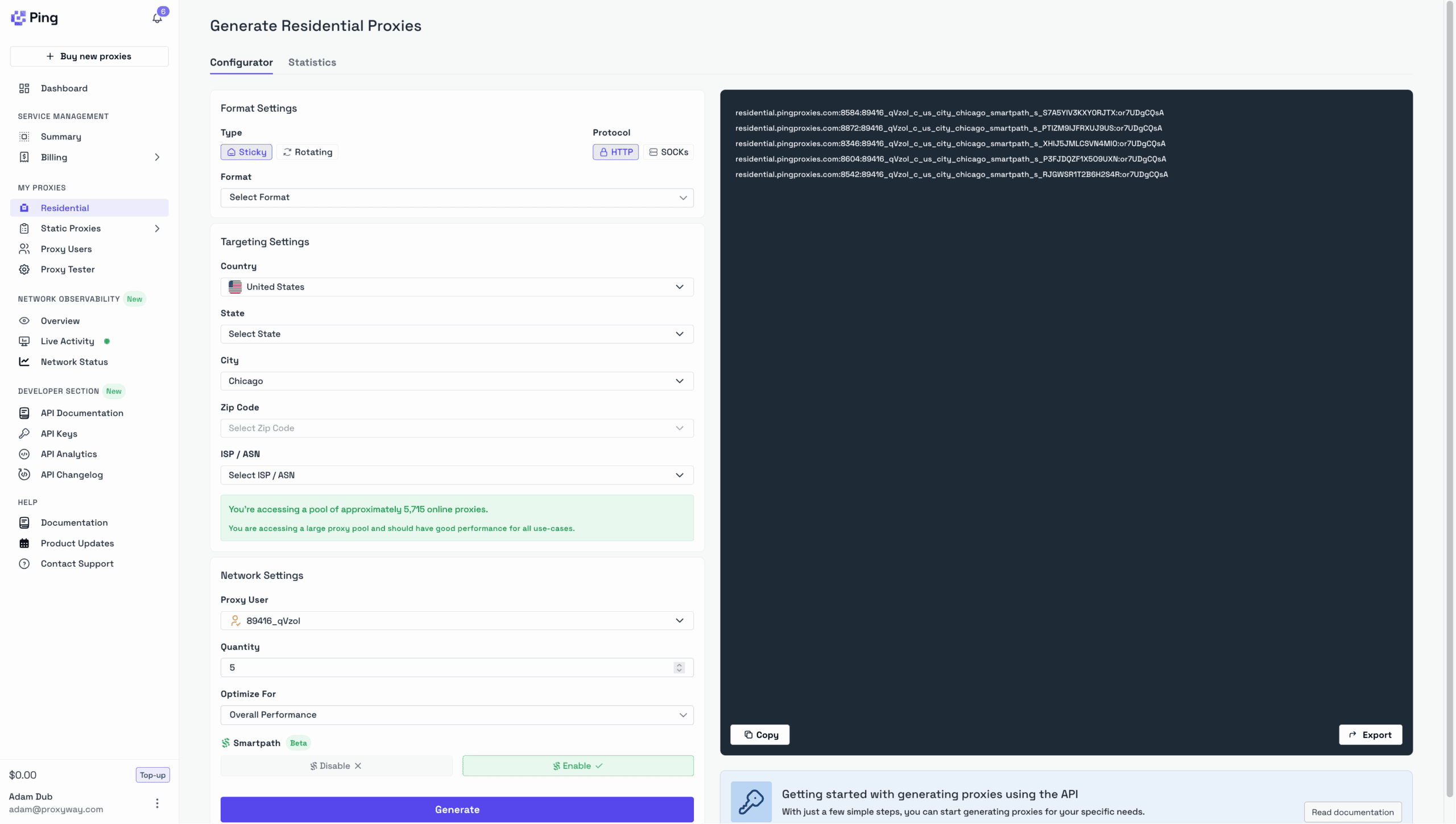
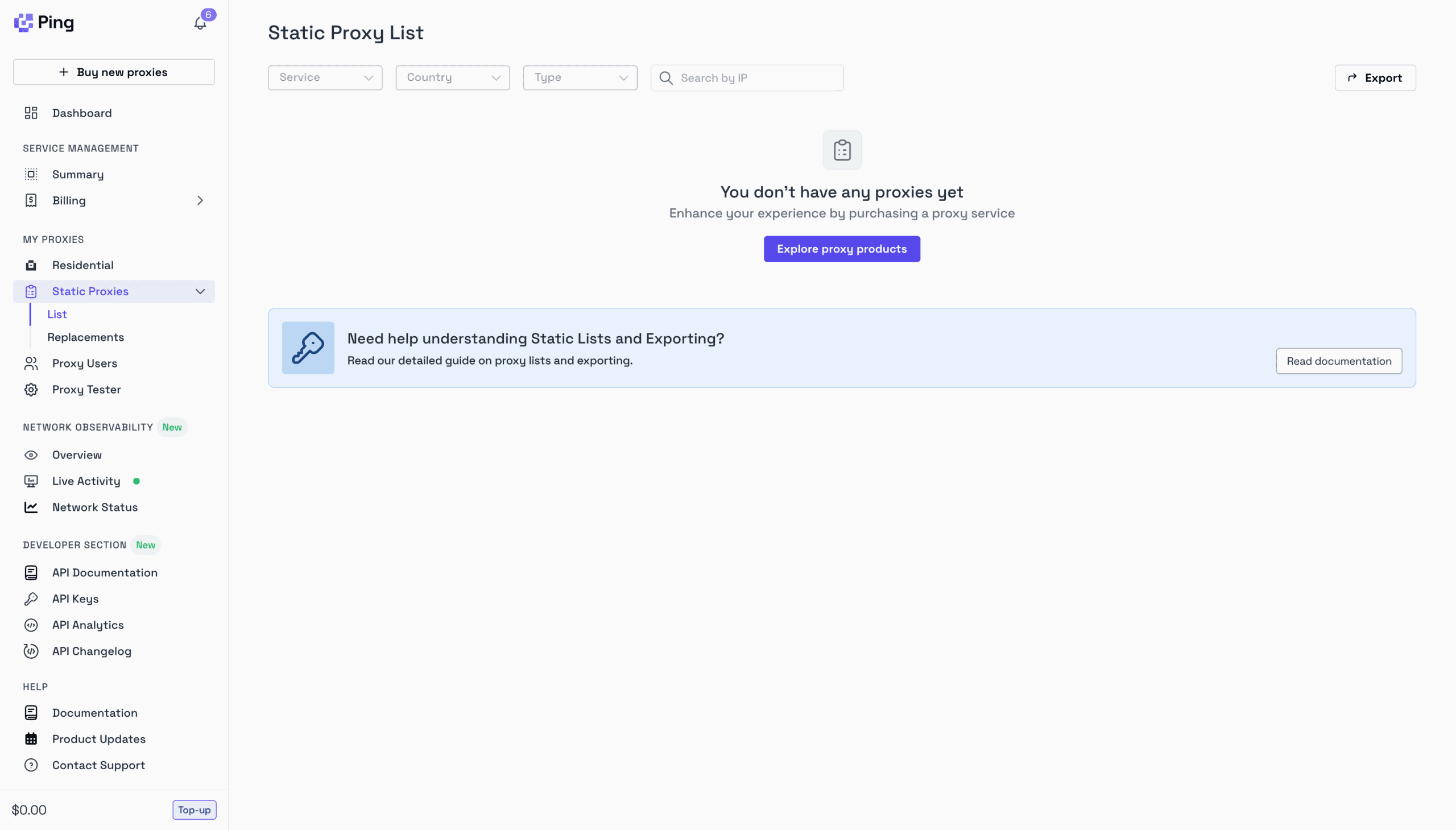
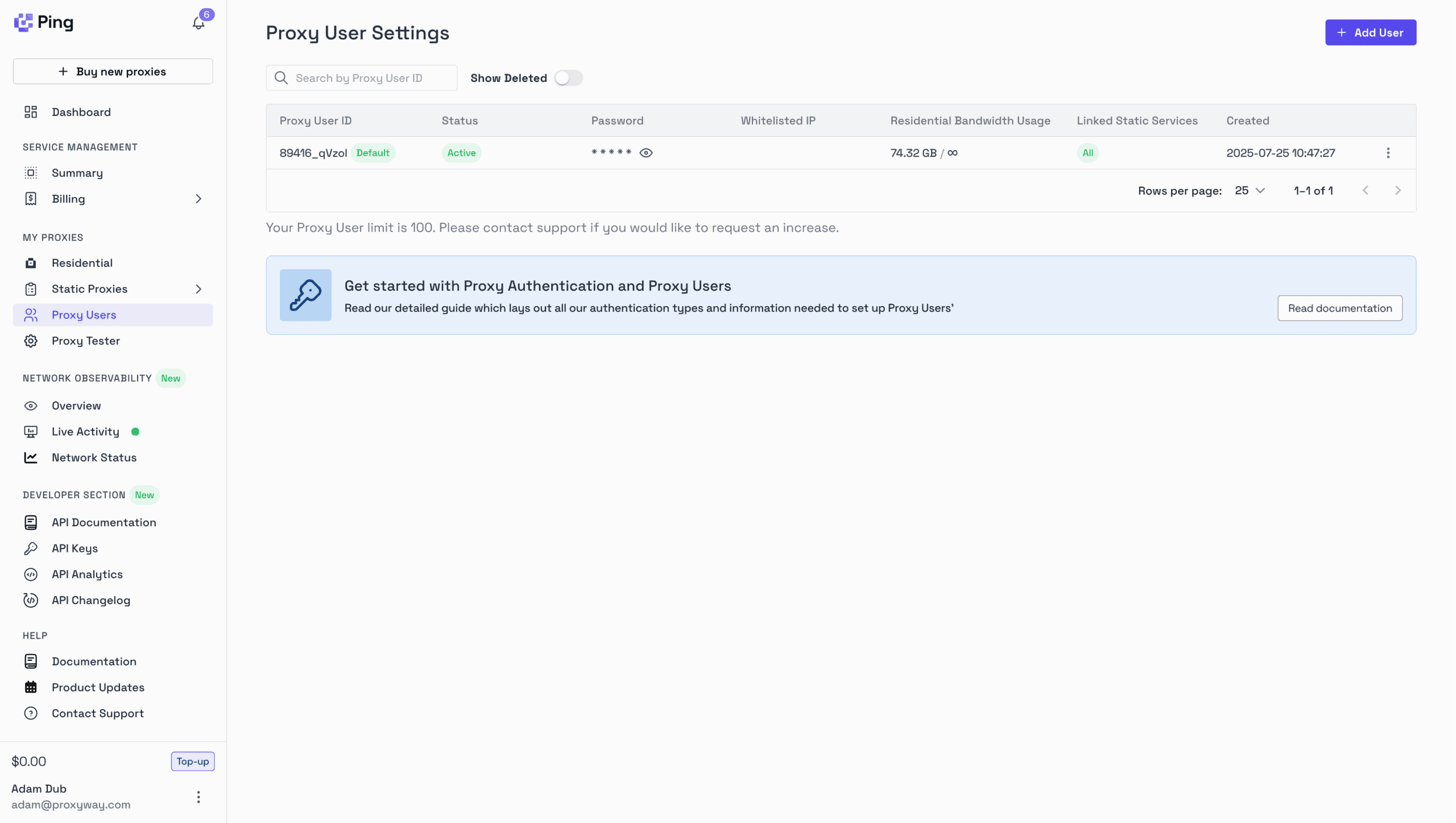
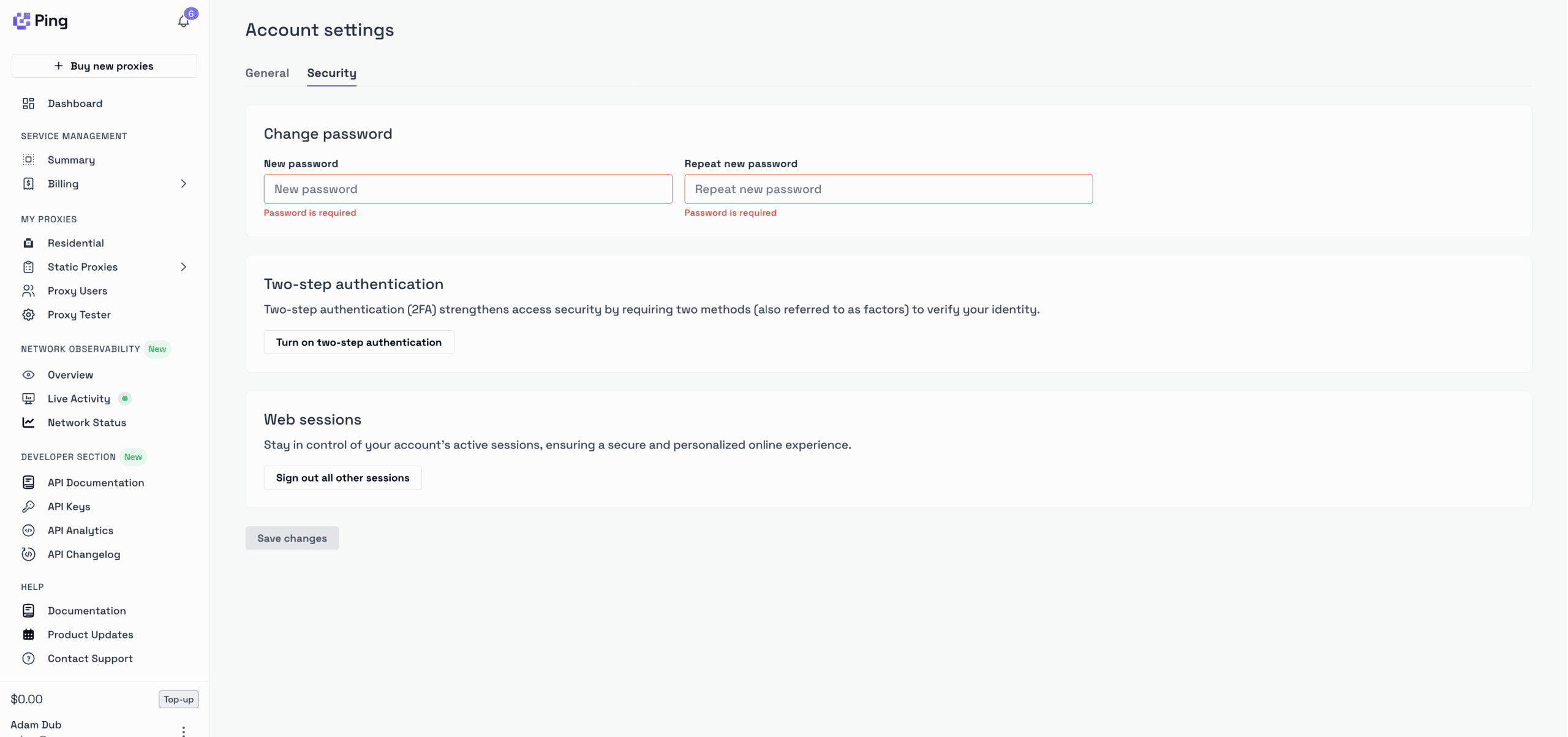
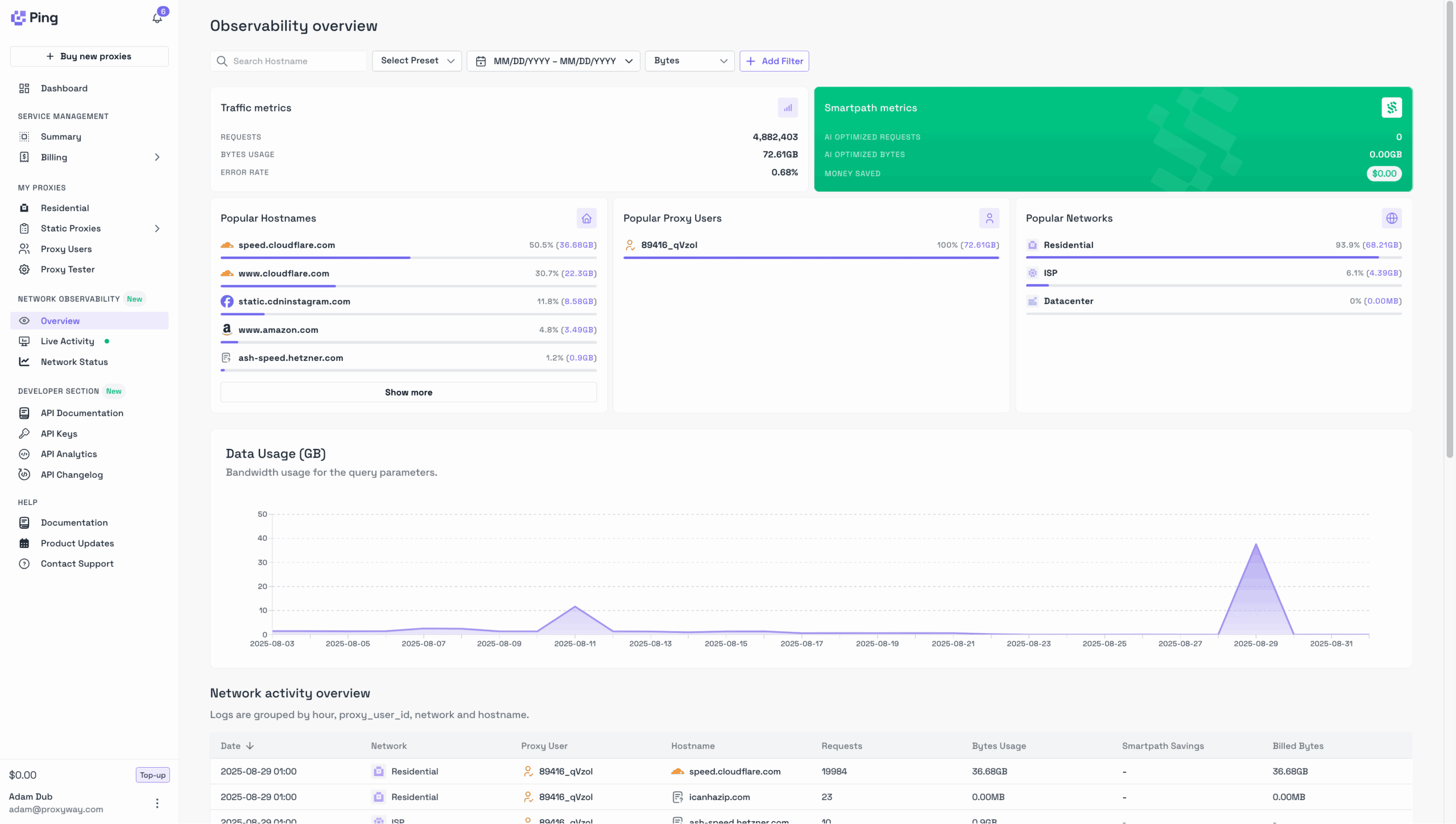
Byteful has great observability tools. The main overview shows traffic and request expenditure per product, user, or domain. You can freely add filters, choose from time presets, or enter custom time frames.
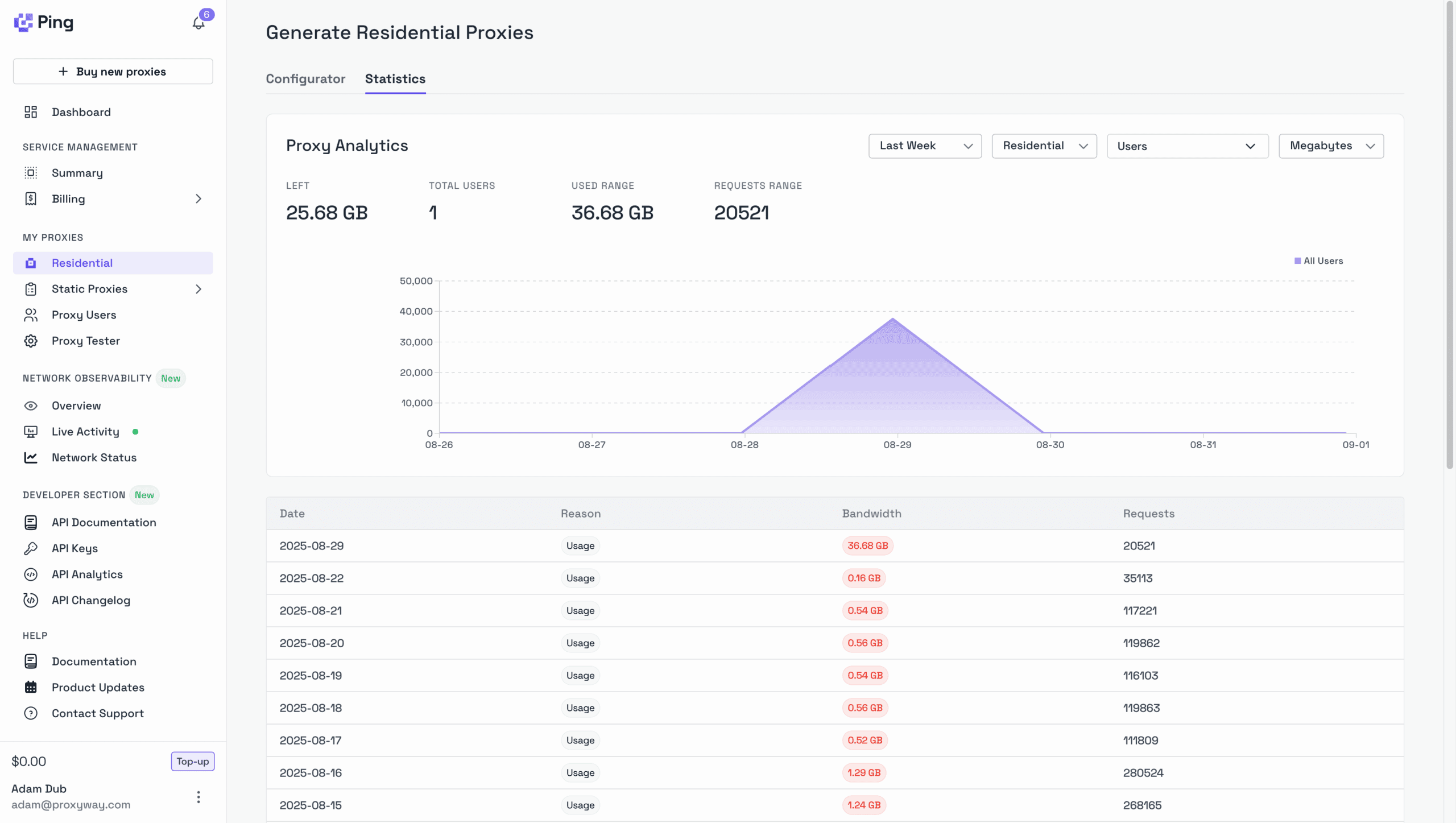
Alternatively, you can view the usage statistics of individual products. This option is more limited, as it no longer shows domains.
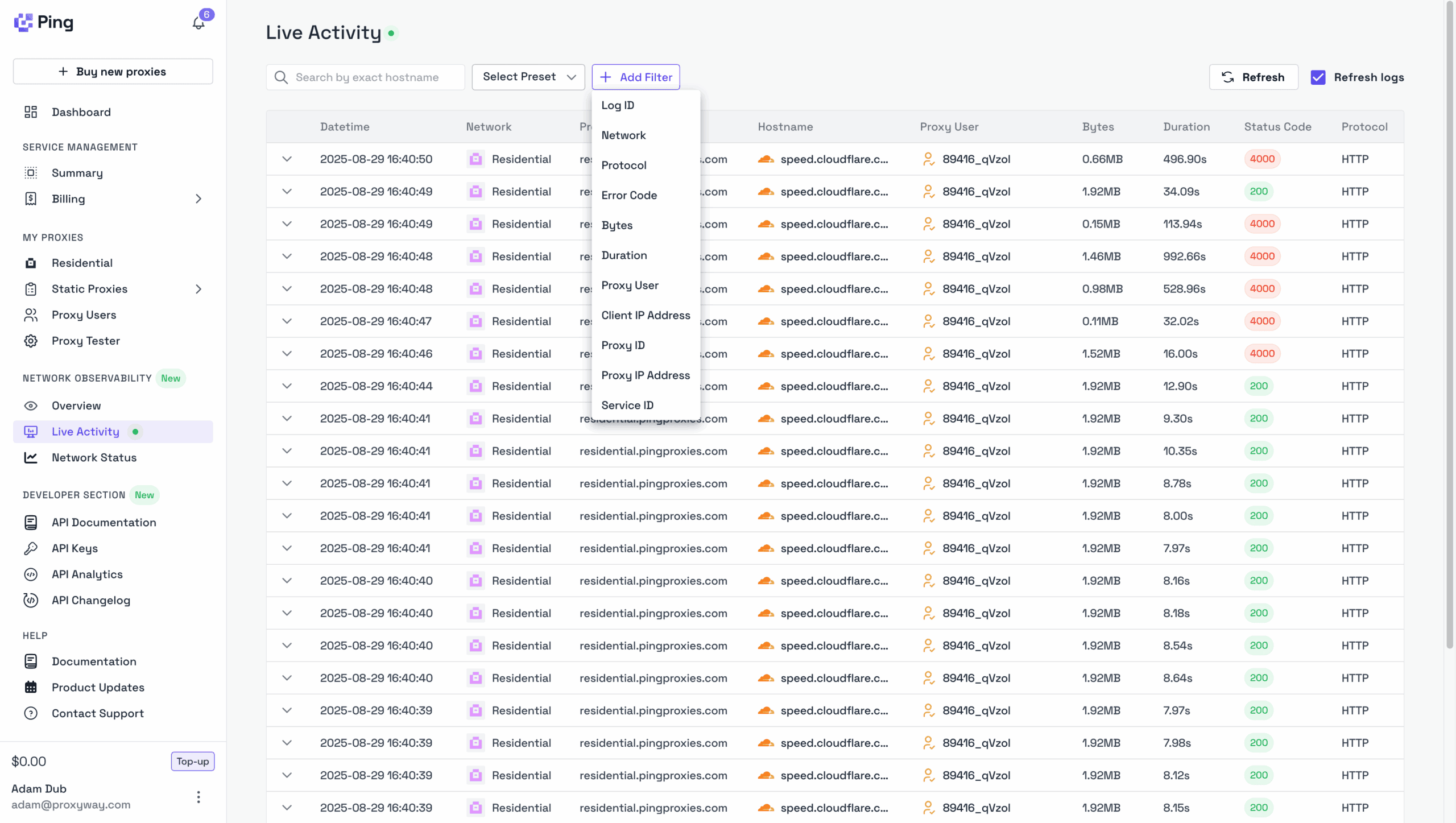
Byteful also has a page for live activity, which is amazing for debugging. The table includes each request you make, showing the target, traffic use, request duration, status code, connection protocol, and more. We were able to inspect over 2,000 requests this way, made over the previous week.
Finally, there’s a network status page that displays the health of various service components. It’s somewhat limited, though, as you can only see the current status and nothing more.
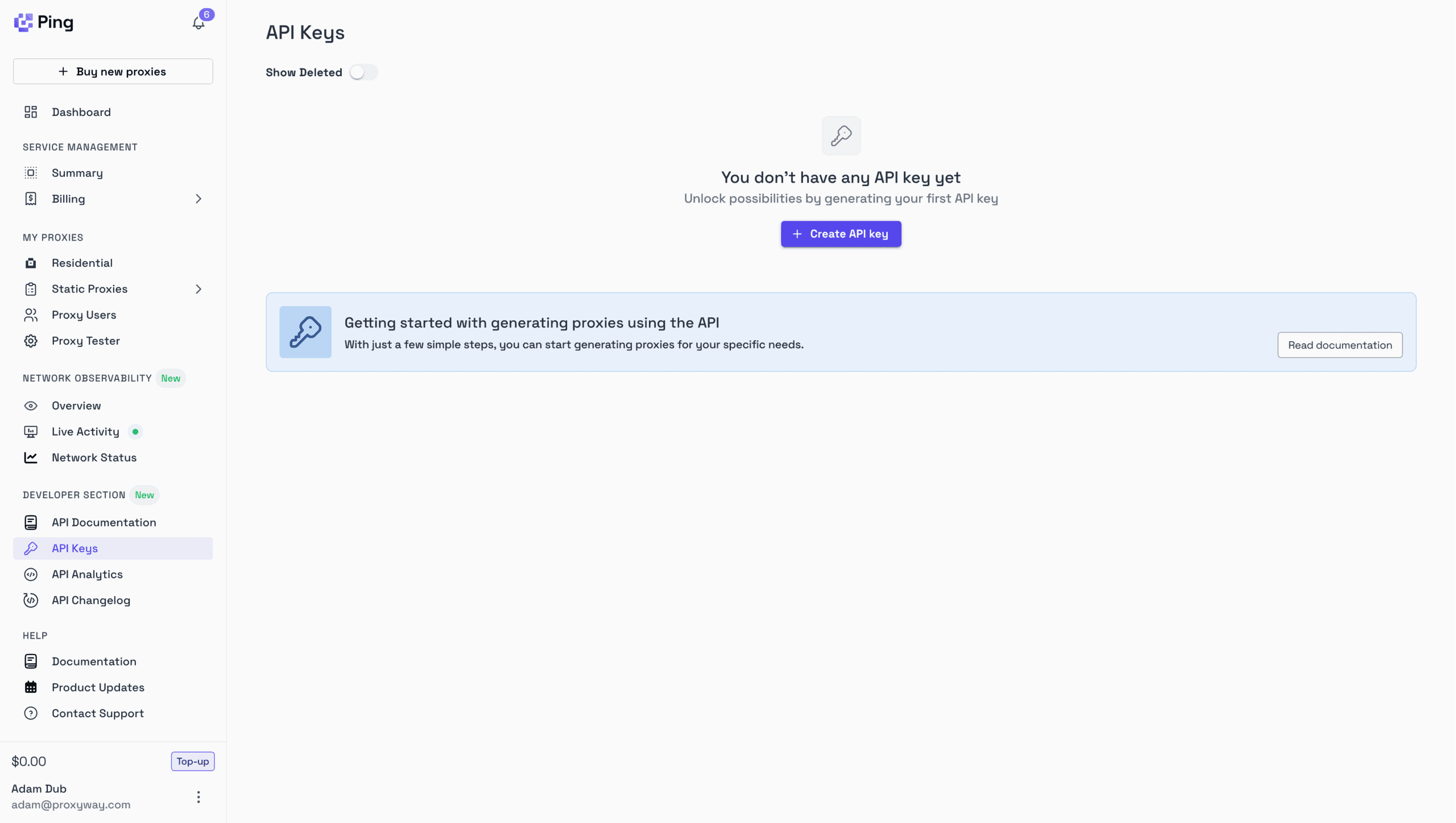
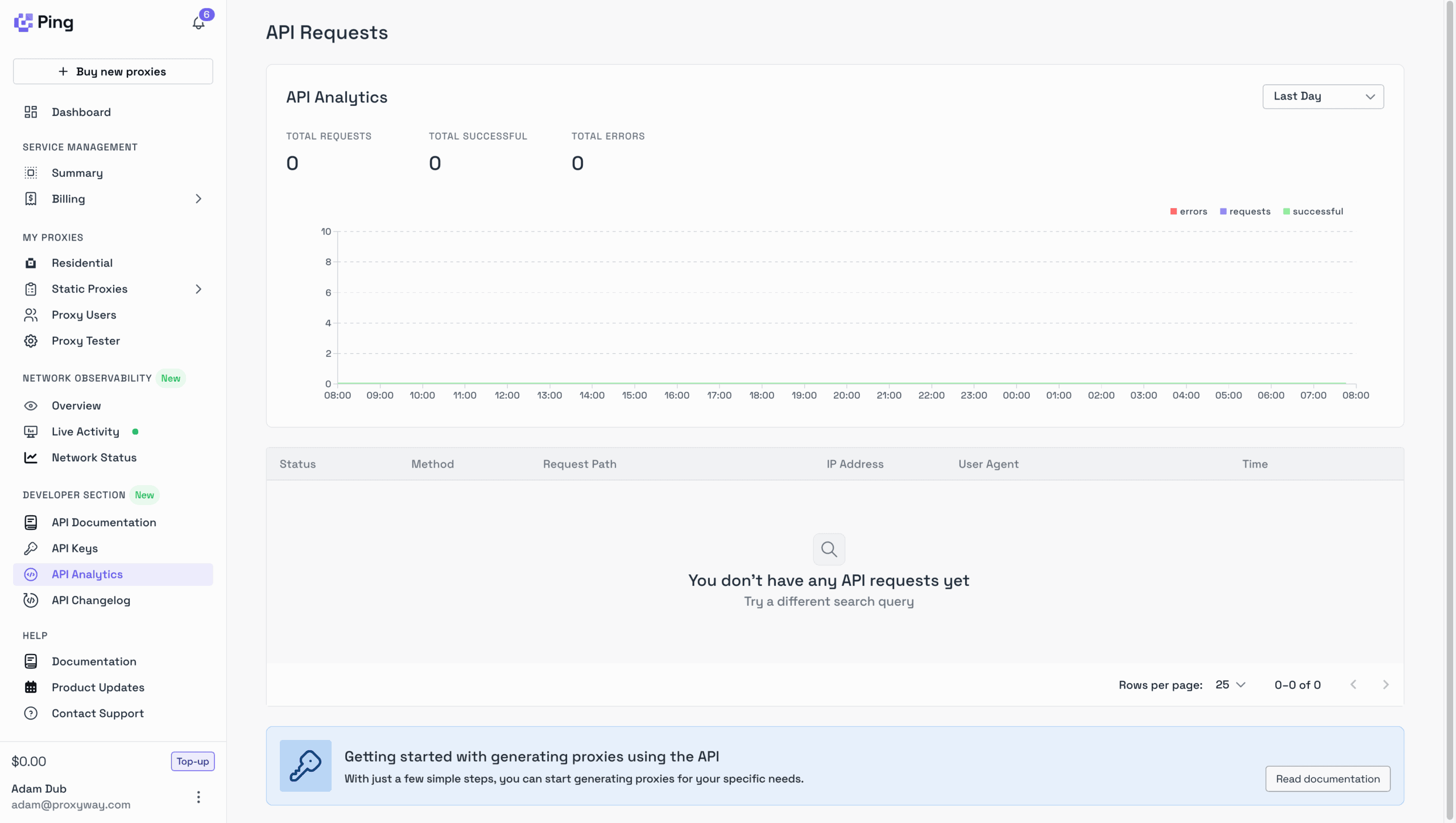
API Access
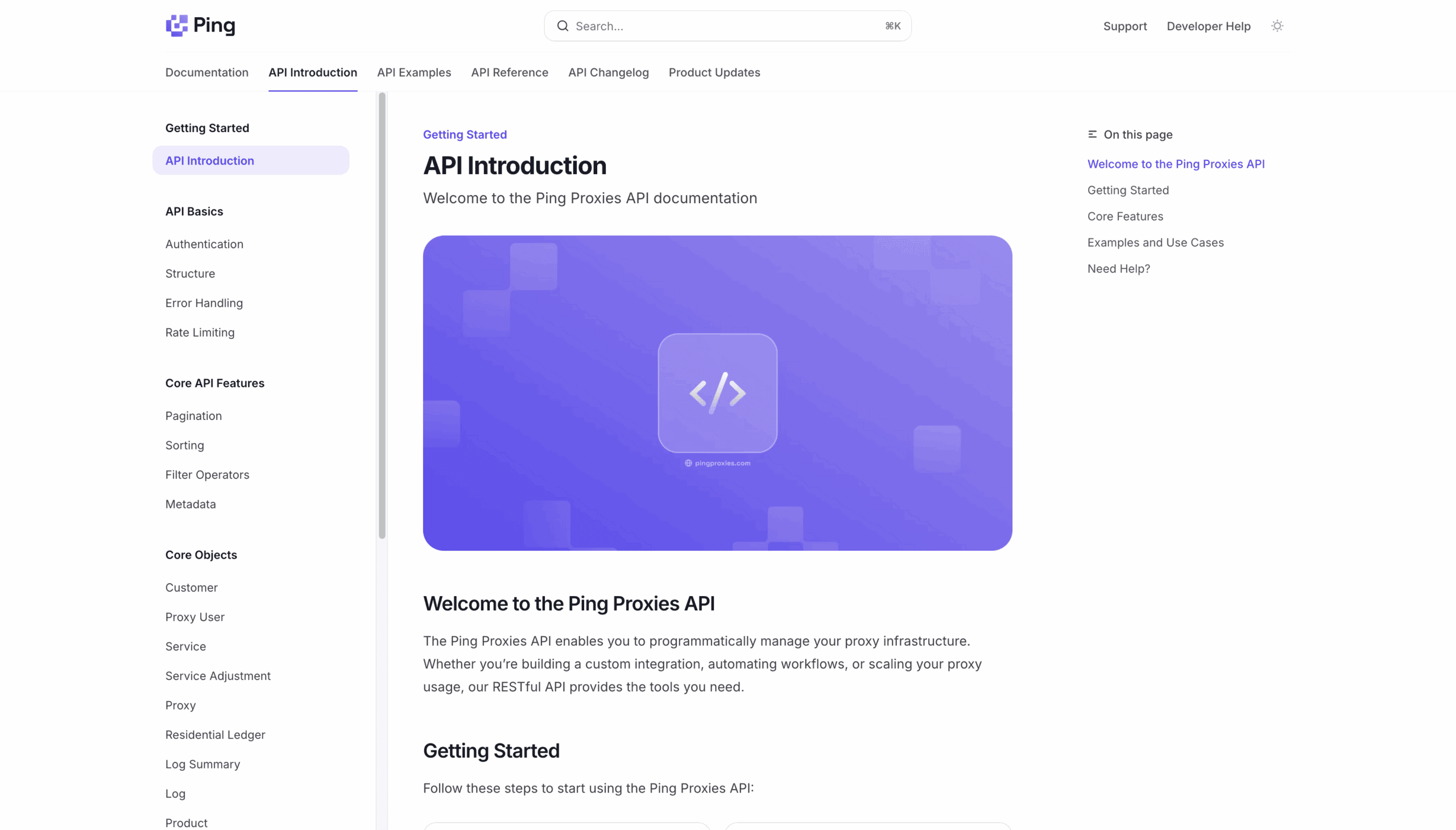
Byteful took a lot of care in designing its API. This is evident by taking a look at the documentation, which is by far the most detailed we’ve seen in this industry.
The API lets you achieve everything available in the dashboard: buy a plan, create and manage users, get information about the pool and use.
The provider imposes a limit of 10 requests per second, and you can track your API usage on the dashboard.
Documentation
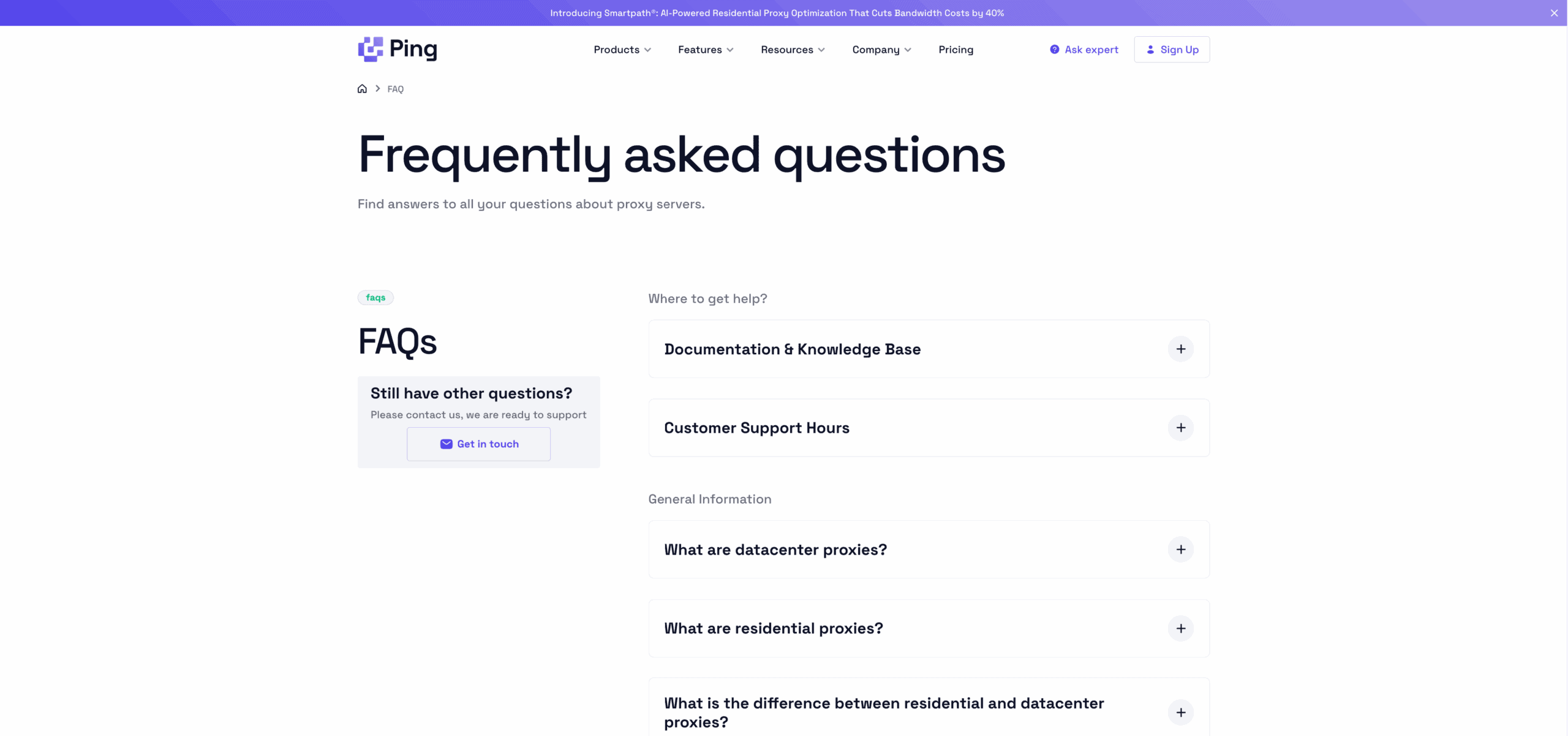
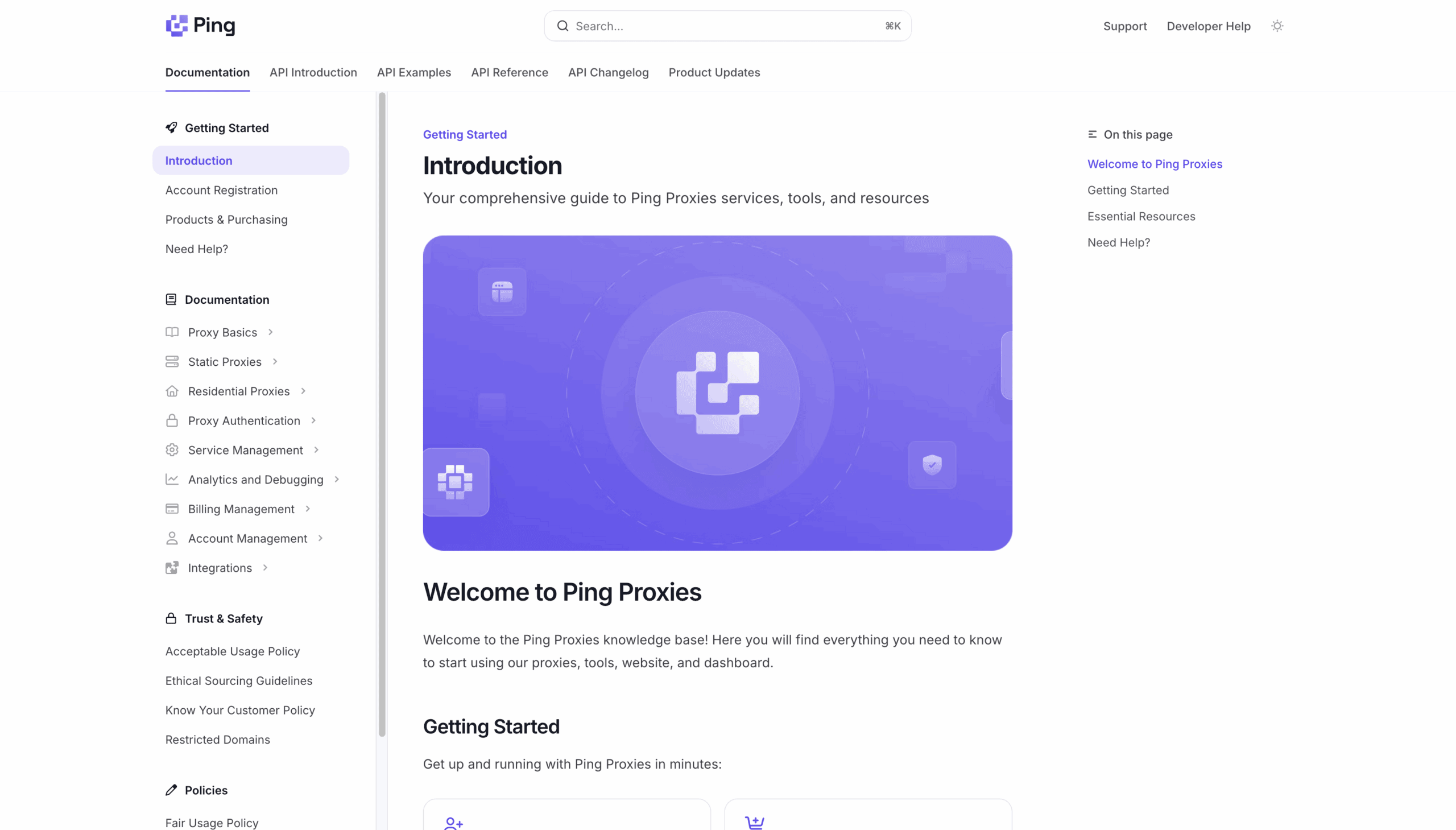
Just like API docs, Byteful’s general documentation is a comprehensive resource for learning about the service. It covers all aspects in a clear and structured manner.
The content was a little verbose for our taste and lacked examples in popular programming languages; other than that, we were really happy with what we found.
Oh, there’s also an FAQ for answering basic pre-sale questions.
Hands-On Support
Byteful’s customer service operates on weekdays between 5AM and 7PM in European time (the exact time zone isn’t mentioned). 24/7 is theoretically available as well, but it has slower response times. The channels for support are live chat, email, tickets, Discord, Telegram, and in some cases, Slack.
The provider writes that it provides support in English only. But with machine translation being this good, we’re sure that other languages wouldn’t be a complete showstopper.
We tried contacting the support through live chat during morning in Europe. An agent replied within ten minutes, giving technical answers to our queries (see screenshot).
We didn’t get a transcript; that’s probably because we provided a fake email during the initial automated questions, even if the system asked for an email address again.

Conclusion
Byteful has built strong fundamentals, with an excellent platform, performant proxy networks, and features that keep in step with latest advancements in the field.
Smartpath, while we’re unsure about its impact on a larger scale, looks like a great effort made foremost for the benefit of the user. It’s the thought that counts, right?
Of course, Byteful still lacks the raw power to tango with enterprise providers or mid-market incumbents like Decodo. But give it time. At this point, we’re already looking at a solid choice for many web scraping and other tasks.
Byteful Alternatives

Evomi offers UDP support, pool filters, and more, with a starting price of just $0.49/GB.

Decodo is the provider to beat in the mid-market segment where Byteful currently stands. It has a significantly bigger pool and more flexible prices.

DataImpulse can be a good option if you need cheaper proxies with a similar number of features. Its IP quality may be worse, though.
Recommended for:
SMBs looking for small amounts of ISP proxies, or a residential proxy network with great management features.