
Decodo vs. Bright Data: A Comparison
Decodo and Bright Data are some of the largest proxy providers in the market. But that isn’t all they do, as both companies also offer tools for collecting web data. So let’s see how they stack up on proxies, scraping services, and customer experience.

As of 2025, Smartproxy has rebranded to Decodo.
Decodo vs Bright Data: The Main Differences
Overall, Bright Data offers more variety, whether we’re talking about features or customizability options. You’ll be able to get anything and fine-tune it for your needs – at the price of complexity and premium rates. However, Bright Data doesn’t give access to residential proxies without completing Know Your Customer (KYC) procedure; and you can’t apply for KYC without having a registered business with a company domain. You may still use ISP, datacenter, and Web Scraper API with a personal email, however.
On the other hand, Decodo delivers features that most customers need, wrapping them up in a convenient and cheaper package. Decodo is also open to any tier of customer, and you don’t need to pass KYC to get started.
In a nutshell, consider whether Decodo’s functionality meets your requirements. If so, you’ll be able to get a similar quality service for significantly less. If it doesn’t – and you’re a business customer – choose Bright Data. You will pay more, but there’s no other service as complete.
What Products Do Decodo and Bright Data Offer?
Decodo and Bright Data both provide proxies and data scraping tools.
Decodo places more emphasis on proxies, while Bright Data has a broader scraping and data collection offering.
Decodo proxies cover all types: residential, mobile, ISP, and datacenter. The company also offers several web scraping tools, from unblockers to targeted scrapers.
Meanwhile, Bright Data has heavily invested in the data side of the business: the company offers many more scraping products alongside pre-collected data. It also deprecated support for mobile proxies.
Still, the existing Bright Data proxy products see continuous improvement. In fact, its residential proxy network has reportedly grown by over 200% in 2026.
| Proxies | Web scraping | |
| Decodo |
|
|
| Bright Data |
|
|
Which Provider Has the Larger Proxy Network?
Bright Data’s network is almost always larger, though it doesn’t provide mobile proxies.
Based on marketing numbers, Bright Data has the larger proxy network. However, there are a couple of exceptions:
- Decodo maintains ten million mobile proxies; Bright Data discontinued this type in 2026.
- Decodo offers more than twice as many shared datacenter proxies.
| Residential | Mobile | ISP | Datacenter | |
| Decodo | 115,000,000 | 10,000,000 | 17,000 (dedicated) | 100,000 (shared), 400,000 (dedicated) |
| Bright Data | 400,000,000 | – | 40,000 (shared), 1,300,000 (dedicated) | 40,000 (shared), 1,300,000 (dedicated) |
However, our yearly Proxy Market Research involves checking such claims. We have run Decodo through the gauntlet every year. We haven’t tested Bright Data since 2024, when its residential network was much smaller. Still, here are the numbers from 2024, next to Decodo’s data from 2026.
| Unique IPs in global pool (out of 1.2 M) | Residential % in global pool | |
| Bright Data | 73.79% | 98.59% |
| Decodo (2024) | 69.41% | 95.99% |
| Decodo (2026) | 79.26% | 98.97% |
However, our yearly Proxy Market Research involves checking such claims. We have run Decodo through the gauntlet every year. We haven’t tested Bright Data since 2024, when its residential network was much smaller. Still, here are the numbers from 2024, next to Decodo’s data from 2026.
| Residential proxies | Datacenter proxies | |||
| Success rate | Response time | Success rate | Response time | |
| Bright Data | 98.96% | 1.12 s | 99.96% | 0.26 s |
| Decodo (2024) | 99.68% | 0.54 s | 99.76% | 0.38 s |
| Decodo (2026) | 99.92% | 0.53 s | 99.94% | 0.35 s |
Which Provider Offers Better Proxy Features?
Outside of differences in pool sizes, Decodo and Bright Data offer roughly comparable proxy features.
For one thing, locations. Both companies cover the globe with their residential proxies. However, Bright Data definitely wins out when it comes to other proxy types. Decodo proxies, whatever the type, can be found in the US. However, other locations aren’t that well served outside of residential and mobile pools.
In contrast, Bright Data proxies are much more likely to be located where you need them to be. Its datacenter and ISP pools cover more than twice as many locations as Decodo. Still, you should check the availability of specific countries for specific proxy types.
When it comes to geolocation targeting, both providers offer similar options. The one standout is Bright Data’s residential proxies: they can be filtered by coordinates. ZIPand ASN filtering is broadly available from both providers, with some caveats. You can’t combine ASN filters with any others for residential Decodo proxies, while mobile proxies can’t combine ASN and country.
For rotation, Bright Data offers potentially more customization via its Proxy Manager API. A much bigger difference is in IP replacement rates for datacenter and ISP IPs . Decodo offers free monthly replacements, but for Bright Data, it’s a paid service. Concurrency is largely unlimited with either company. The exception is Decodo’s shared datacenter proxies, putting a 10K limit on concurred connections.
Protocol availability is largely similar, though Decodo only provides UDP on request. Both companies allow authentication via credentials or IP allowlisting.
There are bigger differences when it comes to the providers’ APIs. Decodo’s API has more access and subscription controls, including the creation of subusers. Meanwhile, Bright Data’s API is mostly about controlling IPs, ports, and proxies, while also having some user management and reporting tools.
| Decodo | Bright Data | |
| Locations | Residential: 195+ Mobile: 160+ Datacenter and ISP: 1-18 | Residential: 195+ Datacenter: 100 ISP: 50 |
| Targeting | Residential and mobile: down to ZIP | Residential: down to coordinates Datacenter and ISP: country ISP (shared): city |
| Non-location filtering | ASN, IP protocol | ASN, ISP, OS, IP protocol |
| Authorization | Credentials, IP whitelist | Credentials, IP whitelist, API token |
| Protocols | HTTP, HTTPS, SOCKS5, QUIC over UDP | HTTP, HTTPS, SOCKS5, QUIC over UDP |
| Rotation | Available with all proxy types, up to 24 hrs for peer-to-peer IPs | Available with all proxy types, customizable with extra software |
| Threads | Up to unlimited | Up to unlimited |
| IP refresh (datacenter, ISP proxies) | Free monthly | Paid |
| API features |
|
|
| Extras | Sub-users, proxy checker, browser extension | Sub-users, domain whitelist/blacklist, control DNS resolution, keep track of individual responses, dedicated resi IPs, browser extension |
What Web Scraping Tools Do Decodo and Bright Data Offer?
Decodo covers all the web scraping basics as well as some specialties. Bright Data provides tools for all scraping angles, including skipping scraping altogether.
| Decodo | Bright Data | |
| Product type | Features | |
| Scrapers |
|
|
| Proxy-like unblocker |
|
|
| Hosted scraper generator |
|
|
| Video downloader |
|
|
| Pre-built datasets |
| |
| Cloud browsers |
| |
| People and company records API |
| |
| Real-time public web data delivery |
| |
| Cached public web data |
| |
| Bespoke data acquisition services |
| |
Decodo has a smaller array of web scraping tools. First off, it has a Web Scraping API, which bundles proxies as well as data scraping and parsing capabilities. It comes with pre-built scrapers for popular targets like Amazon, Google, and ChatGPT. Templates for more specific targets, like TikTok Store items or Amazon Bestsellers, also exist.
Site Unblocker is like a lightweight version of the API. It integrates as a proxy and offers JS rendering and some scraping capability. Meanwhile, Fast Search API is built for speed, delivering just the top SERP results in a JSON format, with all the excess cruft already removed. The fast and clean results are meant to be very useful for retrieval-augmented generation.
Lastly, the YouTube video downloader allows you to download video and/or audio (your choice) at a chosen quality level. You may also do partial downloads based on provided timestamps.
As for Bright Data, the Scraper API is roughly analogous to Decodo’s Web Scraping API, but with a lot more templates/pre-built scrapers. Bright Data advertises “thousands” of scrapers. There are 14 for Amazon alone, and the list goes deep enough to hit Leesa and Gwyneth Paltrow’s Goop. Scraper Studio is used for targets that don’t yet have a template. It creates scrapers based on natural language instructions.
Unblocker API provides roughly the same service as Site Unblocker. Meanwhile, SERP API is for retrieving search results from multiple search engines at once. Naturally, it handles unblocking and such for you. Browser API provides what’s essentially Unblocker API, but with the benefits of giving you full control over a headless browser.
Video Search API, in beta at the time of writing, is for searching through more than a billion indexed videos for specific shots and scenes.
Then there’s the Data Firehose. It collects real-time public web data based on your set parameters. Its “cousin,” the Web Archive, presents a historical record of data. There’s also Managed Data Acquisition: a service for bespoke, large-scale scraping projects.
Finally, there are Datasets. Why not skip all the unblocking and scraping, and just get the data? That’s what Bright Data offers: structured data from hundreds of domains, refreshed monthly.
Which Platform Is Easier to Use?
Decodo and Bright Data are about equally easy to use, with some minor differences in layout and presentation.
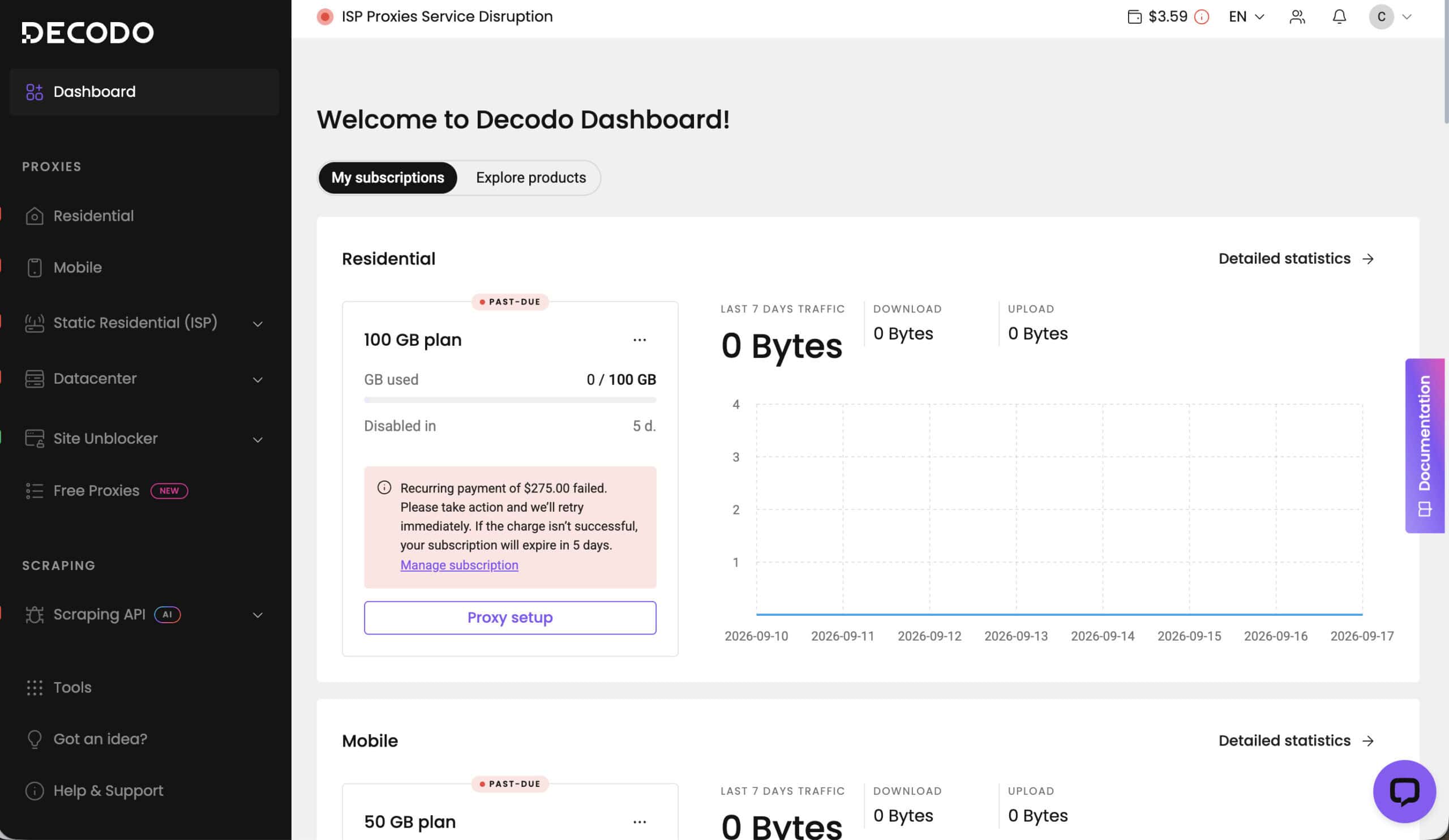
Decodo’s platform starts with the dashboard. It details your subscriptions by plan, showing traffic/request limits and recent use statistics. You can then check detailed stats per service, including top targets, countries, and users. There’s also the Explore products tab, which allows filtering by feature or use case.
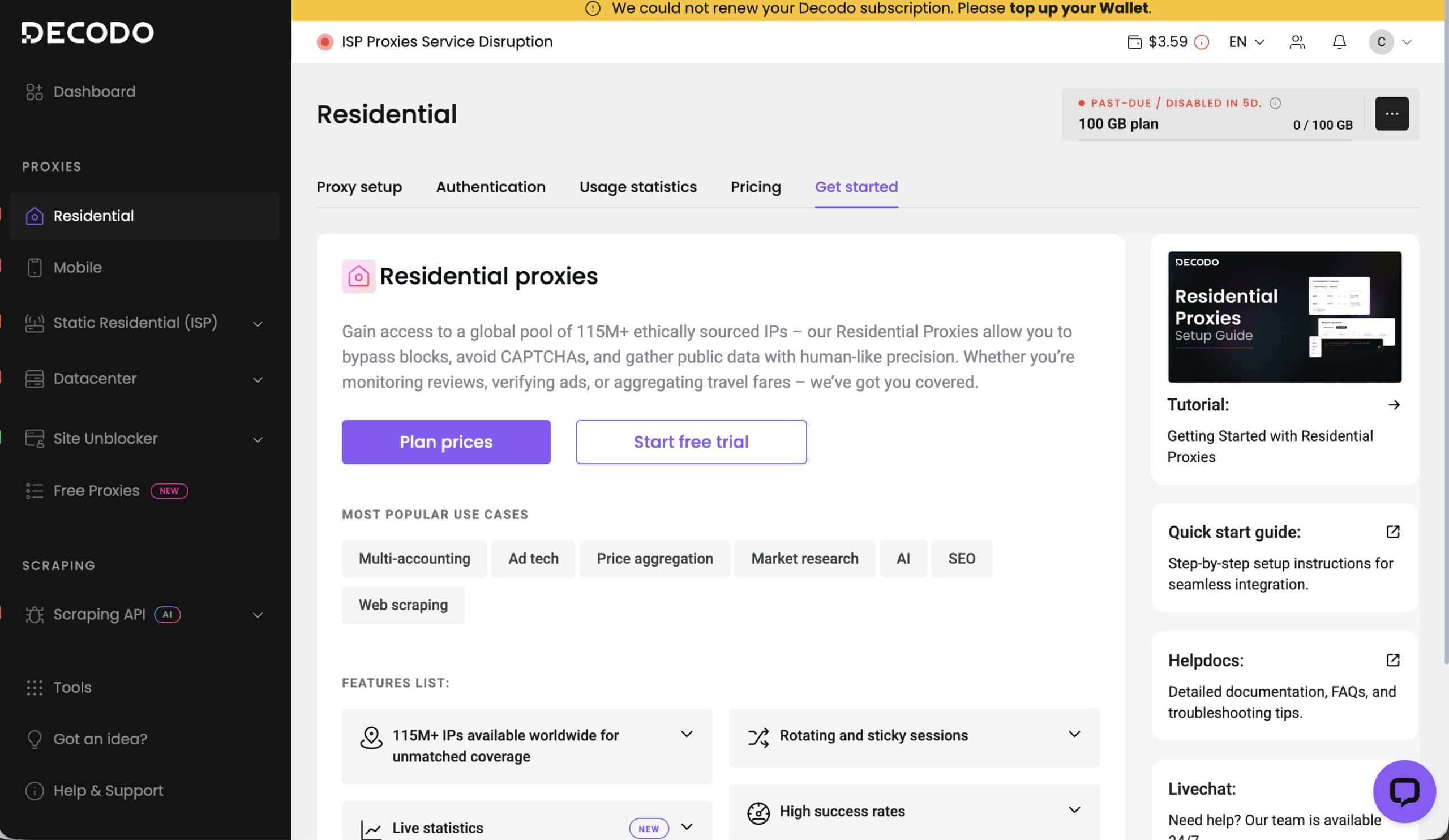
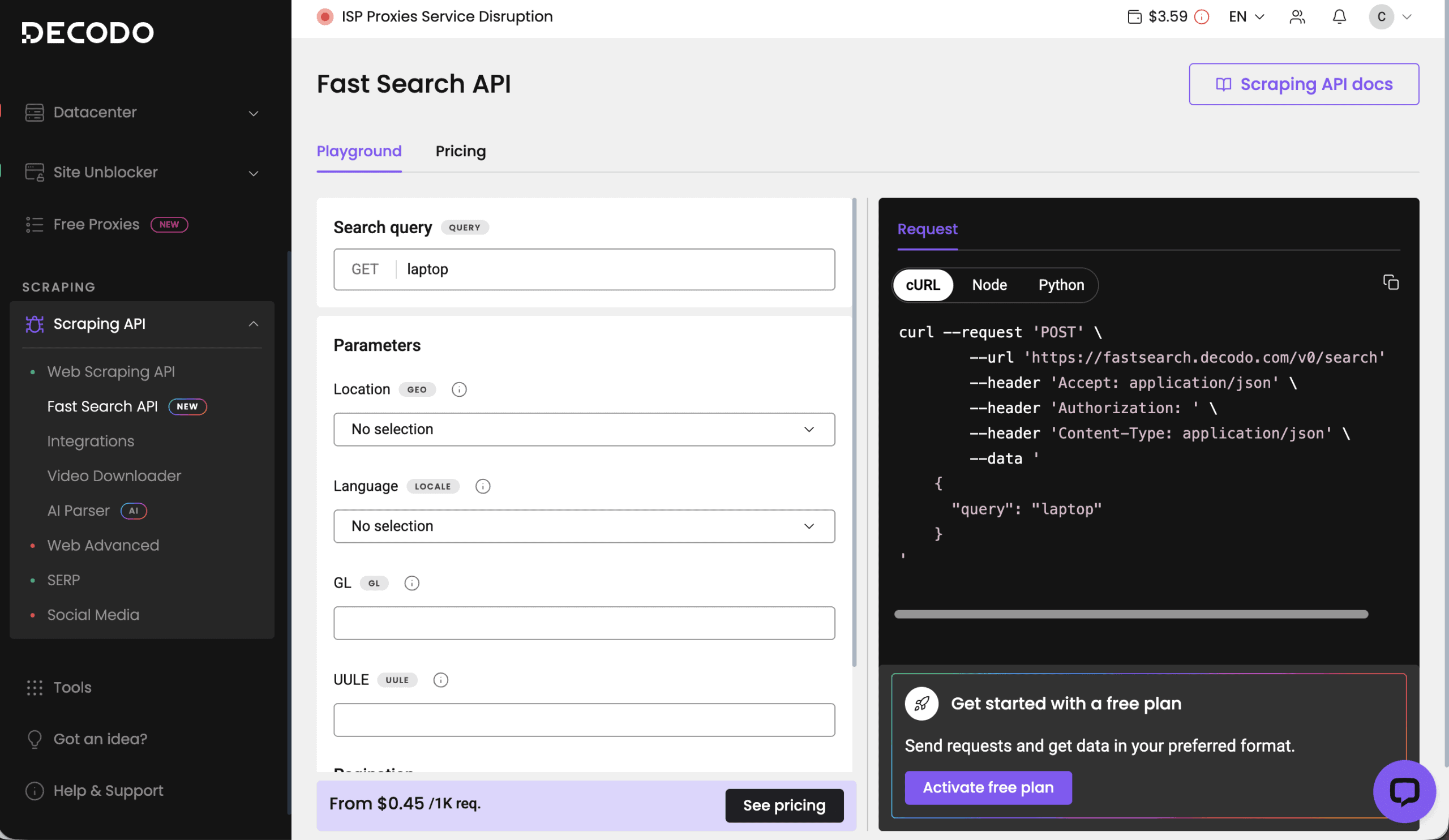
For proxy services, their individual pages feature tabs for proxy setup, authentication (for managing credentials and users), and usage statistics. There is also a tab for pricing and purchasing and a Get Started tab for tips and help. Products available in shared and dedicated varieties get individual pages for each.
All scraping products exist under the Scraping section and the Scraping API drop-down. The individual API dashboards are roughly similar. There are different tabs for configuring scrapers, accessing templates, pricing, and usage.
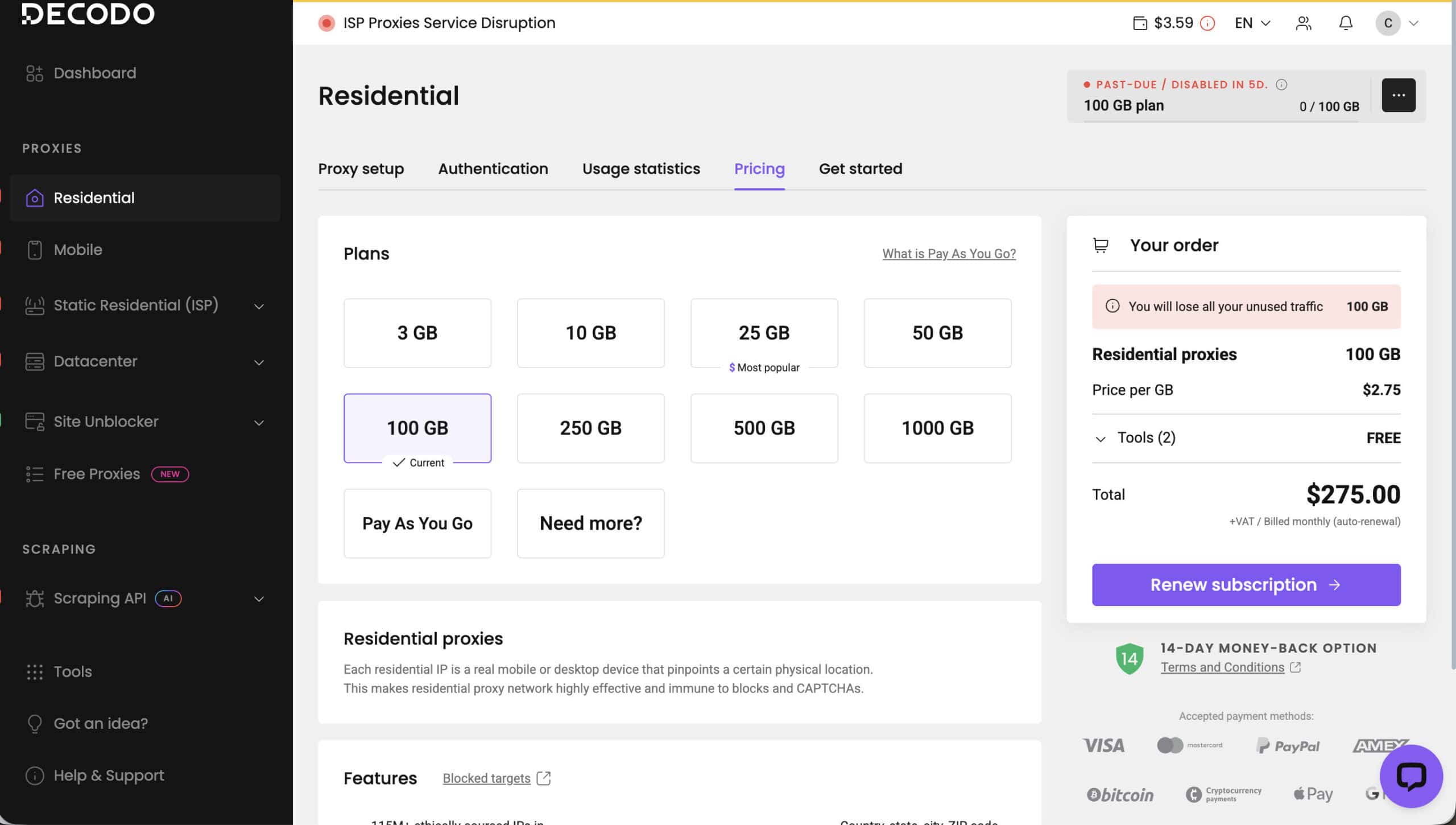
All in all, the Decodo platform is logically laid out and fairly easy to use. Links to documentation and help are present everywhere. The biggest downside is that team member configuration is somewhat deep in the user account settings.
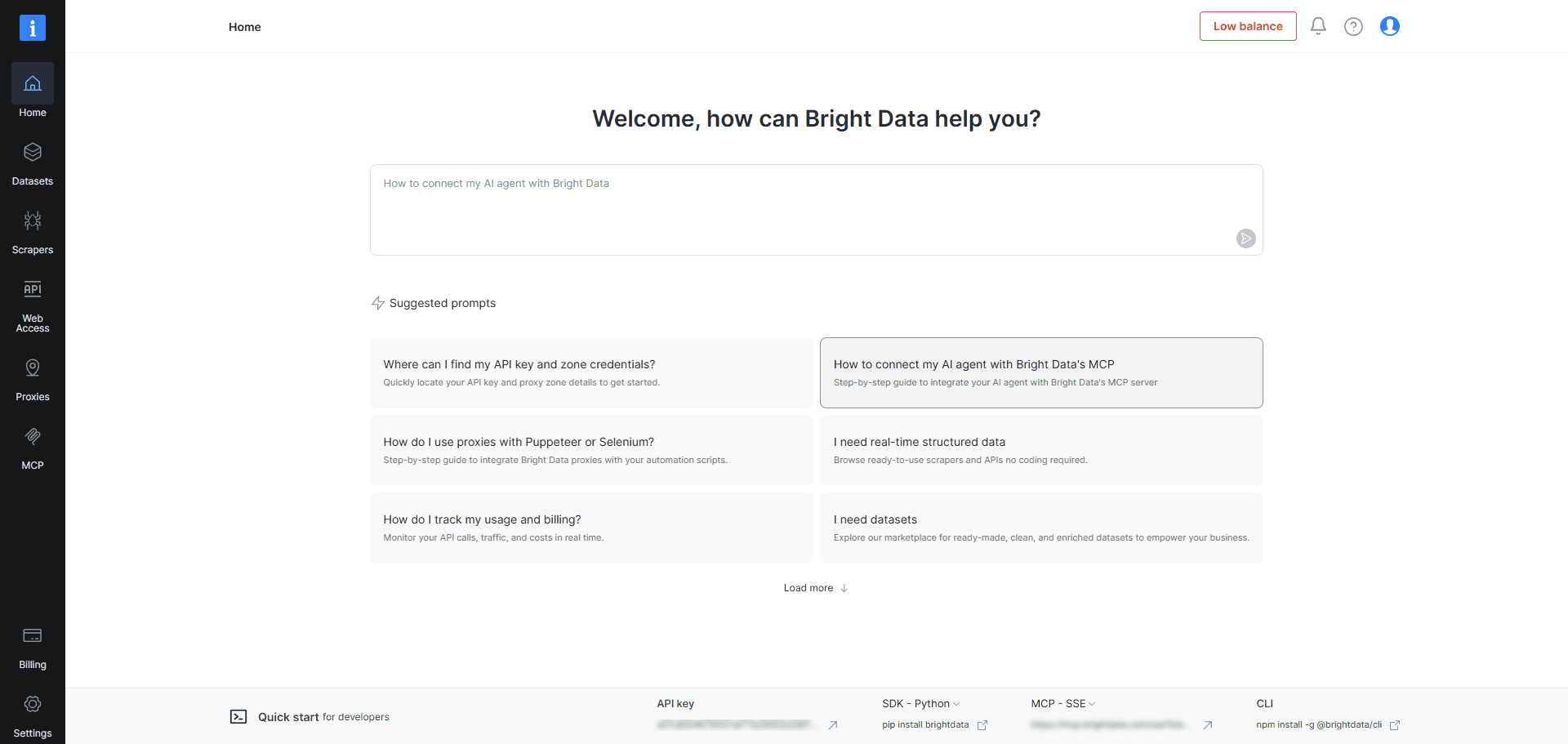
Meanwhile, Bright Data’s dashboard starts with an LLM prompt interface. It’s the same one you’d get in the AI chat. There’s also a bar at the bottom of the screen with quick start utilities, like your API key, commands for installing the SDK, and so on.
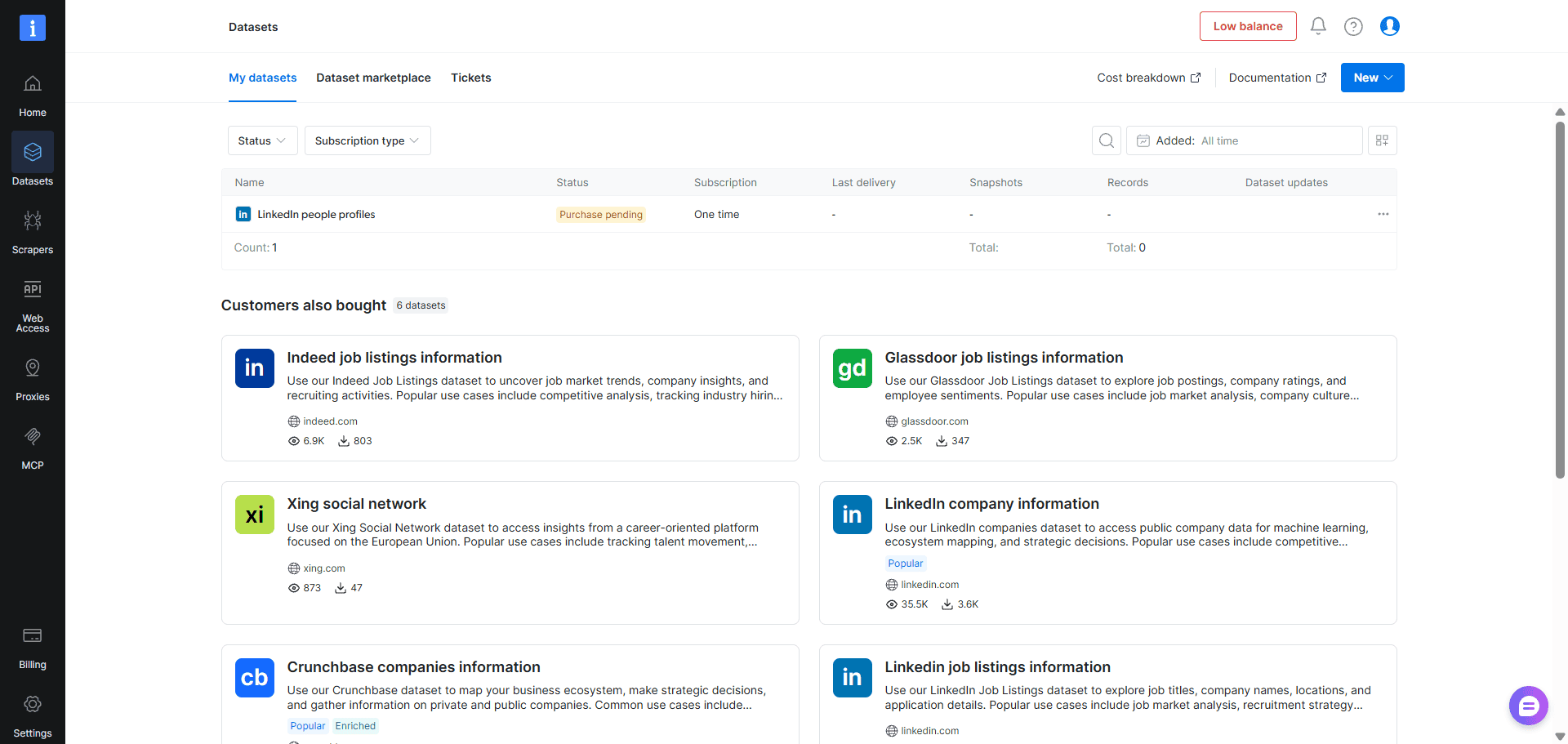
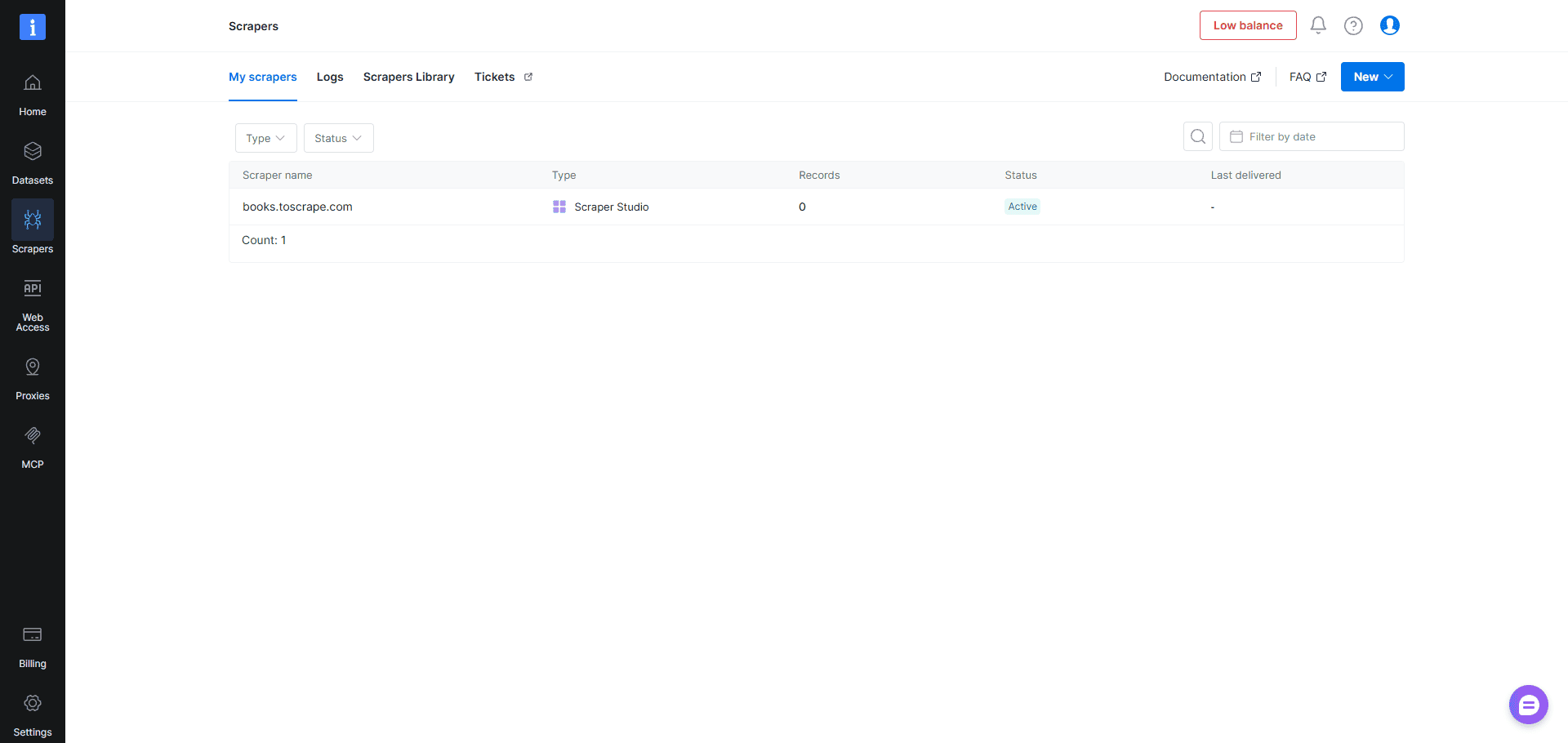
As you go to check individual products, you usually see a list of your scrapers, APIs, or whatever else the smallest unit of the service is. They’ll be listed with pertinent information, like when a dataset was purchased or updated, or what the scraper type is and when its last delivery was. If you haven’t bought anything yet, you’ll be taken to the first step of the process, like choosing the type of proxy you’re interested in.
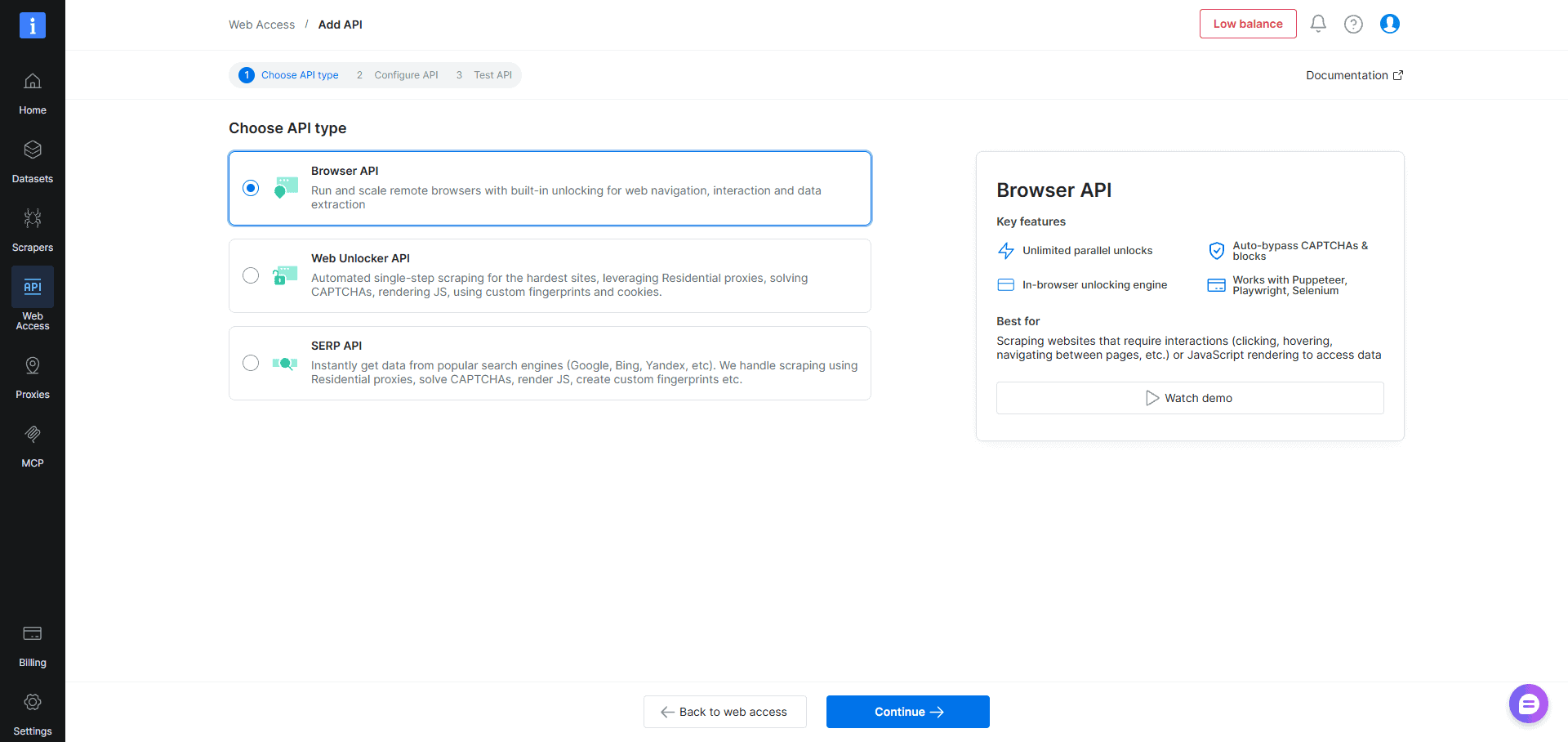
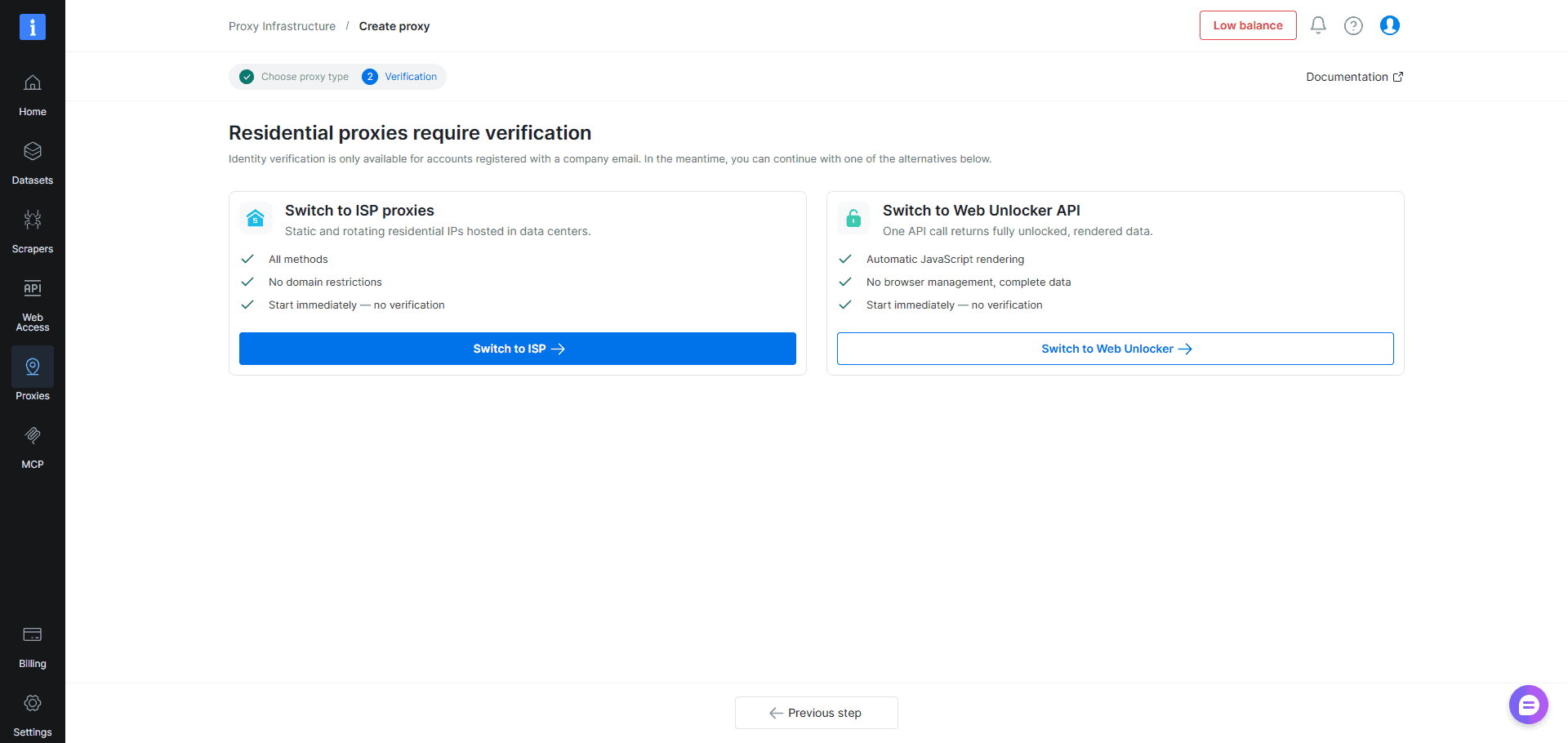
Other tabs may contain important information like usage logs or dataset or scraper marketplaces. Naturally, the API section contains a playground to test it out.
How Do Decodo and Bright Data Handle Proxy Sourcing and Compliance?
Both companies claim ethical residential proxy sourcing and provide several compliance certificates.
When it comes to sourcing proxies, Decodo is cagey about any sort of specifics. The page on proxy sourcing claims that they are sourced “ethically and sustainably.” You can infer that residential proxies are gathered via data-sharing apps. The page states that users can choose whether or not to share their bandwidth. Those who do get compensation and can choose what purposes their IPs can be used for.
Bright Data makes no bones about how it gets its residential proxies: it’s all thanks to Bright SDK. It lists participating games and apps and explains how the SDK works. Bright SDK is also advertised on its own website to app developers. The provider emphasises the ethical aspect of the gathering, including assurances of obvious and clearly worded prompts for potential users.
When it comes to compliance, both providers have trust center sections on their websites. Both display certificates of compliance with ISO standards and GDPR. Decodo is certified by the Ethical Web Data Collection Initiative, but it is also its co-founder. Bright Data shows several more certifications as well as a PwC report.
Both companies carry out Know Your Customer (KYC) procedures. Completing KYC isn’t required to start with Decodo, but it can be triggered by suspicious behavior. However, KYC is needed for larger projects or to unblock restricted target categories. Bright Data requires a KYC procedure to use in the first place.
By default, both companies block access to a variety of websites and services, like government websites, gaming, and banking.
Who Offers Better Customer Support?
Decodo offers superior customer support for those on a budget.
Decodo offers 24/7 email and chat support for all customers. The chat is AI-first, and if the bot can’t solve your problem, you will be transferred to an agent.
Bright Data’s approach depends on the support tier. At the most basic level, live chat is available during business hours. You can then buy additional support options with the Premium package. This gets you access to 24/7 live chats and consultations with subject matter experts. It costs 8% of your monthly payment, with a minimum of $500/mo. The Enterprise tier costs $10k/mo and includes a dedicated technical consultant, Slack access, and more.
Which is Cheaper: Decodo or Bright Data?
Decodo is cheaper than Bright Data on all but the PAYG tier.
Decodo is consistently cheaper across all products, whether they are priced per GB or per IP. This becomes more pronounced at scale, as well. At the 1000 GB mark, Decodo residential proxies cost $2/GB while Bright Data reaches $2.5/GB with its 798 GB plan. In both cases, you end up paying $2000, but with Decodo, you get 202 gigabytes more.
The providers are only matched in price at the Pay-As-You-Go level, with $4/GB. When it comes to actual subscriptions, Decodo is cheaper to get into. Its smallest possible residential plan is $3.75/GB for 3 GB – so $11.25. Meanwhile, the smallest Bright Data plan is 141 GB at $3.50/GB, for a total of $499.
In terms of web scraping, Decodo’s Web Scraping API is priced based on the type of proxies used and whether or not JavaScript rendering was necessary. The entry-level $19 plan costs $0.5-$1.5/1K records. Bright Data’s Web Scraper API’s PAYG is also at $1.50/1K records. However, Bright Data’s lowest subscription tier is $499.
The plans top out at $1999. On Decodo, that gets you a price of $0.09-$1/1K records. For Bright Data, it’s set at $1/1K records. Both only charge for successful scrapes.
Decodo vs Bright Data: Which Should You Choose?
First off, if you’re not a business client, that choice has been made for you: Bright Data only serves businesses these days. So anyone with a smaller project has to go with Decodo. It makes sense, especially considering that, even beyond PAYG, Decodo plans start way below $499.
It’s also better if you only need proxy access, since Decodo offers mobile proxies in addition to other types. You have to have really specific country-level geographic requirements for ISP and datacenter proxies to make Bright Data’s prices worth it. Otherwise, their proxy services are of comparable quality.
If you’re in it for data scraping, then Bright Data offers you a lot more. It’s hard to compete with thousands of pre-made scrapers, collected data sets, and bespoke data scraping services. That said, you have to evaluate these extras against your requirements and budget. However, if you don’t have the needs of a Fortune 500 company, Decodo will get you what you need, and cheaper, too.

Frequently Asked Questions About Decodo vs. Bright Data Comparison
Whether Decodo is better than Bright Data depends on your needs and budget.
For example, Decodo offers lower entry costs, supports mobile proxies, and accepts all tiers of customers.
Bright Data has more geolocation options for ISP and data center proxies. The company also offers more comprehensive data scraping tools.
No. Decodo’s cheaper when it comes to both proxies and data scraping.
It’s a difficult question to answer. As top-tier proxy providers, Decodo and Bright Data both provide quality proxy service. The biggest difference is in the residential proxy pool size: Decodo maintains 115 million while Bright Data has 400 million proxies.
Decodo and Bright Data are mostly equally easy to use. This is to be expected when comparing two of the best performing companies in the market.
Choose Decodo if you want lower entry costs, mobile proxies, residential proxy access without company verification and 24/7 customer service without additional payment.
