
Zyte Extract Summit 2026 (Dublin): A Recap
Our impressions from the second chapter of Zyte’s annual web scraping conference.
- Published:

Zyte’s Extract Summit is finished for the year, but there’s no need to put it behind us: if you missed the Dublin event, all talks are available on demand.
So, let’s ride its coattails for a while longer. We have good intentions, after all – to help you form some informed opinions before committing. And in the age of short form videos and AI summaries, what’s a better way to do that than with row upon row of text?
Without further ado, here’s our recap of Extract Summit 2026 Dublin.
Organizational Matters
The second chapter of Zyte’s conference took place a month after the Austin event. It followed all the same conventions: in-person tickets cost money and included an optional day of workshops.
Online attendance was free of charge. Zyte did a better job promoting the event this time around, or at least we noticed it more. Still, it would be more accurate to call online viewers spectators rather than attendees. They couldn’t really interact with the stage, nor ask questions – those privileges were reserved to badge-donning participants.
On the other hand, a Vimeo recording was available shortly after the conference ended, without any gating or fishing for leads. That was refreshing.
Main Themes
In her opening remarks, the host Suzanne Hassett identified AI agents as the new, third kind of internet user alongside people and bots. And indeed, agentic AI took charge.
One major topic was enabling it to carry out tasks. Pierre Tachoire from Lightpanda and Amit Parpara from Tavily both introduced alternatives to browsers that can hydrate pages leaner and faster, while Ivan Sanchez built an internal wiki to provide agents with the necessary context for fixing spiders.
Agentic AI also brought more human and maybe even philosophical concerns. Zyte’s CEO Shane Evans and the panelists tried to negotiate the relationship between AI and humans, and how the emergence of the former has transformed (and honestly, sometimes displaced) the functions of the latter. Sally Hinfey took on an even broader scope, trying to map and understand this phenomenon from the legal perspective.
And, of course, we had the technical tug of war between those scraping and the ones trying to stop the scraping. Ionut Ciubotariu presented new website protection measures, Pierluigi Vinciguerra used LLMs to understand anti-bot systems, and Robert Vähhi demonstrated how it’s possible to fool artificial intelligence.
The Talks
The conference featured nine presentations (including Shane Evans’ 30-minute intro) and one panel discussion. Feel free to use the hyperlinks for fast navigation:
-
- What AI Actually Changes in Web Scraping
- Antiban Ideas for the Open Web
- Antibots, Explained by a Machine. How LLMs Changed the Cat and Mouse Game
- Beating LLM Reverse Engineering
- How to Browse the Web Faster with Lightpanda
- The Browserless Browser
- (Panel discussion) Economics of Large Scale Scraping and Team Management
- The Legal Side of Web Data in 2026
- OSINT in the Age of AI: Personal Privacy and Cyber Threat Intelligence
- A Self-Maintained Website Knowledge Base for Scraping Agents
Talk 1: What AI Actually Changes in Web Scraping
The real question should be: what has actually changed from Shane Evans’ (Zyte CEO) namesake presentation in Austin just a month ago? Well, it’s more similar than not, with some reshuffling and extra content thrown in. But that’s not a bad thing per se, and definitely not if you missed the previous iteration.
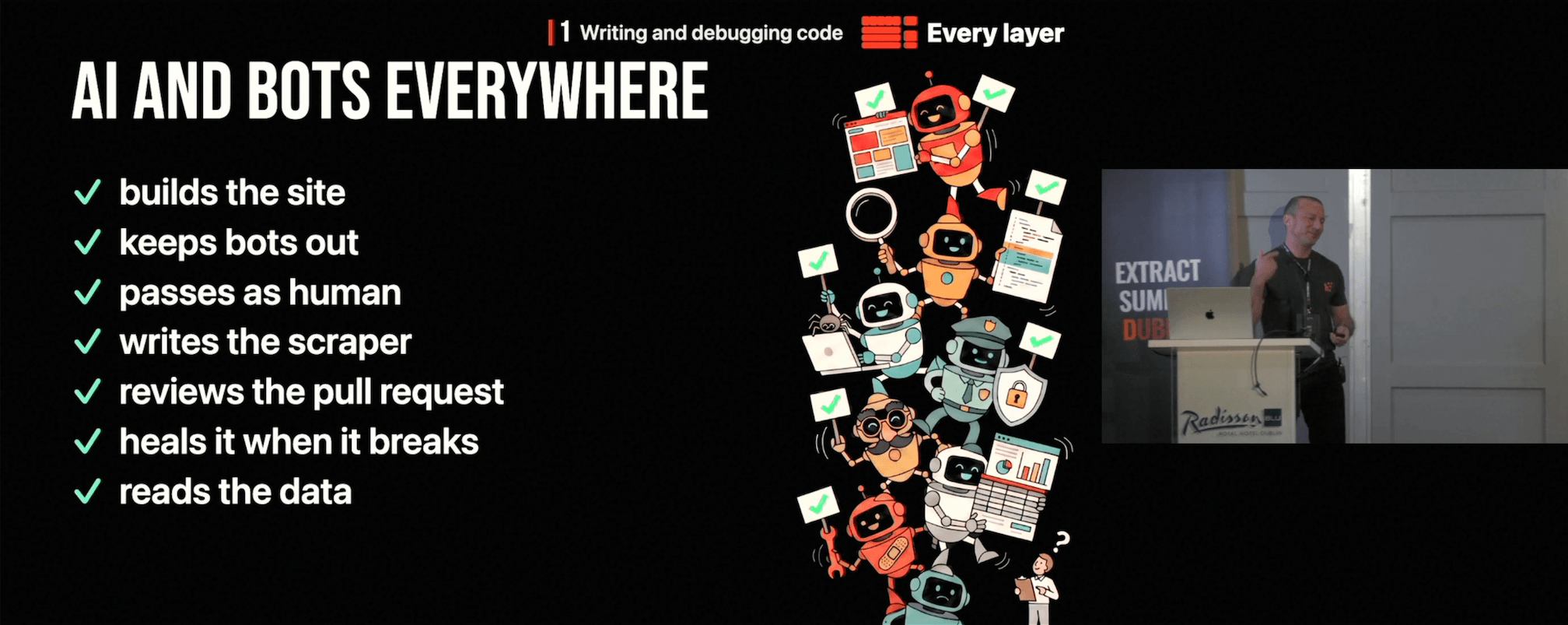
To summarize, Shane distinguished three areas where AI has made a big impact. One is writing and debugging code. It has become reality for many a software engineer to barely touch code directly – instead, they’ve turned into architects, guides, and, to the woe of some, code reviewers. The second area is web access, where agents brief Zyte’s engineers on customer tickets, enabling them to solve problems much faster.
The third is, of course, costs. AI cuts expenses in some areas, but it sometimes introduces indirect costs where you least expect them. Whenever you spend tokens, however, the costs are always very direct. The lesson here is that just because code got cheaper, the bill won’t necessarily shrink in return.
Afterwards, Shane demonstrated Zyte’s new agentic scraper builder which by now had become available in early beta. The nutshell, without going into weeds, is that AI permeates every layer of Zyte’s stack, and that this won’t change anytime soon. The presentation is definitely worth watching if you haven’t seen the Austin edition, and optional if you have.
Talk 2: Antiban Ideas for the Open Web
You scrape a website twice using the same proxies, spider, and fingerprint. One run succeeds 1.6% of the time, another 41%. What’s changed? Just like that, Ionut Ciubotariu from Zyte got everyone (including us, of course) hooked from the first slide.
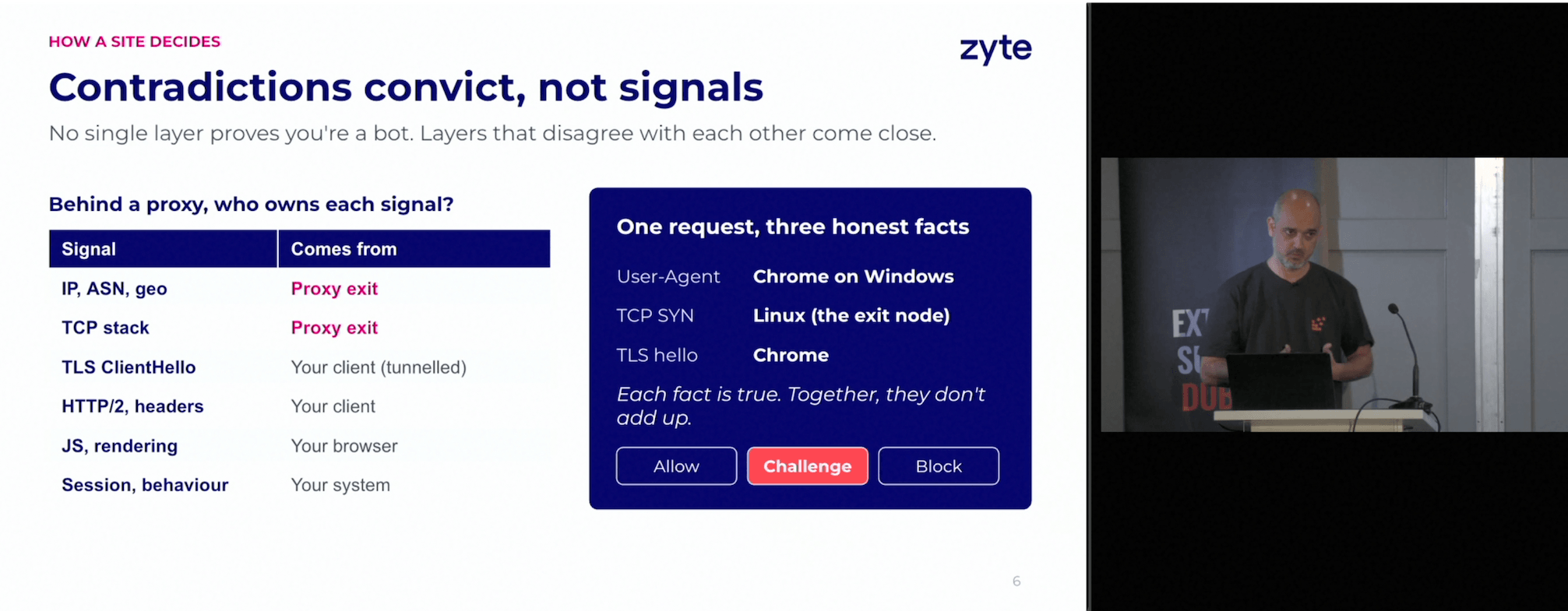
To save your precious attention span, the differentiator was sessions, the main subject of this talk. They’re definitely not the only signal – and Ionut listed six layers that need to cohere – but sessions are increasingly becoming the differentiating unit of trust. The presenter shared his know-how for working with sessions (which included bound cookies, session deprecation, and more) and addressed the anti-bot challenges that arise.
It seems like context is becoming key, and we’re moving past the wild days of fast rotating proxies. Alas. All in all, this is a valuable talk for anyone in the trenches of unblocking.
Talk 3: Antibots, Explained by a Machine. How LLMs Changed the Cat and Mouse Game
One surefire way to confuse an alien would be to show him the rhetoric around web access: it’s mice that are actually spiders getting chased by cats who really want to gate away from them. Colorless green ideas really do sleep furiously. But we digress.
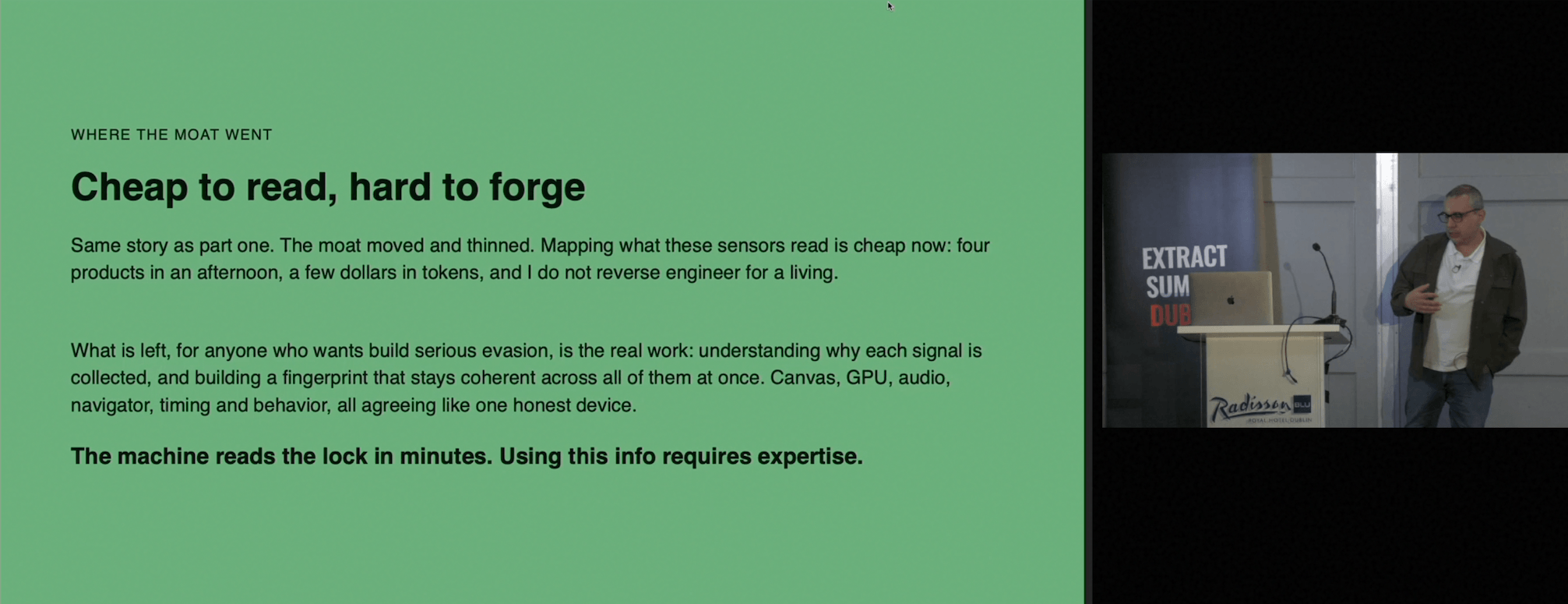
Pierluigi Vinciguerra, the author of the famous Web Scraping Club newsletter and a serial attender of conferences, gave a rather broad talk about how AI has transformed our industry. Here, like anywhere, the cost of building things has cratered, moving the moat to distribution and branding. According to Pierluigi, this shift applies to anti-bot systems, which until now had been the least affected by AI.
To prove his point, the presenter reverse engineered a loosely documented TikTok dataset published on Hugging Face. He then repeated the process with four anti-bots, mapping their sensors and blocking signals. This part was easy. Pierluigi’s crucial point (which the event’s host later reiterated several times in her closing remarks) is that reading an anti-bot is easy – it’s acting on this information and deciding what matters that’s hard. A brilliant nugget of wisdom.
Talk 4: Beating LLM Reverse Engineering
This talk interplays with the previous one very well, as it effectively shows the other side of the same process!.. Or at least it should have. Robert Vähhi pulled the old bait-and-switch: while he did in fact show how to fool LLMs (or anyone for that matter – the approach exploited formatting bugs in scripts, making them run completely different code than visually perceived), most of the talk revolved around his business.
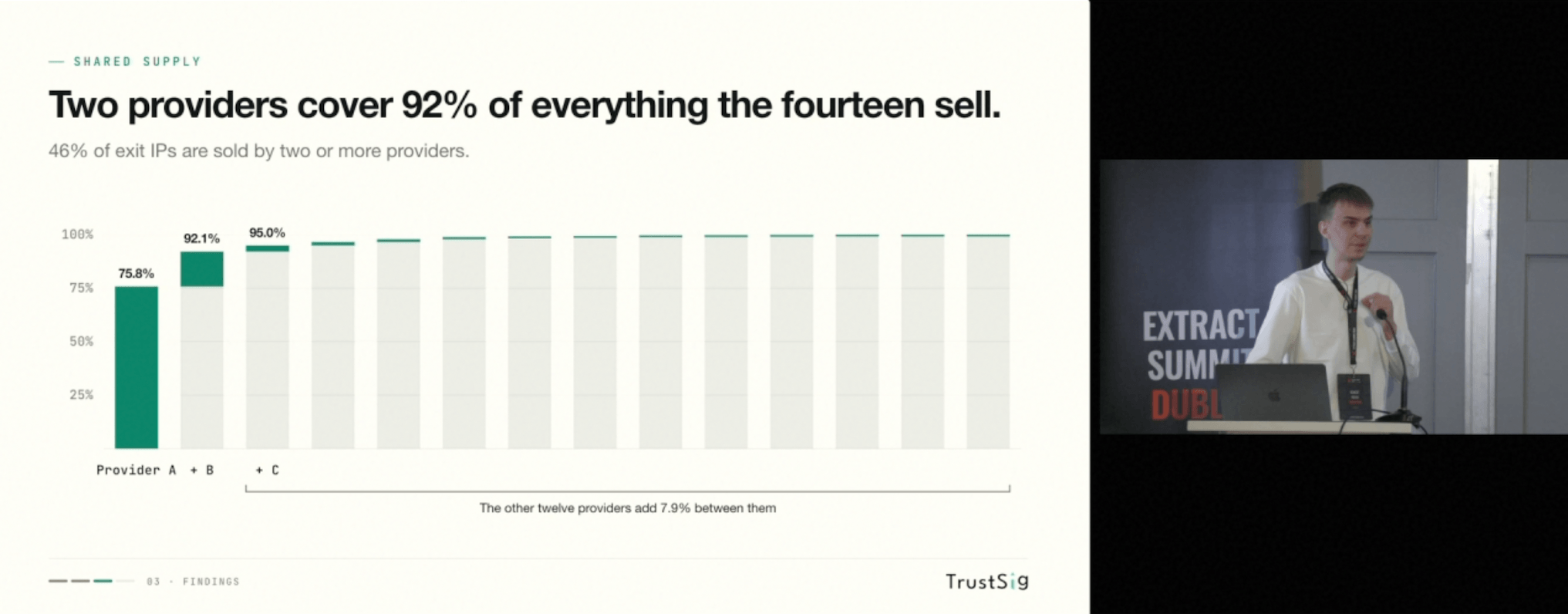
Robert’s company TrustSig runs a residential proxy detection service. It was conceived after a failed interaction with a now-competitor, and has scaled to 101B requests every three weeks across 14 proxy providers. The presenter shared some fascinating insights, like that nearly every third IP in Pakistan is a proxy, or that two out of the 14 pools covered the majority of unique IPs found.
Robert’s advice was to just go for the cheapest proxy provider; there’s a high chance it’ll be the same as the more expensive one. He said that with a mostly straight face, in a conference hosting at least five proxy server vendors. The nerve of that man!
Talk 5: How to Browse the Web Faster with Lightpanda
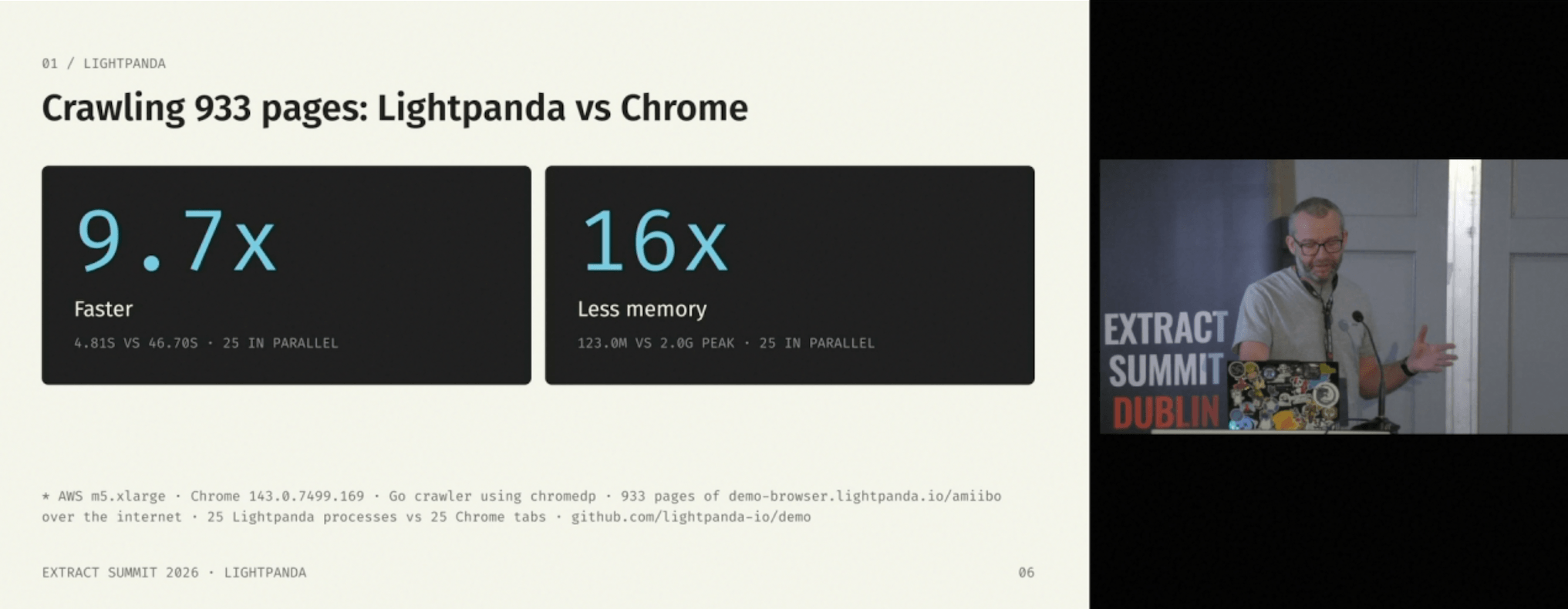
A product demo, but that’s perfectly fine because Lightpanda, a headless browser made for AI, is open source. The project’s co-founder Pierre Tachoire introduced its functionality, progress, and compared Lightpanda to regular headless Chrome.
According to Pierre, Lightpanda is a completely new browser that uses curl for networking and V8 as its JavaScript engine. It doesn’t render graphics, loads only the minimal necessary resources, and includes other neat tricks for things like monitoring, ad blocking, and page caching. As such, Lightpanda can run 10x faster than Chrome, while using 16x less memory and integrating through standard automation frameworks like CDP and WebDriver.
However, it’s not all roses: Lightpanda can’t take screenshots, it can’t defeat anti-bots (and even sends obligatory client hints to introduce itself), and it’s written in a rather niche language of Zig. That’s about the gist of the talk – but Pierre sold his browser better than us, so feel free to watch it if you find Chromium too fat.
Talk 6: The Browserless Browser
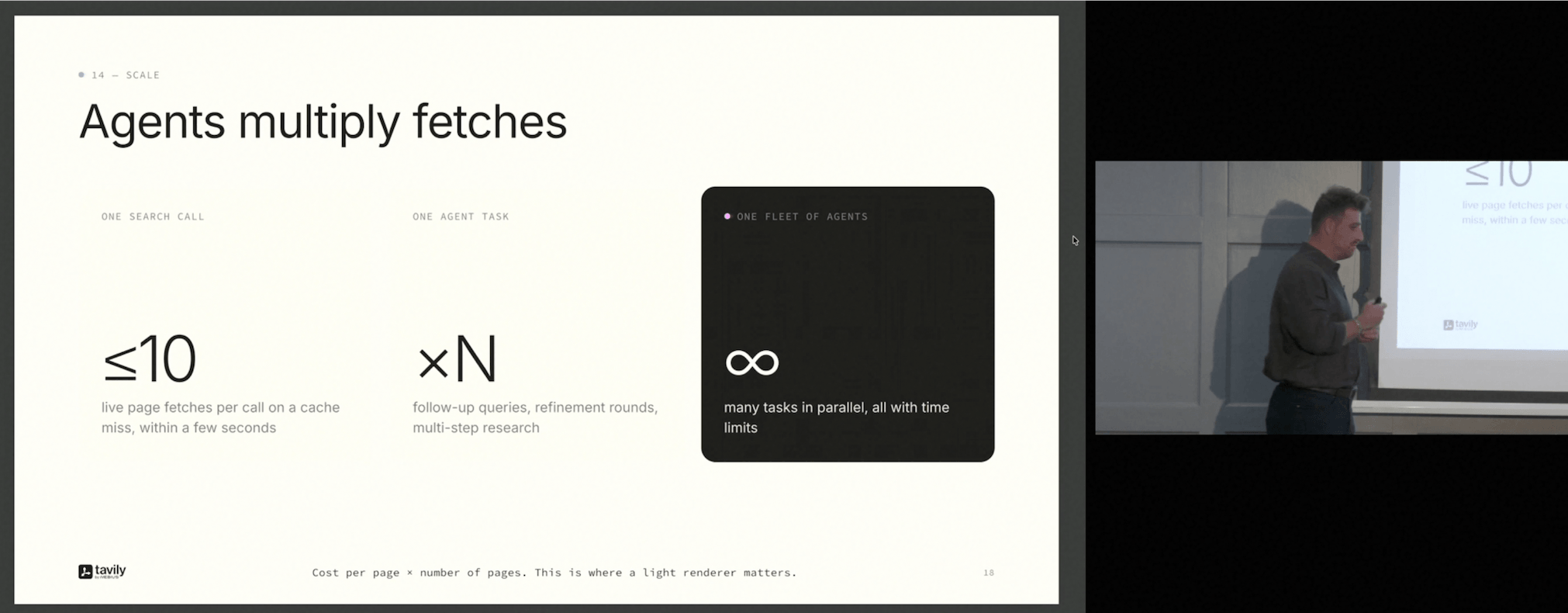
A very similar talk, but this one is about an internal tool which Tavily built specifically for its web search-and-retrieve service. The tool’s main purpose is to hydrate web pages by using the minimal working configuration. It works for 80% of the pages but fails whenever anti-bots or contraptions like WebGL get involved. We’ve heard this already, haven’t we?
But repetition is the mother of invention, and the contents of this talk definitely weren’t all the same. For one, the speaker Amit Parpara introduced his team’s shim taxonomy of web APIs, focusing on determining when a page is actually loaded enough. This is crucial because Tavily, and AI agents in general, do multiple fetches for one query, so deadlines are always tight.
Amit then segued into showing the innards of web search APIs. Most of their content comes from a cache; things get tense when there is no cache to retrieve, or it’s gotten stale. This is where the lightness of browserless browsers comes into use. But even then, you need to consider various constraints and fallback mechanisms.
We recommended the previous presentation if you’re considering implementing something like Lightpanda yourself. This one is for further understanding how this category of products works and the business logic behind it.
(Panel Discussion) Economics of Large Scale Scraping and Team Management
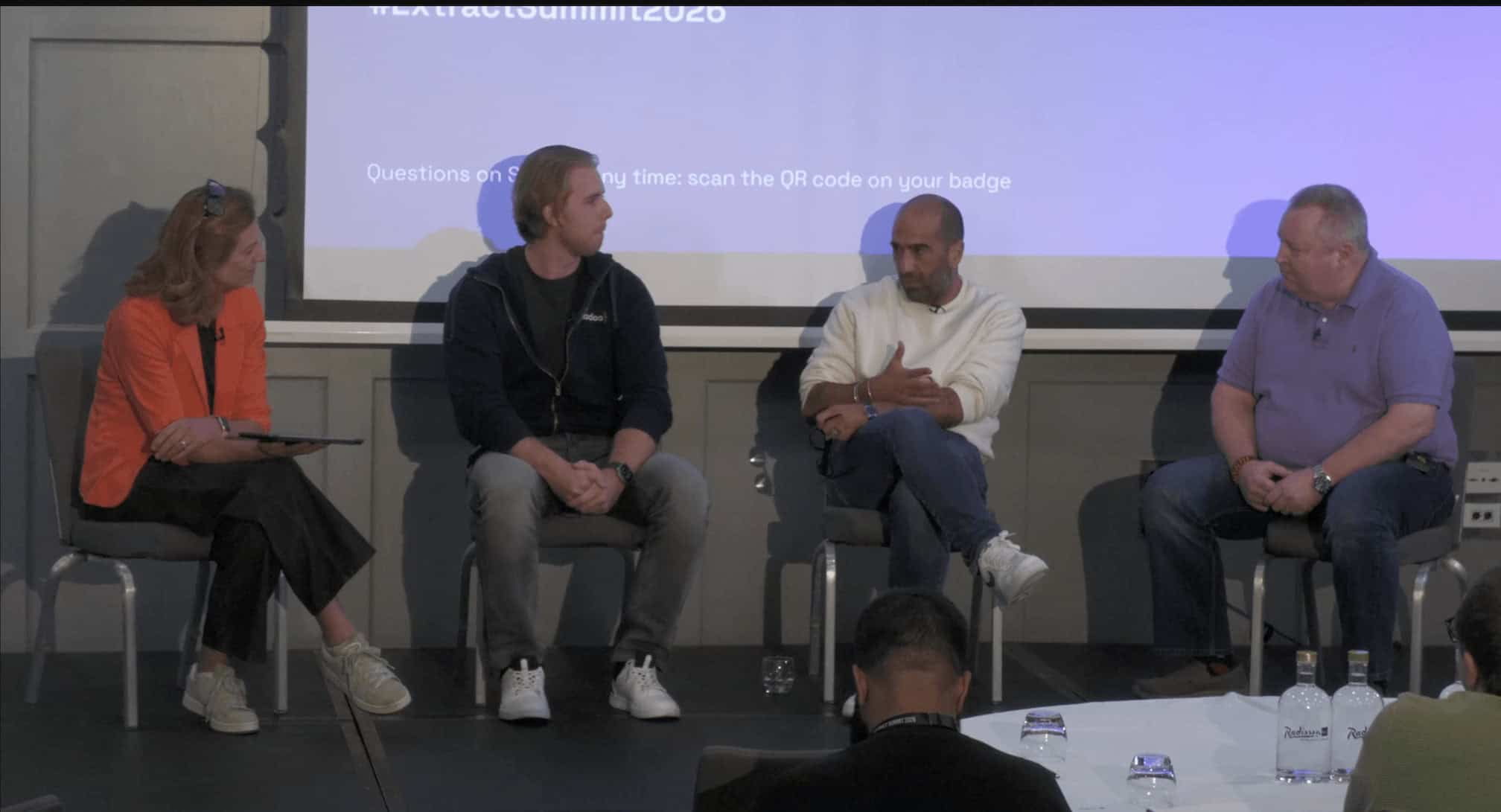
Suzanne Hassett sat down with Ken FitzGerald from Zyte, Johannes Engler from Kadoa, and Hocine Amrane representing NielsenIQ to talk about the pain points of scraping at scale, whether it makes sense to run things in-house, and how AI is changing the equation.
It turns out that even now, two thirds of the costs in production-grade scraping come from labor, and only one third from infrastructure. It’s all about the maintenance and the people behind it. Even though Zyte and Kadoa can delegate over 90% of the scraping code to AI, someone still has to review the output (for now), so the burden has simply shifted from producing to maintaining. Coders are turning into architects and customer success agents.
The question of outsourcing data extraction mainly hinges on whether it sits at the core of your business. Ken phrased it brilliantly: a puppy is not just for Christmas – you have to take care of it all year round. Even if you do rely on web data, you may want to outsource it to meet scaling demands; and then there are matters like compliance, which can no longer be treated as peripheral at any larger scale.
In the end, it’s all about making the customer happy. We agree with Hocine: stop worrying so much, take care of your customers, and try to have fun – we’re not saving lives, after all. In our experience, panel discussions are always worthy of attention; the rule stands unbroken.
Talk 7: The Legal Side of Web Data in 2026
Sally Hinfey, Zyte’s newly-hired Chief Legal Counsel, outlined the legal policy toward web scraping in Europe and the US. She hadn’t fully recovered her voice, while her slides and speech were like a couple in their 40s – competent, collected, and effectively divorced. Still, this didn’t diminish the valuable and timely subject matter.
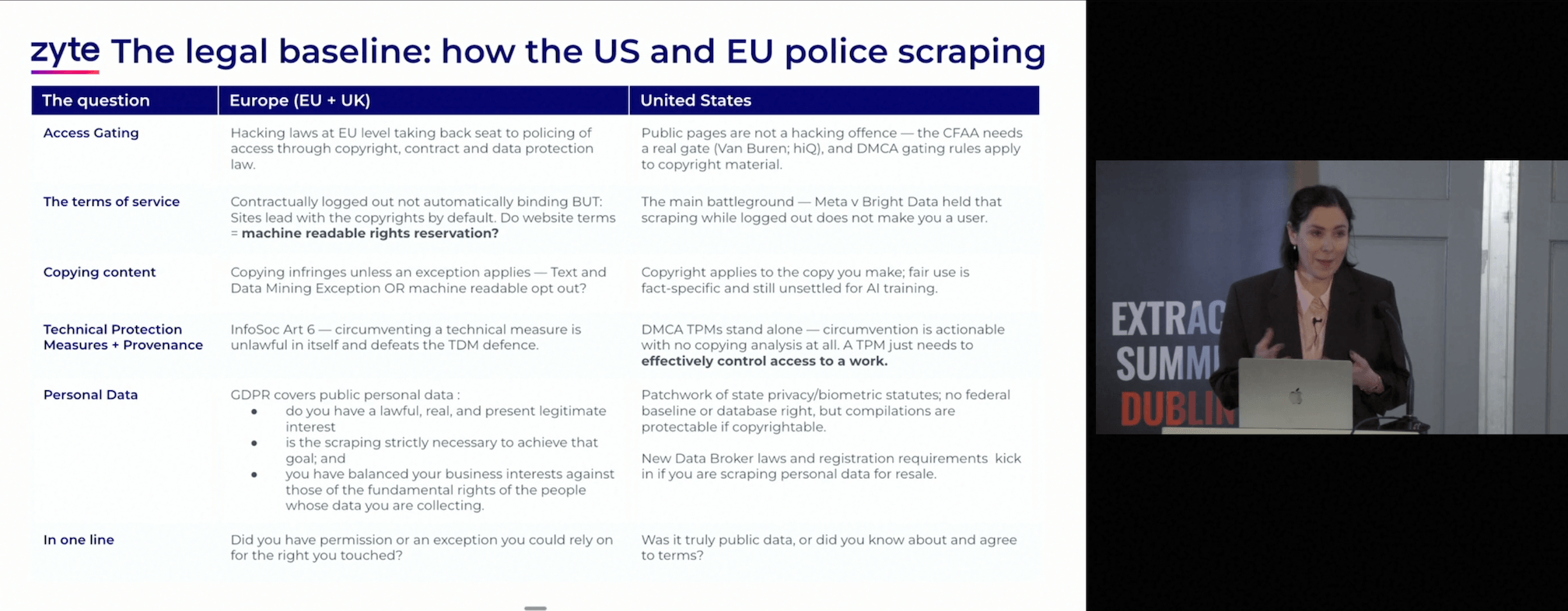
Sally first overviewed the current legal baseline in both jurisdictions from the perspectives of access gating, terms of service, copyright, protection measures, and personal data. This all boiled down to two questions: 1) in the EU, do you have permission or an exception in the EU? and 2) in the US, was the data truly public, and did you agree to the terms?
The presenter then introduced the very recent (when we wrote this – hi, future reader!) Like Company v. Google case that focused on RAG and likely formed the basis of what’s allowed in Europe. Sally finally covered five pertinent issues concerning robots.txt, valid opt-outs, the ToS, data provenance, and the scope of personal data.
The general sentiment of the year is that you should absolutely care about data provenance, and that there’s a lot to look forward to in 2027. This talk is definitely worth watching, at the very minimum to screenshot the slides.
Talk 8: OSINT in the Age of AI: Personal Privacy and Cyber Threat Intelligence
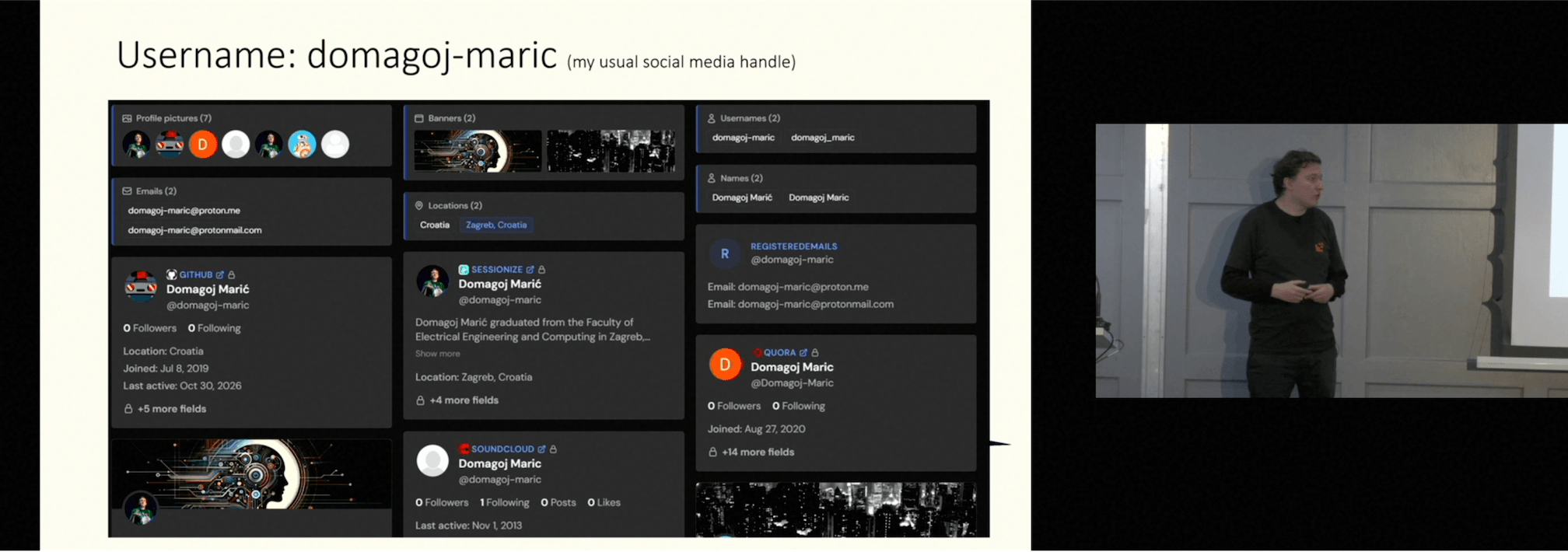
Halloween ends only if you let it end, or at least that’s what this presentation by Domagoj Maric led us to believe. It’s a proper scare piece that upends our usual process of prying into websites, instead showing what the web knows about us. The talk builds upon Domagoj’s last year’s presentation (also at Extract Summit) on the dead internet theory.
The presenter focused on open source intelligence tools and how they can be weaponized for tasks like phishing. It’s surprisingly easy to get a person’s email address, social media profiles, and, if they have more web presence, their face and voice. It takes just a few photos and six seconds of audio to create deepfakes that only a mother would discern.
The best way to protect yourself is to limit the attack surface. Or, if someone does leak something about you, you can always claim that it was AI. Not the shiniest silver lining, but we take what we can get, right? In a nutshell: the presentation was creepy, informative, and entertaining – all (and probably more) that a good Halloween should be.
Talk 9: A Self-Maintained Website Knowledge Base for Scraping Agents
The last talk of the day! At this point, everyone was a bit tired, and 2,000 words later, so are probably you (unless you just warped here through a hyperlink – in that case, good for you!). Well, Ivan Sanchez from Zyte didn’t disappoint.
A problem which Zyte – and any web scraping operation, really – encounters is that spiders break. Getting them fixed requires time and context, which translates to even more time. What’s more, Zyte has built as many as 200 spiders for the toughest websites, each of which requires tapping into and transferring context.
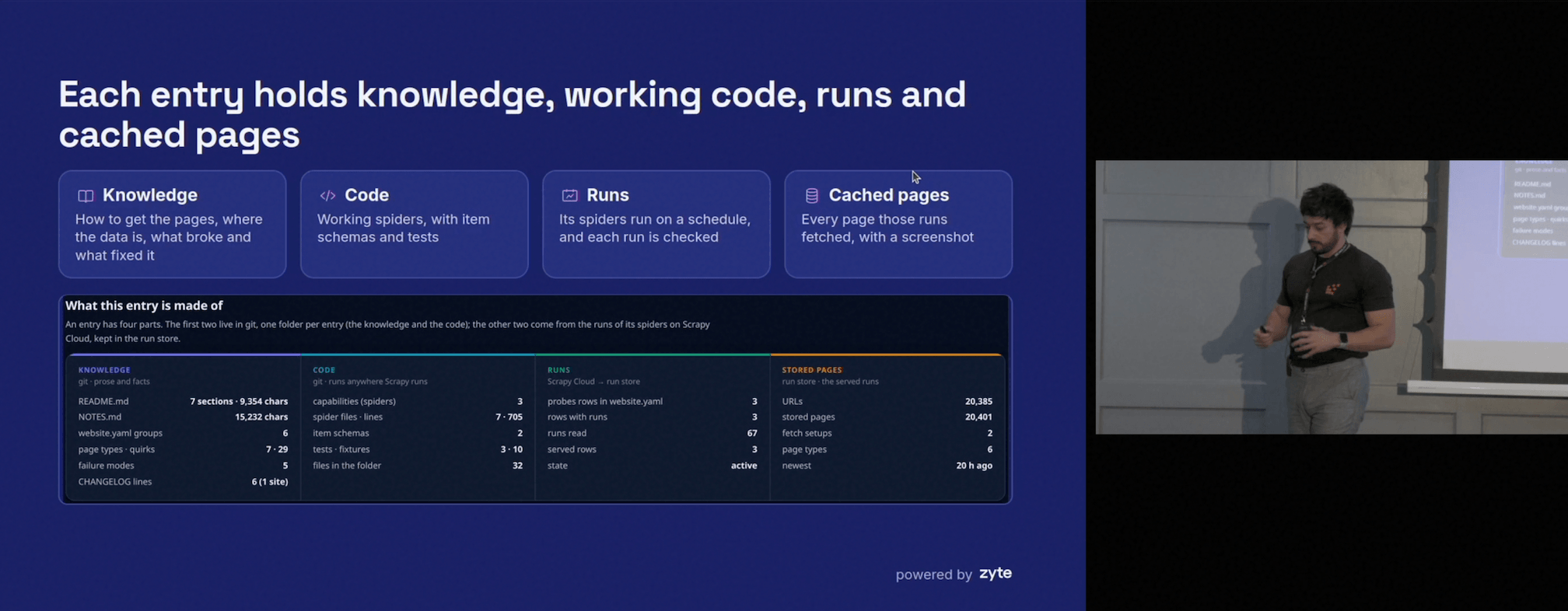
To save time, Ivan’s team has built a centralized knowledge base. It includes not only domain know-how, but also scraper code, previous runs, and even cached pages for quick fixes. Agents build from entries and periodically perform sample runs before doing large scheduled crawls. Ivan claims that this approach requires 30% less time and cost, and that Zyte plans to add 5,000 websites to the database by the end of the year.
Overall, the knowledge base is somewhere between a proof of concept and a production tool. Either way, if you like to keep your finger on the pulse of where web scraping is heading, you’ll likely want to watch this.
Conclusion
That’s all for major web scraping conferences of the year. Thank you for reading all the way through, and we’ll see you again after the next one in 2027!
