
Oxylabs Launches Web API, MASQUE, Credit-Based Pricing
One searches and scrapes the web, the other helps proxies blend in better and run faster, and the third brings all products under one subscription.
- Published:

Web API
Oxylabs has decided to follow the trends and packaged its API as two broad endpoints: /scrape and /search.
The former includes all previously-available features, meaning that it attempts to fetch any website in real time or asynchronously, with the ability to render JavaScript, select geolocation, and more. /scrape includes specialized endpoints for select targets like Google, ChatGPT, or YouTube, as well as AI-based extraction.
The /search endpoint is new. It performs real-time searches using unspecified sources, which the provider then ranks by relevance. This endpoint was designed to work as a discovery tool in tandem with /scrape.
Web API returns output formatted as raw HTML, structured JSON, Markdown, or PNG screenshots. The main integration method is an HTTP API, though it also supports AI-friendly interfaces like MCP or agent skills.
Web API’s pricing counts successful requests. Its rates differ by endpoint and target website; the entry plan charges between $0.5 and $1.5 per 1,000 requests, or $2/GB when downloading media. /search always charges $1 per 1,000 requests, no matter the plan size.

MASQUE Protocol Support
The second change affects Oxylabs’ residential proxies – they can now connect using the MASQUE protocol via the CONNECT-UDP method. This allows the proxy servers to natively route HTTP/3 requests without downgrading to HTTP/2 or /1.
According to Oxylabs, MASQUE brings several improvements. For one, it reduces latency because encryption no longer requires two round trips. Additionally, it may reduce detection, as major websites like social media platforms and Google expect HTTP/3 by default.
Because it’s still a nascent protocol, MASQUE also brings limitations. The major one is that few web scraping libraries support it out of the box, requiring custom tools. Furthermore, Oxylabs currently forbids using this connection method with Google. The MASQUE implementation operates on port 5,000.
Credit-Based Pricing
The last but not the least news involves Oxylabs’ dashboard. It’s been remade to accommodate credit-based pricing. From now on, whenever you buy a plan, it will enable access to all available self-service products instead of requiring separate subscriptions. They will still have individual rates, but you’ll be able to use them drawing from the same budget.
Credit-based pricing is especially beneficial to customers who rely on multiple products. Rather than buying $700 worth of residential proxies and $300 of mobile proxies, you can get a $1,000 plan with better bulk rates for both.
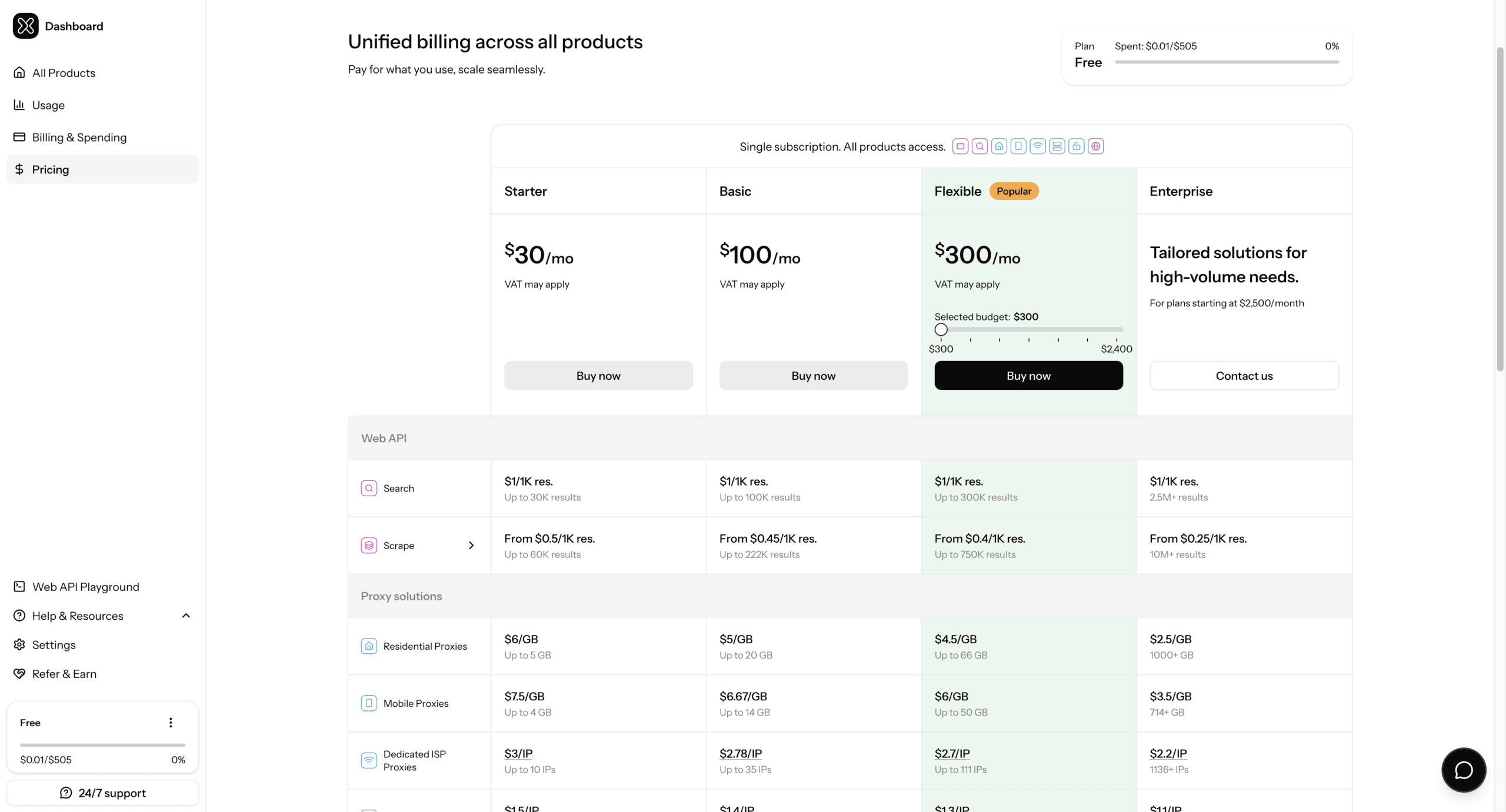
Oxylabs gives new customers $5 in free credits to try out the service.
