
Proxy Market Research 2026
Welcome to our report on the proxy server industry. It overviews the market as a whole, then benchmarks and compares major proxy networks. Proxy Market Research has been running each year since 2019.
You’ll find this report useful whether you’re a customer looking for a proxy provider, an analyst investigating the market, or a vendor evaluating where your service stands compared to established names.
This year’s report:
- Features 13 companies that cover all segments of the market.
- Overviews three proxy server types: residential, mobile, and shared datacenter.
- Describes the prevailing market trends informed by a questionnaire we sent to all participants.
- Provides large-scale performance benchmarks enriched with years of historical data.
The majority of data were collected in March and April of 2026.
Participants
Here are this year’s participants with the proxy networks we tested for the report. If you’re unfamiliar with the types of proxy servers, refer to our guide explaining their differences.
We tried to segment the participants by their target audience. Our taxonomy relied on brand messaging, pricing schemes, and enterprise-oriented features:
- Entry-level providers work best for individual or small-scale projects.
- Mid-market providers cater to a wide range of scraping, account management, and similar tasks.
- Enterprise providers focus on an integrated experience that accommodates large-scale use by teams.
| Target audience | Residential | Mobile (pool) | Datacenter (shared) | |
|---|---|---|---|---|
| NetNut | Enterprise | ✅ | ✅ | ✅ |
| Oxylabs | Enterprise | ✅ | ✅ | ✅ |
| Infatica | Enterprise leaning | ✅ | ✅ | ✅ |
| Byteful | Mid-market | ✅ | ✅ | ❌ |
| DataImpulse | Mid-market | ✅ | ✅ | ✅ |
| Decodo | Mid-market | ✅ | ✅ | ✅ |
| IPRoyal | Mid-market | ✅ | Not tested | ❌ |
| SOAX | Mid-market | ✅ | ✅ | ❌ |
| Proxyrack | Mid-market | ✅ | Not tested | ✅ |
| Rayobyte | Entry/mid-market | ✅ | ✅ | ✅ |
| Evomi | Entry-level | ✅ | ✅ | ✅ |
| ProxyEmpire | Entry-level | ✅ | ✅ | Not tested |
| Webshare | Entry-level | ✅ | ❌ | ✅ |
| Provider | Key Information | Description |
 |
| A former sneaker proxy vendor turned general purpose, Byteful focuses on tech and platform building. It was known as Ping Proxies until recently. To our knowledge, Byteful acquires ISP proxies in-house and residential IPs through an SDK, among other sources. |
 |
| A product of the Ukrainian dev house Softoria, DataImpulse runs on affordable plans with non-expiring traffic. Its sister brand is a popular search API DataForSeo. The provider sources proxies through an SDK, as well as a bandwidth-sharing app. |
 |
| Known as Smartproxy until April 2025, Decodo is a top five provider and a long-standing value choice. The company is associated with the Lithuanian Tesonet group. |
 |
| The successor of a brand called InfiniteProxies, Evomi emphasizes its Swiss roots and reliability. The provider uses an extremely flexible pricing model for its residential IPs, which are sourced through Earn.fm, an SDK, and maybe other proxy vendors. |
 |
| A company with at least three offices worldwide, Infatica can be considered a consistenly growing mid-sized provider. It openly sources IPs through an SDK, actively participates in conferences, and has been going upmarket for the last few years. |
 |
| A quickly-growing value choice with enterprise aspirations. The company’s claim to fame has been scaling pay-as-you-go residential traffic. IPRoyal maintains its own residential proxy pool through an app called Pawns. |
 |
| The only publicly traded company here and a top five proxy provider by size. NetNut focuses on serving enterprise customers that operate at scale. |
 |
| Perhaps the market leader, competing with Bright Data in the enterprise segment. Oxylabs sources IPs through partner apps Honeygain, JumpTask, and an SDK. |
 |
| A well-known brand, ProxyEmpire offers all major types of proxy servers at affordable entry points. Its major selling point is traffic that carries over subscription cycles. |
 |
| A veteran provider known for its unlimited traffic residential proxy plans. Proxyrack keeps a low profile when it comes to its team; but unlike other Hong Kong providers, it imposes strict usage terms. The company sources IPs through an SDK and proxyware. |
 |
| A former datacenter proxy powerhouse, Rayobyte now offers a broad range of products. The provider talks about enterprise but tailors its service and communication in favor of entry-level users. |
 |
| A mid-sized technologist with an international team. SOAX offers a wealth of features and a unified platform for all its products. |
 |
| A hugely popular destination for server-based proxies thanks to its flexible pricing and powerful self-service features. The company was acquired by Oxylabs in 2022, which likely supplies Webshare with residential IPs. |
🔎 Market Overview
This section provides an overview of the proxy server market. It’s based on our own observations and enriched with responses from a questionnaire we sent to all participants.
🗞️ 2025 Report: AI Continues Propelling the Market Hard
- In 2025, AI-related startups received more venture capital than all other companies, creating a US-based data infrastructure industry.
- Proxy providers also reaped the benefits, some growing 50% of more year over year.
- The plans for 2026 involved maintaining and growing capacity, as well as continuing to scale vertically.
Full version
In our previous report, we called 2024 a decent year: recessions fears had largely failed to materialize, and businesses sighed in relief as they put HR euphemisms like “operational efficiency” back into bottom drawers. At the same time, venture capital was throwing record money at AI, increasingly shoving other industries to the sidelines.
If, like some believe, artificial intelligence is growing a financial bubble, it certainly hasn’t burst yet. Reuters has made colorful comparisons about AI funding outstripping The Manhattan Project and the Apollo Program. The OECD reports that AI startups received more VC money in 2025 than all non-AI companies combined.
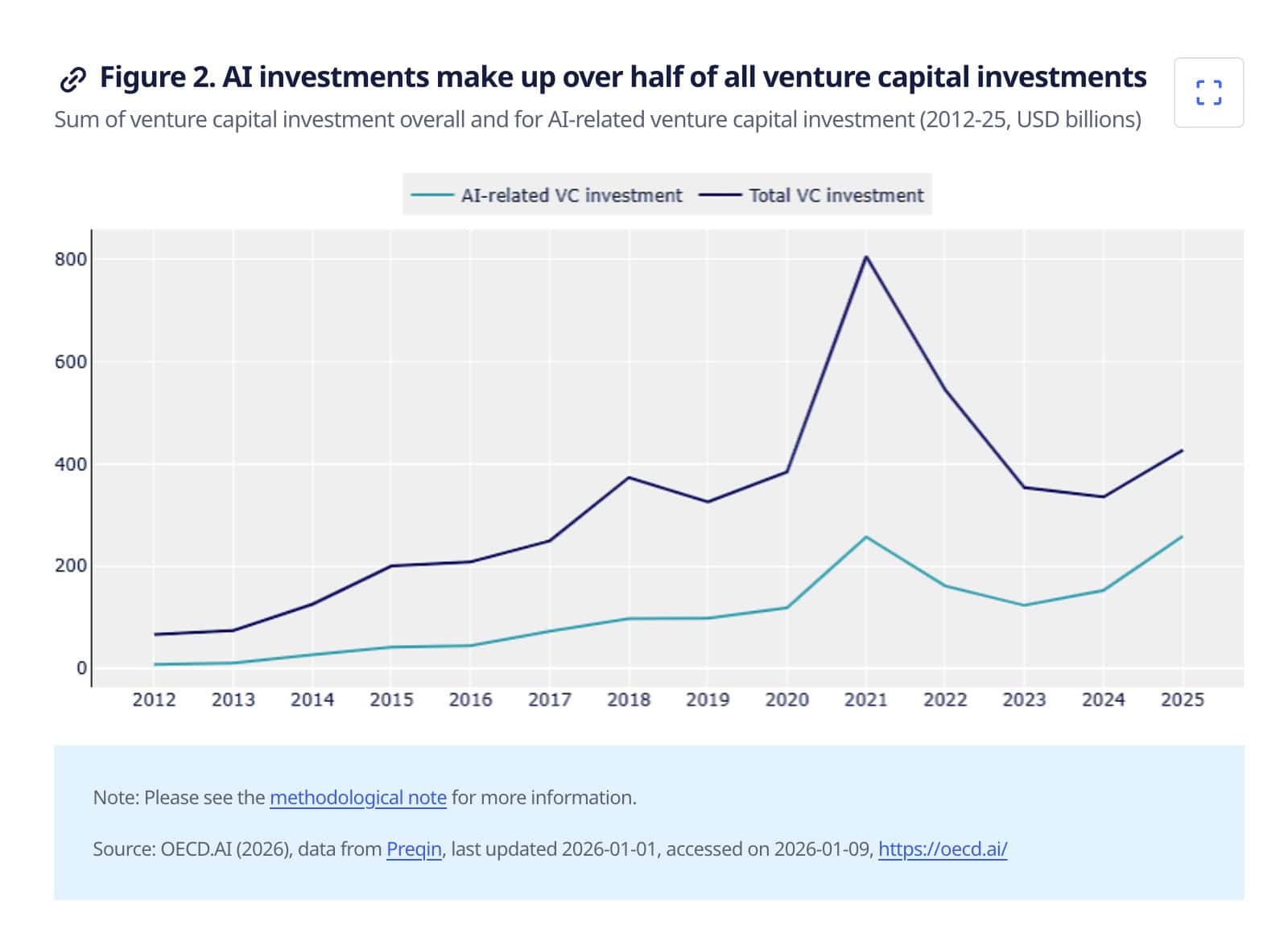
According to the same Reuters, much of this money went to hyperscalers and particularly for building out infrastructure. In the last few years, American capital has created a home-grown industry of web data, web search, and cloud browser startups like Exa, Tavily, Browserbase, Firecrawl, Parallel, and more.
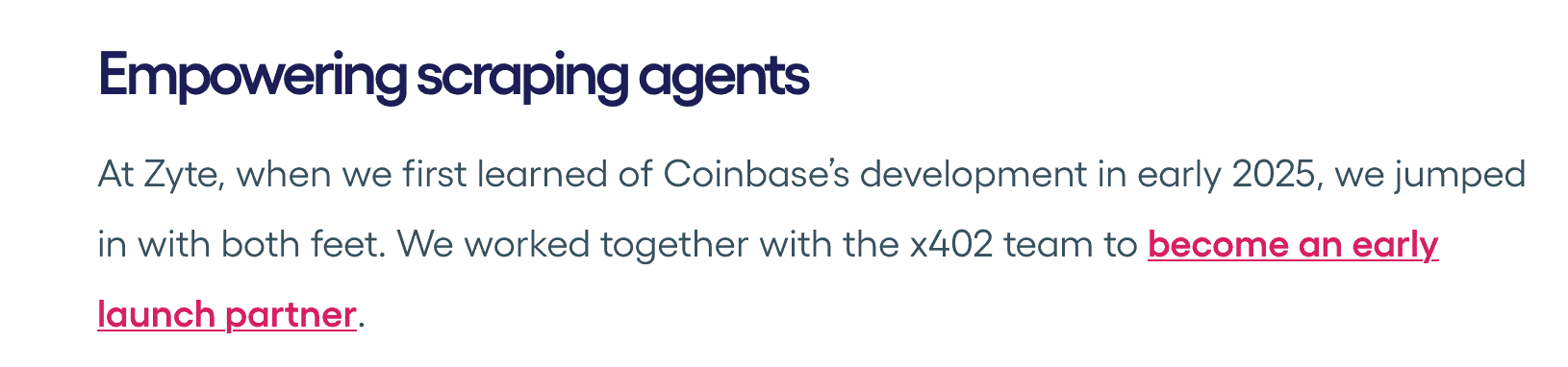
This is extremely relevant to our industry. Proxies and the overlying web-crawling-and-scraping tools power AI software every step of the way: training and retraining models, grounding their on-the-fly reasoning, and operating agentic programs. We’re frighteningly indispensable, at least until the internet powers that be find other, non-adversarial methods to ensure web access. Cloudflare, Coinbase, and more are certainly trying, but initiatives of such scale take years – even decades – to proliferate.
Does the AI boon reflect in the results of proxy providers? Absolutely! In November 2025, Bright Data announced that it was growing by 50% year-over-year thanks to AI. It reported an annualized revenue of $300M, with plans to hit $400M by mid-2026. Annualized, of course, isn’t the same as annual, as it projects yearly results based on a month’s performance – but despite this small sleight of hand, Bright Data CEO Or Lenchner’s excitement was undeniable.
NetNut, Bright Data’s peer from Israel and one of the few publicly traded major proxy providers, increased revenue by 28%. Once again, the company attributed its growth to AI customers. For the rest, we had to rely on questionnaire responses. Here’s what they had to say:
- Oxylabs, the top one or two proxy provider today, scaled exponentially: it increased headcount by 20%, growing usage and revenue further.
- Decodo increased its headcount by 15% and revenue even more.
- IPRoyal continued building on its impressive achievements of 2024, when the company made nearly 50% more revenue and doubled in size.
- Infatica significantly accelerated its growth rate compared to 2024, when the company’s MRR doubled.
- Rayobyte had the greatest revenue growth since the company’s founding, adding nearly 25% in a year.
- Webshare earned 30% more from customers compared to 2024.
- DataImpulse grew significantly both from new and scaling clients; Evomi and ProxyEmpire both had a good year; while Proxyrack described its growth as steady.
In brief, 2025 was an undeniably strong year, at least for the companies participating in our report.
Now let’s take a look at headcount figures. LinkedIn’s data can be inaccurate: Rayobyte self-reports around 50 employees, DataImpulse shares people with its sibling companies, and Proxyrack barely has a presence on the platform. But it’s the best we’ve got.
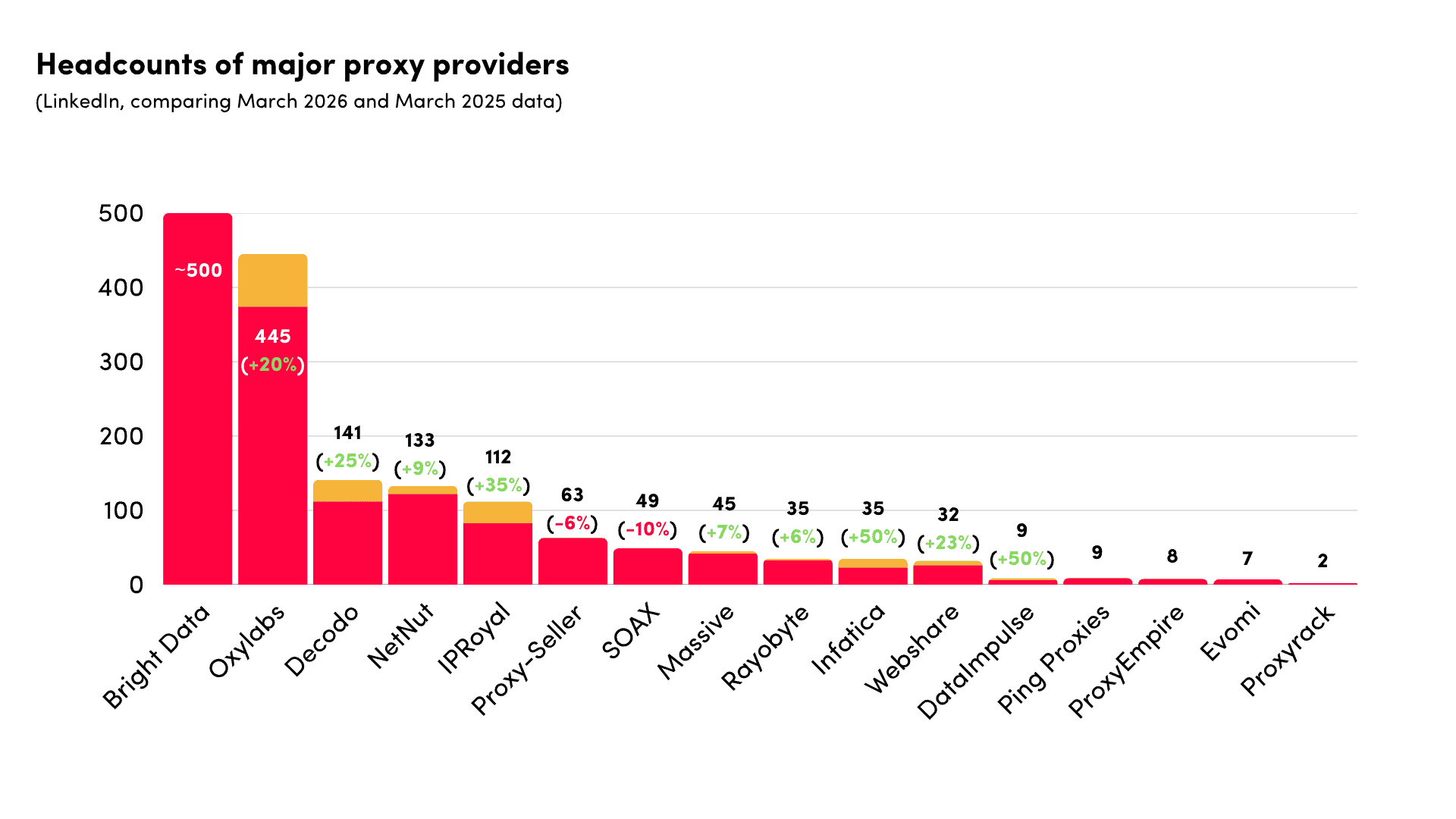
Quite a few providers scaled their labor significantly, whether in raw or percentage figures. It’s interesting that companies from Lithuania like Oxylabs, Decodo, and IPRoyal were among the biggest growers, and they now occupy three out of five top positions by this metric.
Alright, enough about the past – let’s turn our gaze to 2026. We’re no Gartner, but the economic climate is by no means certain. For one, the financial bubble concerns remain very valid: LLM providers like OpenAI continue running in the red, whereas tech giants gamble their outsized valuations on AI expectations that are extremely hard to meet.
At the same time, the US is making everything more volatile and expensive with its war in Iran. This, of course, has a much bigger impact on the physical than the digital world; but in today’s economy, everything is connected.
Startups with AI at their core will likely remain a captive audience – after all, what choice do they have? The rest, which have been FOMOd into boarding the AI train, may start treating it as a cost center rather than a future bet if the payoff isn’t big or fast enough. For now, the music plays on, and it’s darn loud indeed, so we might as well dance.
What do our respondents have in store for 2026? One prevailing trend involved expanding and maintaining capacity. It’s borne out of the needs of AI customers, which we’ll touch upon soon. The second was scaling vertically to APIs and similar scraping products. For one provider, Byteful, it was to turn its technological prowess into growth.
🗞️ Competitive Environment: Tough, But Providers Find Ways to Manage
- We identified over 50 proxy server vendors established since 2025; the majority offered residential proxies or mobile SIM card farms.
- Overall, competition has increased and remains extremely tough in lower market ranges where botnet-based services pressure prices.
- The scraper API landscape is also getting crowded, but it still offers potentially better margins and more opportunities to build a moat.
Full version
Last year, we identified over 250 active proxy server providers. Nearly a quarter of them started in 2024, showing how tough the competition was and the ease with which new brands could enter the market.
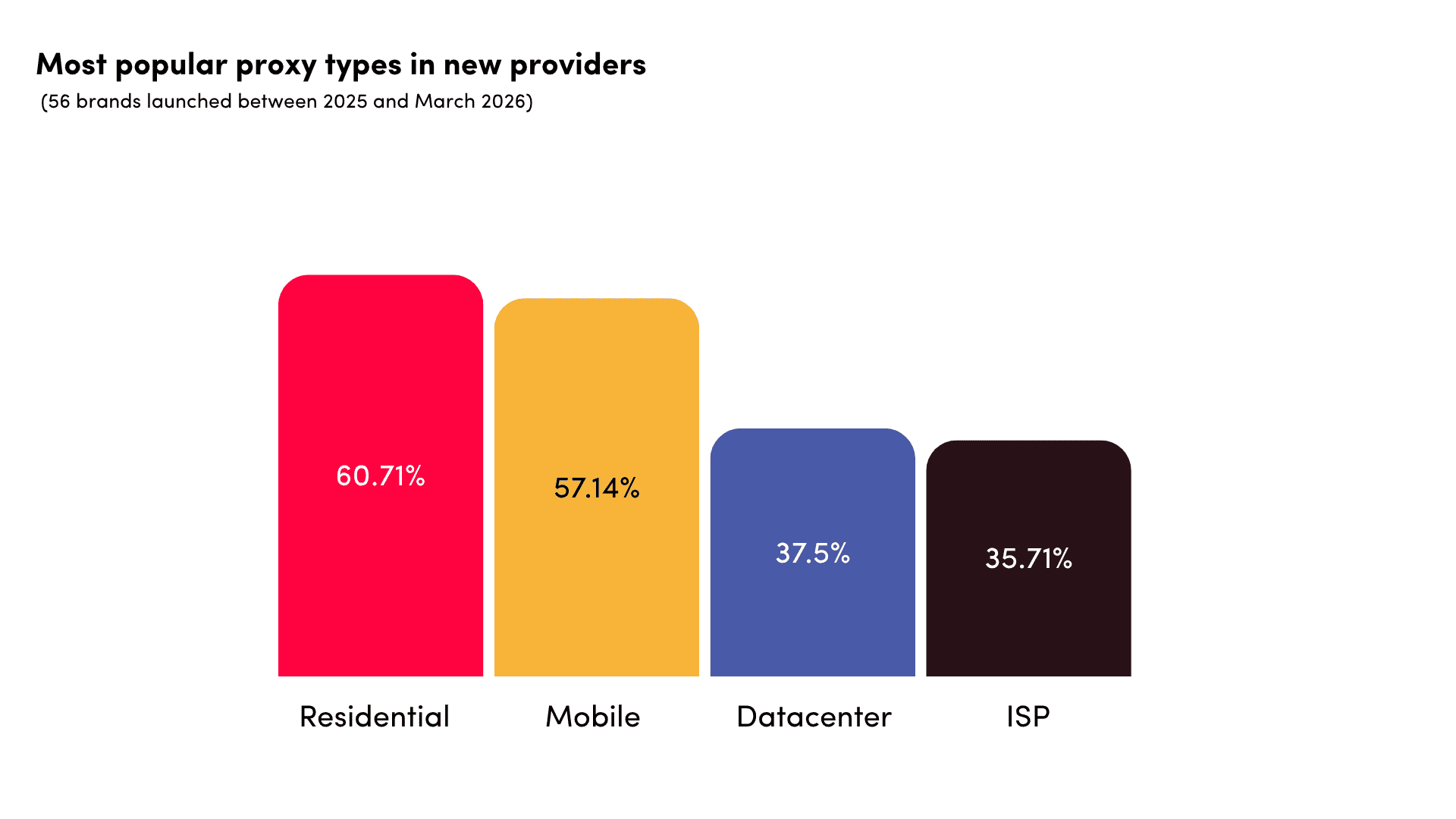
Not much has changed since then. After analyzing the same sources (Google’s buy intent keywords and the BlackHatWorld forum), we found at least 56 companies that emerged between 2025 and March 2026. The majority advertised on BlackHatWorld – Google Search these days is uncharitable to emerging brands, unless they buy ads.
60% of the new providers offered residential proxies, and nearly as many sold access to mobile IPs. However, there were stark differences between the two: the residential proxy vendors were predominantly white labels, while the mobile proxy providers often built their own dongle-based infrastructures.
The adage stands true: residential IPs are challenging to source at scale, so the market supports only 10 to 15 companies with their own networks. Even then, a half of them overlap to various extents due to sharing upstream sources. As such, very few truly unique and independent residential IP pools exist.
The general attitude towards reselling remains favorable. And while Google’s actions have impeded major botnets (we talk about this below), a dozen of their remaining storefronts continue welcoming aspiring resellers.
We expect most of these brands to close within a few years (the botnet-powered ones – even sooner) or remain in the small niches they’ve carved for themselves. However, that doesn’t have to be the case. Byteful has managed to break out of sneaker reselling; it now has a team of nine, growing usage by 16.7x and monthly recurring revenue by 100% year over year.
Naturally, our questionnaire respondents noted that competition has increased since last year. Proxyrack succinctly attributed this to three major factors: 1) more niche (and, of course, Chinese) providers entering the market; 2) larger players expanding product portfolios; and 3) price pressure across certain segments.
According to ProxyEmpire, margins have also been under pressure due to rising acquisition costs: more brands mean more competition for both virtual ads and physical space in conferences – one event has raised attendance costs by 80%. NetNut believes that market dynamics have shifted, with overall scale and volume increasingly sharply.

The interviewed providers had different strategies to compete, price rarely being the answer. One was to optimize their proxy networks and scale capacity. AI customers have huge data needs, and resellers simply can’t match them. With similar concerns in mind, Infatica and IPRoyal continue moving towards the enterprise segment, implementing relevant features like team management, and achieving certifications.
Another method to ensure growth is to move up the value chain. This process has been going on for a while; but despite operating a scraping API for multiple years, Decodo pinpointed it as a focus for the upcoming year. Rayobyte has rediscovered its API and launched an unblocking browser; NetNut identifies scrapers and datasets as a strategic direction; Infatica spoke about its transition from a proxy to a data provider; and DataImpulse is preparing to launch a scraper line-up of its own.
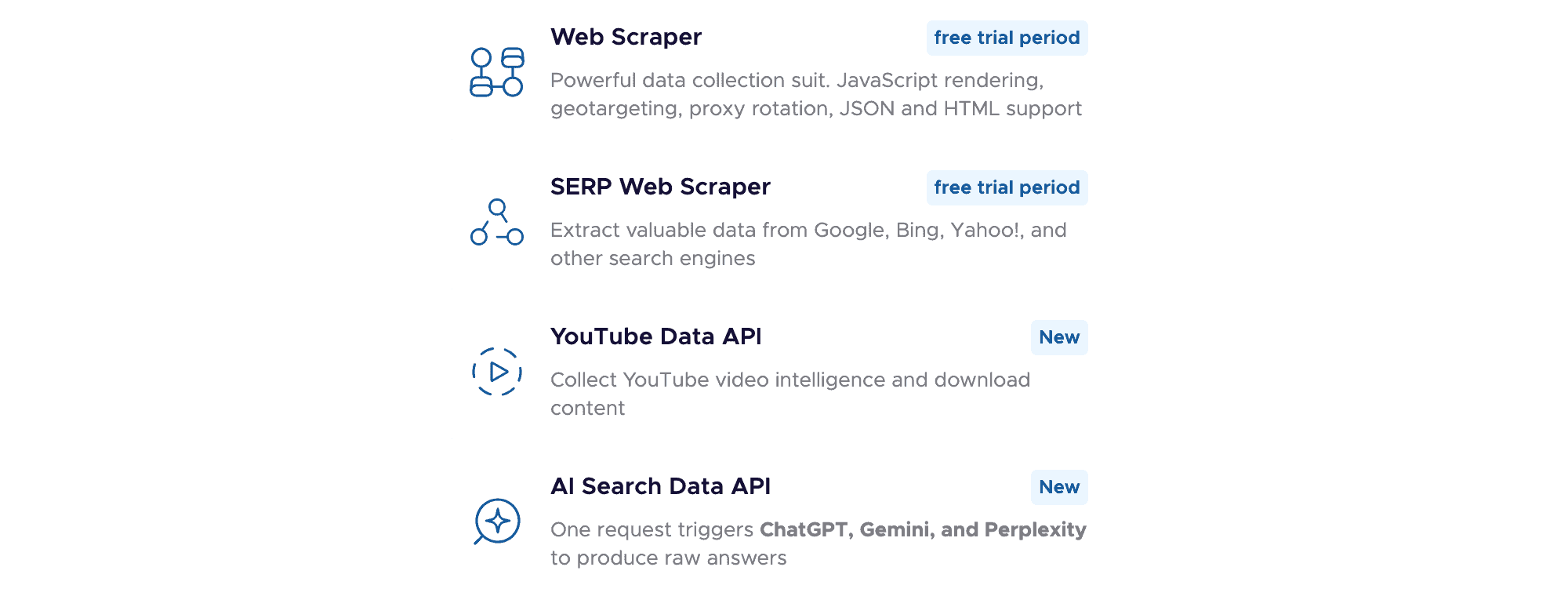
Moving up doesn’t guarantee success. As Oxylabs noticed, the space is becoming crowded, with many new and well-funded players entering the race. Still, with web scraping getting harder, APIs and similar tools offer higher margins and reward skill more.
We consider Zyte’s statement that “proxies are dead” to be wildly exaggerated. But it does have a point: for purposes like web scraping, it may become easier to just get an API than wrestle with anti-bot systems on your own.
Demand for scrapers is evident from the responses: though residential proxies contributed the most to Decodo’s and Oxylabs’ growth in nominal terms, percentage wise their main growth drivers were the APIs. Rayobyte’s scraper API generated nearly a quarter of revenue, jumping from just 2% in one year, thanks to unlocking several challenging Asian websites. And NetNut’s earnings from proxies actually fell despite the exploding usage, while scrapers & datasets grew from nothing to $10M in 2025.
On the other hand, the interchangeability of proxy networks makes it nearly impossible to build a moat. Bright Data has tried through legal means and failed; the only realistic method would rely on building resilience while external actors like Google tighten proxy server supply chains.
🗞️ Use Cases: AI Is Giving E-Commerce a Run for Its Money
- E-commerce remains the most popular use cases, and providers like Rayobyte have found opportunities to unlock its niches even further.
- However, AI has been the largest needle mover; however, while huge, the demand was unstable.
- Aside from providing data for LLMs, some participants have found success in scraping the LLMs themselves.
Full version
One question we always ask is: what are your top three use cases? The answers vary significantly in quality. One or two respondents skip the question altogether, most list their podiums as asked, and some even share the impact these verticals have on their business.
On the other hand, there’s little change in quantity, at least where the most popular use case is concerned. It’s invariably e-commerce: price comparison, sentiment analysis, and stock monitoring are always in demand.
While the e-commerce use tends to be taken for granted, it offers serious opportunities for those smart enough to unlock them. Rayobyte has experienced this first hand: most of its growth came from landing an Asian e-commerce whale. This one customer has impacted not only Rayobyte’s bottom line, but also its roadmap and positioning.
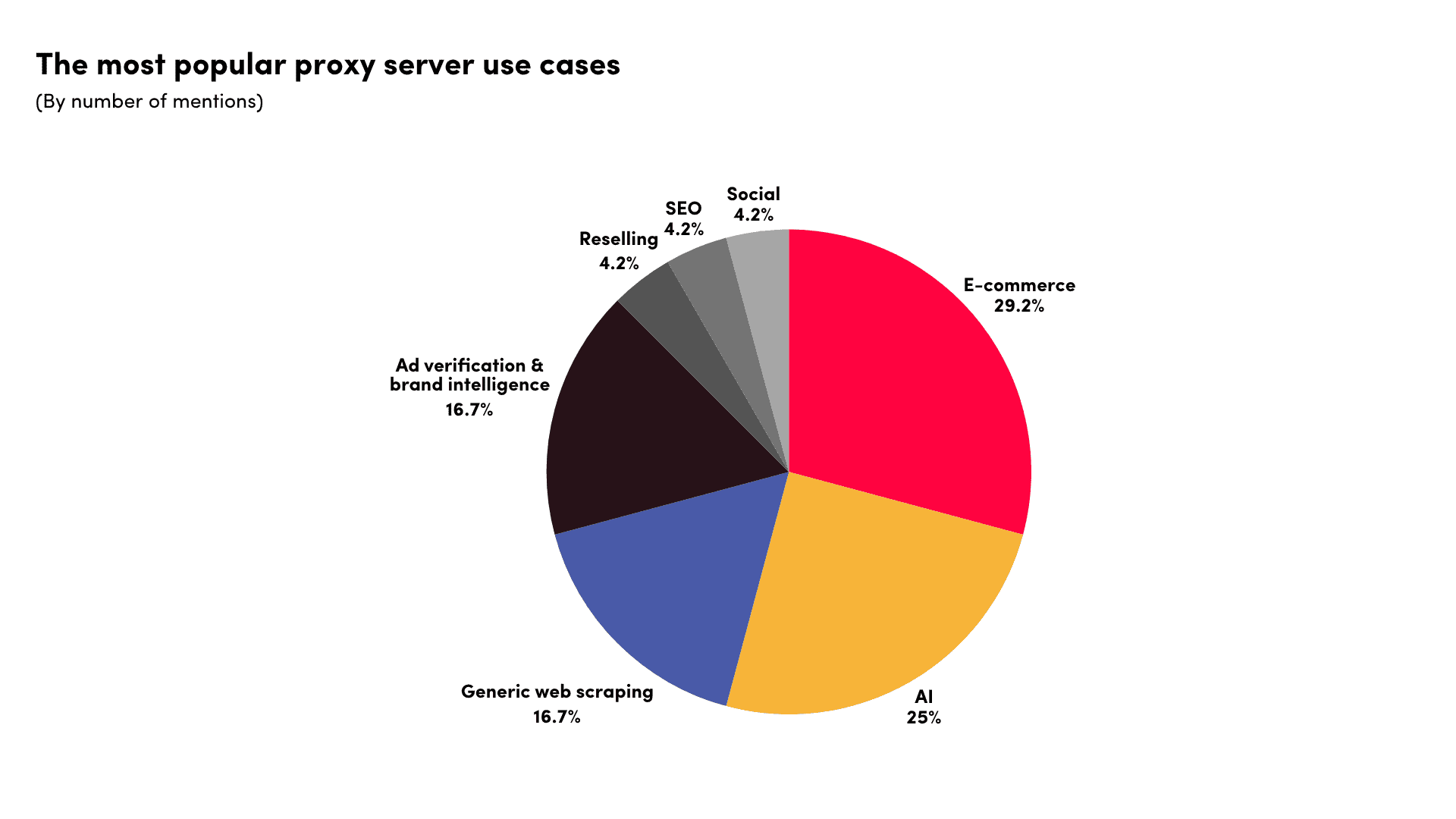
For the past few years though, everyone has had their gazes turned to artificial intelligence. One stark example is NetNut: for this provider, AI companies (however they’re classified) now take the largest share of the user base, beating even e-commerce.
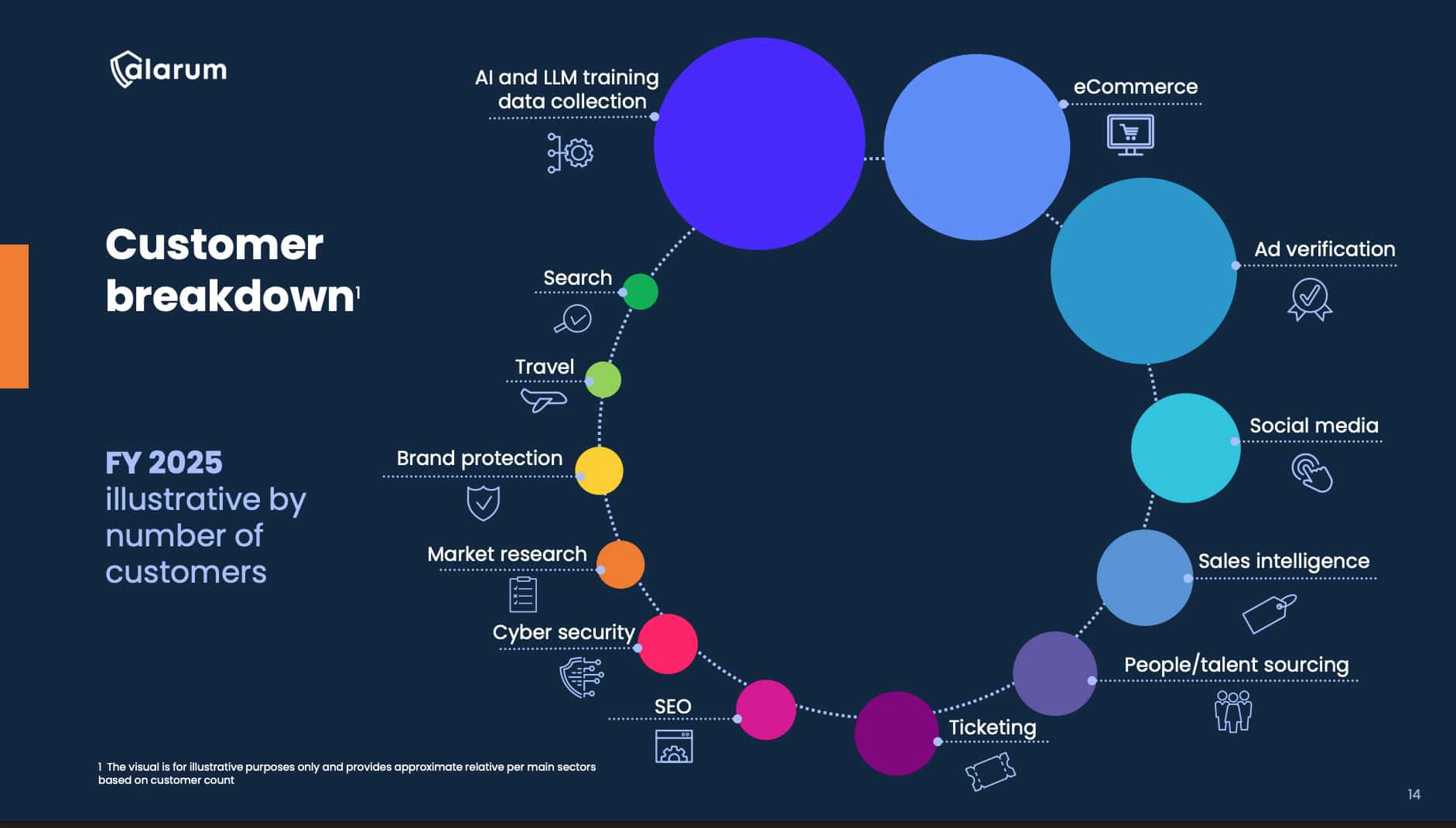
Not unlike Rayobyte, NetNut is captive to enterprise whales: in 2025, just six customers generated a half of its $40M revenue. One or more use NetNut’s services for LLM training, which is both a blessing and a curse. Their traffic needs reach tremendous proportions during the data collection phase and then subside until the next iteration. The provider defended its volatile quarterly results in an investors’ call:
At this stage of the AI build-out, demand from leading labs can move sharply quarter-to-quarter a day; one, refresh massive data sets; two, test new architectures or shift compute priorities. This volatility is normal in a market that is still in a land grab phase. As models move from research to more structured production and fine-tuning cycles, revenue patterns will naturally become smoother and more predictable.
This may sound like an excuse, but other respondents also pinpointed heavy data requirements, selective use cases, and unpredictable demand as defining current AI needs. Everyone expected this segment to accelerate, as companies move toward more frequent data refreshes and build increasingly complex real-time (both RAG and agentic) systems.
Some have found a different angle to capitalize on the AI boom. Instead of renting tools for web access or interactions, they scrape major LLMs themselves for prompt responses. Decodo reported that it had unlocked the use case of generative engine optimization, and Infatica’s multi-LLM scraper was something the company promoted a lot in its response.
To counteract the hype, Webshare provided some food for thought in its response:
- How will this impact proxy pricing, as skyrocketing volumes are pushing to optimize costs?
- The market is flooded with product innovation aimed specifically at AI customers. Will these products supplant proxy servers?
- Once the AI companies are inevitably challenged on profitability themselves, will the amount of players and the pace of investment change?
These concerns have doubtlessly crossed the minds of many web data infrastructure companies. If not, they definitely shouldn’t be overlooked.
🗞️ Proxy Types: Residential IPs Remain the Favorite, ISP Proxies Gain Ground
- Residential proxies were the top choice for all but two respondents. They address the need for higher-trust proxy servers and can be extremely affordable (though not always legitimate) in unlimited traffic formats.
- ISP proxies are proving to be a worthy successor to datacenter IPs, but their sourcing difficulties tempt providers to take shortcuts.
- Peer-to-peer mobile proxy servers remain a niche product, with some major players even discontinuing them altogether.
Full version
We couldn’t sensationalize this section even if we tried. The status quo remains unmoved from last year, or the year before – residential proxies occupy their place as the most popular proxy server type.
What we can do, though, is give you some context about the subtle market dynamics and how they affect the different kinds of proxy servers. But first, here’s a big pie chart confirming our previous statement:
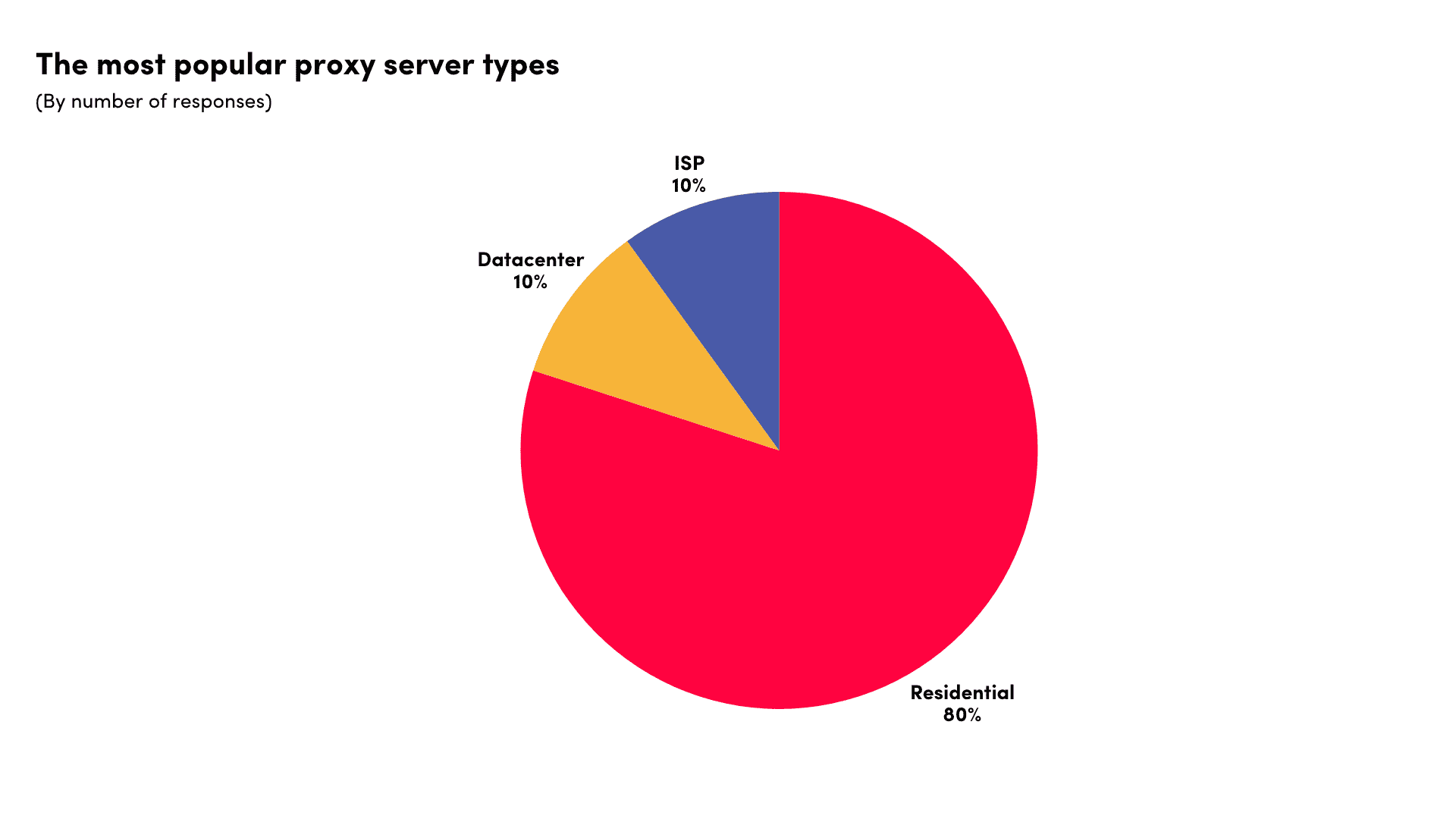
The dominance of residential proxies has well-established reasons. Their main competitor until recently, datacenter proxies, is too easy to detect by anyone that cares. The number of web scrapers and their appetites have increased exponentially, feeding the already fat market of bot detection services. And, the rates of residential traffic dropped by up to 70% between 2023 and 2025.
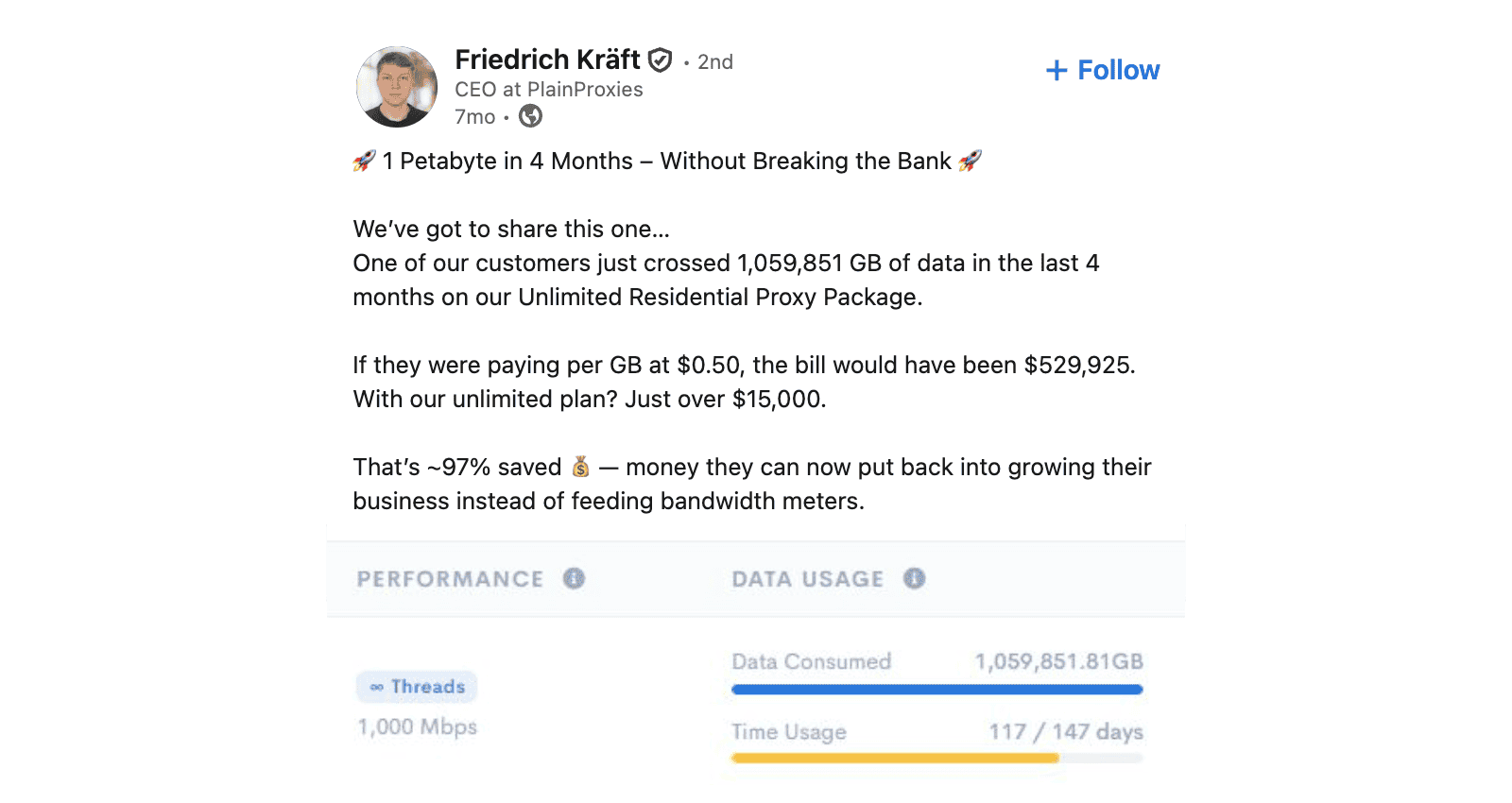
We don’t cover them here, but the Chinese (and several more) providers have further distorted the market by introducing unlimited traffic plans. Major brands are seriously disadvantaged here due to their IP acquisition costs and ethical commitments. But, as we’ll discuss later on, brands with unlimited plans have a tendency not to last long.
For Rayobyte, datacenter proxies fell from 85% of revenue in 2023 to just 42.4% in 2025. Residential proxies ate most of their share and now stand at 35%. For Byteful, where ISP proxies still bear the flag, residential proxies grew from 10% to 30-40% of the business throughout 2025. Proxyrack and DataImpulse also identified increasing customer demand for higher-trust proxy servers, which residential IPs can provide.
Few examples are able to better demonstrate the power of residential proxies than this report by GreyNoise, a popular cybersecurity company. After observing four billion malicious sessions, it came to a conclusion that it’s impossible to detect residential proxies through IP signals and static blocklists alone.

Webshare remains the holdout: datacenter proxies remain its most popular product, by far. But even here, the trend is shifting toward residential and ISP proxies, the latter being preferred due to a similar implementation and lower costs.
ISP proxies are proving to be a good substitute for datacenter IPs in general. We’re seeing signals that demand for them is growing, and major providers continue to invest in this product. Oxylabs launched dedicated ISP proxies in self-service, while IPRoyal has expanded their country coverage to 30+, enabling city and state targeting in the process.
The biggest mistake with ISP proxies is packaging them as traffic-bound rotating pools. This may be the reason why SOAX discontinued its ISP proxy service and why ProxyEmpire is seeing little demand compared to other proxy types.
But sourcing good ISP proxies is no easy feat. They’re often geo-located virtually rather than physically, and tools like ping0 can pick up the location discrepancy. Hong Kong-based proxy providers even tend to distinguish between native and broadband IPs based on this criterion, putting a premium on the former.
Futhermore, IP databases like IP2Location evaluate the nature of IPs based on who owns them and not the network they’re on, which is why they’re sometimes identified as hosting addresses. And major ISPs like AT&T have stopped leasing their IP space, thus complicating procurement.
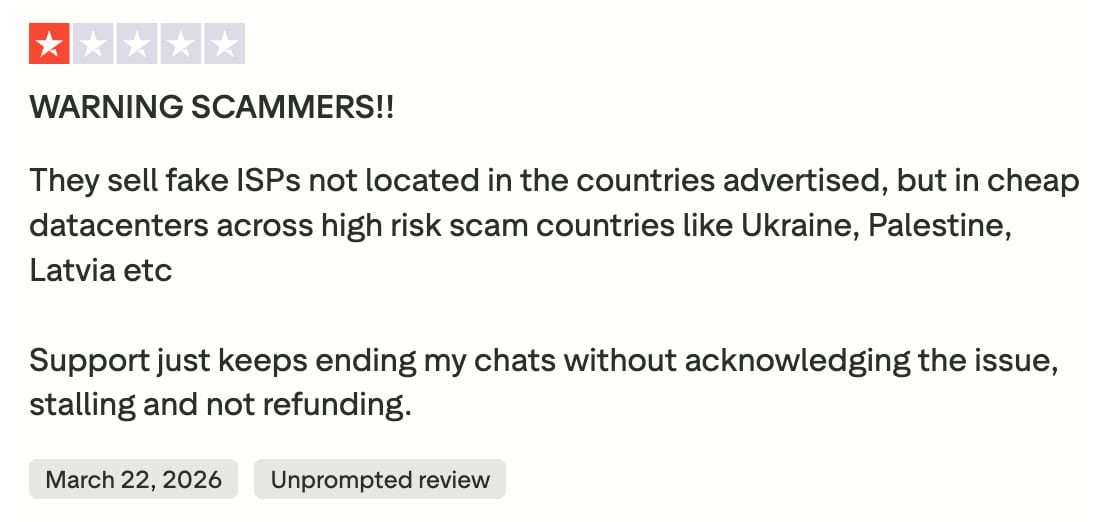
The above factors also play a role in how IP reputation feeds score proxies. While their reliability is questionable, services like Scamalytics, IPQualityScore, and Spur.us are often used by small-time buyers who need reassurance. At the time of writing, one provider’s Trustpilot page was full of negative reviews for failing to meet these high expectations.
The mobile proxy front remains stable. Major providers still won’t adopt SIM card farms, though we are seeing some movement here: Proxidize and Rayobyte have packaged them into affordable rotating pools for web scraping.
Peer-to-peer mobile proxies remain relegated to high-value niches, seeming more as a filler or a me-too product than a needle mover. In fact, Bright Data discontinued its mobile proxy product in April 2026:

🗞️ Prices: No Longer in Freefall – at Least for Residential Proxies
- Residential proxy rates have stabilized among major providers and even started to revert compared to 2025 .
- This doesn’t apply to the grey market, where a gigabyte can cost $0.30 or even less.
- Mobile proxies, on the other hand, have experienced steep price cuts, reaching as far as 98%.
Full version
The market has truly grown a lot, but proxy providers couldn’t fully enjoy this. That’s because between 2023 and 2025, the rates of residential proxies contracted by up to 75%. In other words, to maintain the same revenue, you had to move two to three times the traffic – or even more to cover extra operational and acquisition costs.
In early 2026, it looks like the situation with residential proxies has stabilized and even started to revert. Here’s how their rates have changed over time, with 2023 as the reference point:
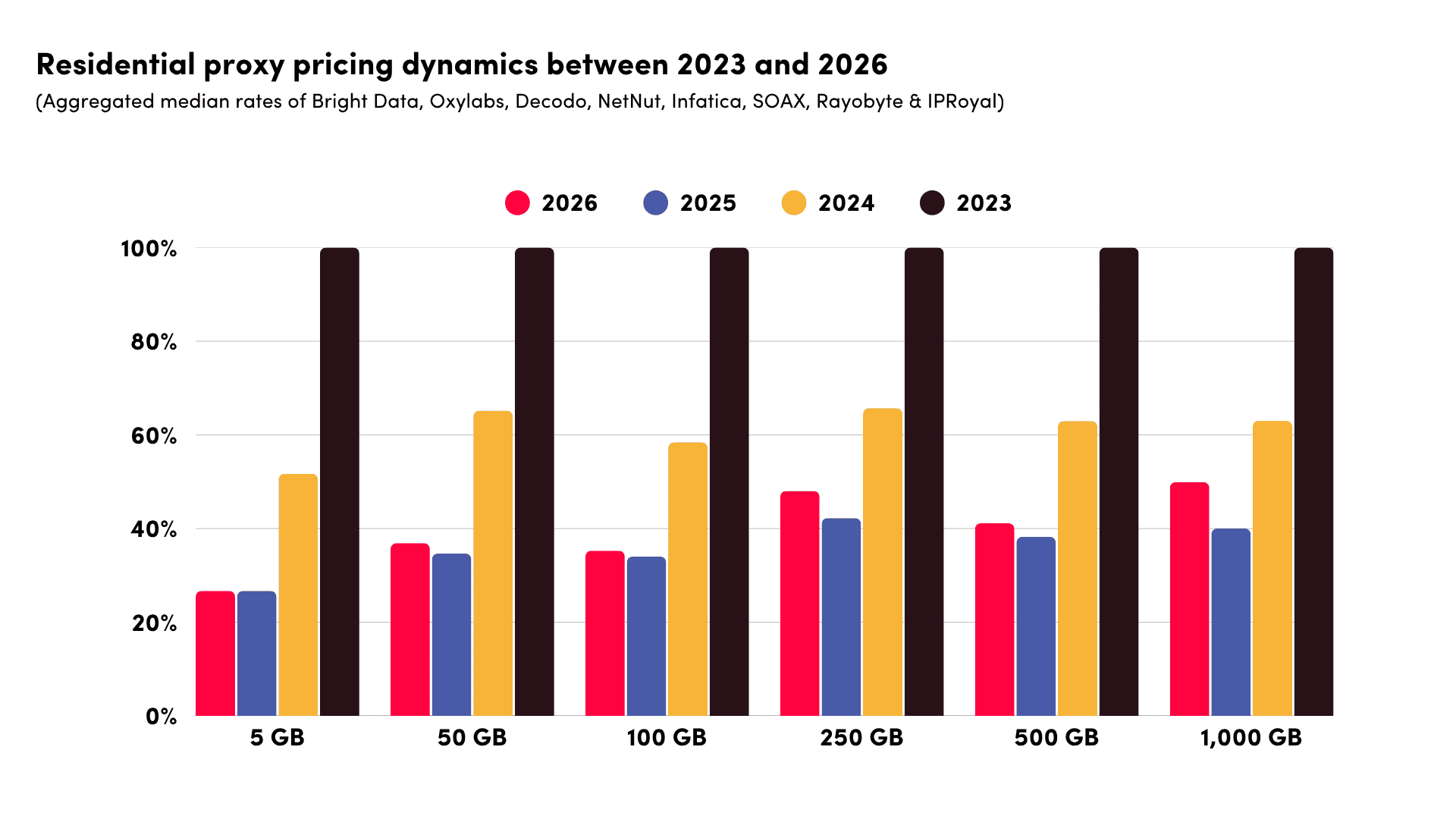
More specifically, providers like IPRoyal, Decodo, Oxylabs, and Massive have removed their long-running 40-50% coupon codes. Whereas Decodo and Oxylabs revised their permanent plans, making them ~25% cheaper than the original price, IPRoyal simply reverted to pre-coupon rates.
The price floor has risen, too. Oxylabs, Massive, and SOAX hid or discontinued their pay-as-you-go plans, increasing the entry points by up to twenty-five times.
The situation is different for resellers and entry-level providers for whom budget-conscious users make the most of their clientele. For example, ProxyEmpire and Webshare have halved their rates compared to last March. But they have services like FlashProxy and various storefronts of botnet-sourced proxies to compete with, where a gigabyte often runs under $0.50, reaching $0.15 at its lowest.
On the other hand, the prices of rotating mobile proxies continue reaching new lows. Like we wrote in previous reports, this product had lost its aura of superiority, and there was no reason to keep it two or even three times more expensive than residential proxies.
It even looks like we’ve reached a conceptual shift: with Rayobyte cutting rates by up to 98%, and Proxidize with Proxyrack charging less than $2/GB, mobile proxy pools sometimes cost less than their residential counterparts. This would’ve been unthinkable back in 2023, yet here we are.
When asked, most respondents expected prices to stabilize. IP sourcing and infrastructure costs create a natural floor. According to DataImpulse, going lower compromises the ability to maintain and scale high-quality infrastructure, a trade-off which only commodity and grey-market providers can accept. According to IPRoyal, realistic ways to work around the price floor are through scale, operational efficiency, and retention rather than discounts.
Byteful noted that ISP proxies have even less leeway when it comes to price. There’s only so much room above raw inputs like IP address leasing, servers, and bandwidth expenses. The cost of quality static ISP proxies has remained steady – providers are simply changing the optics by advertising shared models or sometimes selling multi-tenant IPs as dedicated proxies.
🗞️ The Hairy Part: Botnets, Vulnerabilities in Proxy Networks, and the Culling of Chinese Providers
- The past few years have surfaced multiple high-profile botnets, including BADBOX, Aisuru, and Kimwolf. The latter has found a way to spread through residential proxy networks.
- Google has taken action against 10+ Chinese proxy providers, but twice that number is still active.
- The backlash to botnets has made it harder to source residential proxies, especially through Android’s Play Store.
Full version
The least thankful jobs in the proxy server industry are those of brand and risk managers. No matter how well you polish your veneer or how many certifications you achieve, the shady back-alleys always find a way to deface the industry.
Unfortunately, the past few years have been extremely eventful in this regard. The BADBOX botnet appeared in 2023; it affected Android TV boxes, tablets, and other compromised devices. Despite Germany’s efforts to disrupt it in late 2024, BADBOX’s second iteration grew to 10 million devices. Google sued its operators in July 2025.
Another botnet, Aisuru, also fed on unprotected IoT hardware. According to Cloudflare, it comprised between one and four million devices and wrecked havoc throughout 2025 with record-breaking DDoS attacks. In addition to taking down websites, it monetized the network as a residential proxy service.
An Android-focused variation of Aisuru, Kimwolf, got even more insidious. The IP intelligence service Synthient discovered that it had found a way to spread through other residential proxy networks and even access other devices on their local networks. By January 2026, Kimwolf had amassed a fleet of over two million devices throughout the world.
In March, a joint effort by the authorities in the US, Canada, and Germany once again disrupted Aisuru, Kimwolf, and several other botnets. However, their nature and the vulnerable state of infected devices make it very hard to stop the spread of botnets for good.

Kimwolf et al. have brought a lot of negative press – it’s reached as far as the FBI which published a bulletin warning about residential proxy networks.
The Chinese providers got hit the hardest: after their viral spread throughout 2022-2025, a dozen of popular brands like 922Proxy and LunaProxy got shut down by none other than Google. The search giant contended that they were all storefronts of IPidea, a large Chinese proxy server vendor which facilitated the botnets and enabled various bad actors.
Even after the culling, the market continues to hold over a dozen China-related brands, many of which effectively mirror those removed:
The state of Chinese proxy server brands
| Shut down | Functioning (non-exhaustive) |
| ipidea.io lunaproxy.com ABCproxy.com cherryproxy.com piaproxy.com pyproxy.com 922proxy.com ip2world.com tabproxy.com | smartproxy.org thordata.com 911proxy.com novada.com omegaproxy.com aproxy.com proxylite.com bestproxy.com swiftproxy.net proxy.cc proxyshare.com proxy4free.com lumiproxy.com naproxy.com cliproxy.com luckproxy.com |
Not everyone got hurt. According to Krebs, the operators of Kimwolf monetized infected devices through the Byteconnect residential proxy SDK, which is also related to the provider Plain Proxies.
Unlike IPidea, which at least communicated with security researchers and attempted to patch its vulnerability, the founders of Plain Proxies reportedly ignored all outreach attempts. What’s more, they reportedly continued benefitting from the botnet.
Other major providers were also affected and have taken steps to mitigate their security flaws. For customers, this means that some vendors have started requiring a KYC procedure to access ASN targeting, or that they’ve removed this feature altogether.
In general, the backlash to botnets has made it harder to source residential proxies, as Google has tightened Play Store requirements. It’s also increased the importance of conscious proxy sourcing and use; though more providers have begun advertising ethical IP sourcing, simply claiming that something is the case doesn’t make it real.
It’s time to get serious about governance, especially when the stakes are rising this fast.
📈 Provider Benchmarks & Comparison
This section compares the participants in key metrics.
Many of our graphs are interactive. You can hover on labels to highlight them or click to hide.
⚙️ Testing Methodology
The tabs below describe the benchmarks we ran for this report. They differ by proxy type – residential proxies underwent the most thorough testing.
Be aware that we asked all participants for access and shared the methodology doc in advance. It’s a good idea to treat what you see as their best rather than default configuration.
Our main benchmark measures the pool size, success rate, and response time at the same time, making it hard to hyper-optimize for all metrics.
This is our main benchmark. It serves a dual purpose. First, it aims to check how many unique IPs a provider’s proxy network contains. At the same time, it measures the speed and success rate when connecting to a small page that doesn’t block requests.
⚙️ Parameters
- Scraper: custom Python script
- Target: endpoint of a global CDN. The page weighs ~6KB and accesses a data center nearest to the proxy server.
- Geolocation data: latest IP2Location, MaxMind, IPinfo databases.
- Residential/mobile IP percentage: IP2Location’s Usage type data point, ISP and/or MOB IPs.
🏠 Residential proxies
| Proxy location | Days | Total requests | Testing server |
| Global | 21 | 3.6M (180k/day) | DE |
| EU (DE, ES, FR, IT, NL) | 14 | 1.2M (80k/day) | DE |
| US | 14 | 1.2M (80k/day) | US |
| UK | 14 | 560k (40k/day) | DE |
| India | 14 | 560k (40k/day) | SG |
| Brazil | 14 | 560k (40k/day) | US |
| Australia | 7 | 140k (20k/day) | SG |
📱 Mobile proxies
| Proxy location | Days | Total requests | Testing server |
| Random | 14 | 1.2M (80k/day) | DE |
| EU (DE, ES, FR, IT, NL) | 14 | 560k (40k/day) | DE |
| US | 14 | 280k (20k/day) | US |
| UK | 14 | 280k (20k/day) | DE |
| India | 14 | 280k (20k/day) | SG |
| Brazil | 14 | 280k (20k/day) | US |
| Australia | 7 | 140k (20k/day) | SG |
🏢 Datacenter proxies
| Proxy location | Days | Total requests | Testing server |
| US | 7 | 70,000 (10k/day) | US |
This benchmark aims to evaluate the proxy networks in more realistic conditions. It has too many variables (such as the scraper’s quality and changes in bot protection) to be reliable on its own. However, the test has value when comparing providers under the same conditions.
⚙️ Parameters
- Scraper: custom HTTPX script for Amazon, headless browsers for Google & Instagram.
- Rate: 1 request per second.
- Request validation: response code, HTML size, page title
Targets (🏠, 📱, 🏢)
| Website | Proxy location | Testing server | Requests |
| Amazon | US | US | 5,200 (1,800 * 3 tests) |
We also run a collection of smaller benchmarks to test various aspects of the proxy networks. The brackets indicate which product the benchmark applies to.
Download speed (🏢)
| Tool | Testing server | IPs checked |
| Hetzner’s 100 MB & 1 GB speed tests | US | At least 10 |
IP quality (🏠)
This benchmark uses popular third-party tools to measure how many IPs they’ve flagged as residential or carrying a high risk score.
| Tool | Checks (US) | Checks (Global) |
| IPinfo | 10,000 | 20,000 |
| Scamalytics | 10,000 | 20,000 |
Infrastructure performance with larger pages (🏠)
This test targets an endpoint of a global CDN. It downloads a 2 MB package from a data center nearest to the proxy server.
| Proxy location | Requests | Testing server |
| Global | 15,000 | DE |
| US | 5,000 | US |
Session persistence (🏠)
This benchmark measures how long proxy peers remain online. We establish a sticky session and send requests every 20 seconds until 30 minutes pass or the IP changes.
| Target | Proxy location | Session count | Testing server |
| http://icanhazip.com | US | 330 | US |
Proxy operating system (🏠)
This test tries to determine which types of devices (Windows, Android, iOS, etc.) comprise a provider’s proxy pool. It’s based on zardaxt’s passive fingerprinting tool.
| Target | Proxy location | Proxies checked |
| Our own domain | Global | 500,000 |
🏠 Residential Proxies
Residential proxies are devices connected to consumer internet service providers like Comcast and Sky. These devices can be computers, phones, TVs, and, it turns out, even smart picture frames.
Residential proxies are the preferred proxy server type for accessing protected websites like Google or Shopee.
🌐 Proxy pools
- Advertised pool size: median – 54 million, largest – 175 million (Oxylabs)
- Global pool: most unique IPs – 3,241,404/3.6 million (Oxylabs)
- US pool: most unique IPs – 961,218/1.2 million (Decodo)
📊 Infrastructure success rate
- Global pool: median – 99.28% (-0.28% YoY), best – 99.93% (Oxylabs).
- US pool: median – 99.12%, best – 99.92% (SOAX)
- Any pool: best – 99.96% (Oxylabs’ Australian proxies)
⏱️ Infrastructure response time
- Global pool: median – 0.93 s (0 s YoY), best – 0.41 s (Byteful)
- US pool: median – 0.80 s, best – 0.39 s (Evomi)
- Any pool: best – 0.33 s (DataImpulse’s UK, EU proxies)
🎯 Target benchmarks (Amazon, Google, Instagram)
- Success rate: median – 74.43%, best – 81.23% (Byteful)
- Response time: median – 3.21 s, best – 2.58 s (DataImpulse)
⚙️ Features
- Targeting options: city – 13/13, ASN – 8(10)/13, ZIP/coordinates – 5/13
- Protocol support: SOCKS5 – 12/13, UDP – 3(8)/13
- Access methods: IP whitelisting – 9(10)/13, sub-users – 7(8)/13
- New developments: IPv4/IPv6, OS filters, more flexible rotation behavior
💵 Pricing
- Entry point: median – $4
- 5 GB rates: median – $3.75/GB
- 50 GB rates: median – $3.00/GB
- 500 GB rates: median – $2.25/GB
Advertised proxy pools
| Advertised pool size | Yearly change | |
|---|---|---|
| Oxylabs | 175,000,000 | N/A |
| SOAX | 155,000,000 | N/A |
| Decodo | 115,000,000 | N/A |
| Dataimpulse | 90,000,000 | +500% |
| NetNut | 85,000,000 | N/A |
| Webshare | 80,000,000 | +167% |
| Evomi | 54,000,000 | N/A |
| Rayobyte | 40,000,000 | +11% |
| Byteful | 35,000,000 | N/A |
| Infatica | 35,000,000 | +133% |
| IPRoyal | 32,000,000 | N/A |
| ProxyEmpire | 30,000,000 | N/A |
| Proxyrack | 5,000,000 | N/A |
Residential proxy pools continue to inflate. In some cases, they’ve reached absurd proportions: Bright Data, which isn’t participating this year, would be number three by population as a country!
Unique IPs in the unfiltered (Global) pool
3.6M requests over 21 days (180k/day)
Oxylabs had an impressive number of unique IPs, closely followed by Decodo and then NetNut. In fact, most participants returned over 1.5M proxies during the three weeks of testing, which is impressive in its own right.
We have three further observations from this test:
1) DataImpulse continues to package its Premium pool as the filtered version of the regular product, prioritizing quality over quantity. It’s a curious strategy that goes against established norms.
2) SOAX only returns IPs from countries around the requester’s location, even after removing all pool filters. Our server was in Europe, so we only got European IPs. We had to rerun the benchmark using an undocumented parameter.
3) IPRoyal’s proxy pool included over 900k US IPs associated with little-known ASNs belonging to Comcast. By the time we processed the data, Comcast had already made some of the ASNs inactive. This sounds suspiciously familiar to BGP hijacking.
Unique IPs in country-filtered pools
US, EU: 1.2M requests over 14 days, AU: 140k over 7 days, the rest: 560k over 14 days
Our benchmarks with country-filtered pools surfaced the same top three providers, but it notably rearranged the rest. Webshare and SOAX moved up, while Infatica and Rayobyte descended, which shows a smaller presence in Tier 1 countries. We have to commend Byteful and ProxyEmpire for their strong coverage.
Percentage of residential IPs
IP2location database, ISP or MOB usage type
| Provider avg. | Global | US | UK | EU | BR | IN | AU | |
|---|---|---|---|---|---|---|---|---|
| Byteful | 98.68% | 98.58% | 99.14% | 98.70% | 98.81% | 99.08% | 98.11% | 98.34% |
| Webshare | 98.67% | 98.88% | 98.77% | 98.61% | 98.54% | 99.07% | 98.17% | 98.65% |
| Infatica | 98.30% | 98.31% | 98.99% | 97.33% | 99.05% | 98.79% | 97.28% | 98.36% |
| Decodo | 98.29% | 98.97% | 97.08% | 98.09% | 98.51% | 99.19% | 98.07% | 98.15% |
| Rayobyte | 98.23% | 98.16% | 98.63% | 98.05% | 98.89% | 98.64% | 97.23% | 98.04% |
| Oxylabs | 98.21% | 99.01% | 96.38% | 98.19% | 98.57% | 99.22% | 98.15% | 97.95% |
| SOAX | 98.08% | 97.39% | 99.37% | 99.72% | 99.17% | 97.95% | 94.12% | 98.81% |
| IPRoyal | 97.93% | 86.77% | 99.68% | 99.95% | 99.49% | 99.82% | 99.94% | 99.85% |
| ProxyEmpire | 97.92% | 96.63% | 99.00% | 98.70% | 98.87% | 98.34% | 95.25% | 98.67% |
| DataImpulse Premium | 97.59% | 96.69% | 94.93% | 99.02% | 98.39% | 98.78% | 95.95% | 99.38% |
| Evomi Premium | 97.30% | 97.62% | 94.72% | 98.05% | 97.41% | 98.66% | 95.92% | 98.72% |
| NetNut | 94.84% | 95.90% | 94.02% | 94.88% | 93.54% | 98.16% | 96.19% | 91.16% |
| DataImpulse | 93.26% | 91.77% | 86.94% | 94.17% | 91.34% | 98.28% | 94.84% | 95.50% |
| Proxyrack | 92.20% | 96.23% | 87.47% | 87.99% | 84.51% | 97.73% | 97.17% | 94.28% |
Some participants had a noticeable share of proxies identified as hosting, business, or even military IPs – anything but residential or mobile addresses. Proxyrack and DataImpulse were the worst offenders; the latter has a toggle to improve IP quality which we didn’t use.
Pool compositions by IP protocol
Unfiltered (Global) proxy pools
Without applying special filters, IPv4 remains the dominant IP protocol. At most, IPv6 constituted up to a quarter of proxy pools, with providers like Evomi remaining IPv4 purists.
Pool compositions by OS
Up to 500k unique IPs per provider
Android devices are the primary hosts of residential proxies. Proxyrack and Infatica were the only participants that had more desktop devices running Windows. Decodo and Oxylabs had a notable share of those as well, but they may not be enabled in default self-service configurations.
The residential proxy data point draws from IPinfo’s data. It shows how many IPs the database identifies as residential proxies. To get the average fraud score, we used Scamalytics. The tool doesn’t specify how exactly it determines its scores.
Full disclosure: we don’t completely trust IP checkers and recommend using them as supplementary data sources, at best.
Global pool
20,000 checks per provider
| Residential proxy | Avg. risk score | |
|---|---|---|
| IPRoyal | 16.70% | 1.95 |
| SOAX | 27.85% | 3.2 |
| Oxylabs | 27.94% | 2.61 |
| Decodo | 29.72% | 2.6 |
| Webshare | 33.61% | 2.47 |
| Byteful | 37.09% | 2.61 |
| Infatica | 44.75% | 2.91 |
| Rayobyte | 47.66% | 4.36 |
| ProxyEmpire | 48.24% | 5.81 |
| DataImpulse | 49.61% | 3.9 |
| Evomi Premium | 50.88% | 3.72 |
| Proxyrack | 53.38% | 3.02 |
| NetNut | 56.09% | 5.98 |
In a surprising turnaround since last year, IPRoyal had the cleanest IP pool with two different databases. The bottom performers were around twice more detectable than those at the top.
US pool
10,000 checks per provider
| Residential proxy | Avg. risk score | |
|---|---|---|
| IPRoyal | 24.25% | 6.49 |
| Oxylabs | 42.89% | 9.9 |
| SOAX | 42.96% | 9.15 |
| Decodo | 47.41% | 8.97 |
| Proxyrack | 48.13% | 11.61 |
| Byteful | 48.62% | 10.33 |
| NetNut | 49.24% | 13.07 |
| Webshare | 50.22% | 10.42 |
| DataImpulse | 52.38% | 9.84 |
| ProxyEmpire | 52.55% | 10.07 |
| Rayobyte | 52.59% | 10.67 |
| Infatica | 52.64% | 10.25 |
| Evomi Premium | 52.85% | 10.1 |
US-only pools displayed similar results, though they were more abused (or simply detectable) in general.
Infrastructure success rate
| wdt_ID | wdt_created_by | wdt_created_at | wdt_last_edited_by | wdt_last_edited_at | Provider | Global | US | UK | EU | BR | IN | AU |
|---|---|---|---|---|---|---|---|---|---|---|---|---|
| 1 | Oxylabs | 99.93 | 99.40 | 99.94 | 99.85 | 99.68 | 99.59 | 99.96 | ||||
| 2 | Decodo | 99.92 | 99.32 | 99.84 | 99.90 | 99.63 | 99.86 | 99.81 | ||||
| 4 | DataI Premium | 99.82 | 99.63 | 99.16 | 99.91 | 99.93 | 99.68 | 99.79 | ||||
| 5 | SOAX | 99.78 | 99.92 | 99.72 | 99.87 | 99.87 | 99.86 | 99.89 | ||||
| 6 | Data Impulse | 99.74 | 99.44 | 99.68 | 99.79 | 99.53 | 99.62 | 99.91 | ||||
| 7 | Byteful | 99.69 | 99.08 | 99.69 | 99.87 | 99.51 | 99.59 | 99.58 | ||||
| 8 | Evomi Premium | 99.58 | 99.56 | 99.63 | 99.30 | 99.28 | 99.61 | 99.66 | ||||
| 10 | Webshare | 99.28 | 98.92 | 99.58 | 99.25 | 99.02 | 99.48 | 99.57 | ||||
| 11 | Proxy Empire | 98.17 | 99.16 | 99.58 | 99.70 | 99.03 | 99.48 | 99.50 | ||||
| 12 | Rayobyte | 98.02 | 98.76 | 99.44 | 97.13 | 97.18 | 99.69 | 99.49 | ||||
| 13 | Infatica | 97.57 | 97.00 | 98.89 | 96.30 | 96.54 | 97.50 | 99.22 | ||||
| 14 | Proxyrack | 96.73 | 95.20 | 98.06 | 96.62 | 96.48 | 96.58 | 98.67 | ||||
| 15 | IPRoyal | 96.11 | 98.48 | 97.70 | 96.41 | 97.87 | 93.57 | 99.24 | ||||
| 16 | NetNut | 95.28 | 98.23 | 96.36 | 97.09 | 98.31 | 98.24 | 98.14 |
| 2026 | vs 2025 | vs 2024 | vs 2023 | |
|---|---|---|---|---|
| Oxylabs | 99.93 | 0.03 | 0.11 | 0.32 |
| Decodo | 99.92 | 0.06 | 0.24 | 0.49 |
| SOAX | 99.78 | 0.05 | 1.29 | 0.75 |
| DataImpulse | 99.74 | 0.08 | 1.05 | 0.08 |
| Webshare | 99.28 | -0.30 | ||
| Rayobyte | 98.02 | -1.45 | -0.99 | -0.32 |
| Infatica | 97.57 | 2.40 | 0.45 | 1.62 |
| IPRoyal | 96.11 | -3.45 | -2.11 | 6.55 |
| NetNut | 95.28 | -3.12 | -2.87 | 1.76 |
Most residential proxy networks connected reliably over 99% of the time. Aside from the leaders Oxylabs and Decodo, SOAX worked very well, and DataImpulse punched above its price.
On the other hand, NetNut and Infatica continue having issues with our benchmark. IPRoyal has regressed significantly, as well – it easily cleared 99% one year ago.
Infrastructure response time
– Global pool
– US pool
Average response time
| wdt_ID | wdt_created_by | wdt_created_at | wdt_last_edited_by | wdt_last_edited_at | Provider | Global | US | UK | EU | BR | IN | AU |
|---|---|---|---|---|---|---|---|---|---|---|---|---|
| 1 | Byteful | 0.41 | 0.53 | 0.35 | 0.34 | 0.64 | 0.51 | 0.47 | ||||
| 2 | Data Impulse | 0.97 | 0.49 | 0.51 | 0.56 | 0.71 | 0.81 | 0.93 | ||||
| 4 | DataI Premium | 0.66 | 0.41 | 0.33 | 0.33 | 0.69 | 0.57 | 0.85 | ||||
| 5 | Decodo | 0.53 | 0.75 | 0.43 | 0.48 | 0.96 | 0.65 | 0.67 | ||||
| 6 | Evomi Premium | 0.79 | 0.39 | 0.47 | 0.58 | 0.76 | 1.78 | 1.90 | ||||
| 7 | Infatica | 1.64 | 0.86 | 0.82 | 1.42 | 1.57 | 2.50 | 2.61 | ||||
| 8 | IPRoyal | 1.24 | 1.42 | 1.72 | 1.69 | 2.10 | 1.65 | 1.52 | ||||
| 10 | NetNut | 1.66 | 1.27 | 0.88 | 1.01 | 1.48 | 2.40 | 1.43 | ||||
| 11 | Oxylabs | 0.60 | 0.65 | 0.45 | 0.59 | 0.82 | 0.66 | 0.69 | ||||
| 12 | Proxy Empire | 1.32 | 1.18 | 0.89 | 0.86 | 1.53 | 2.21 | 2.32 | ||||
| 13 | Proxyrack | 1.88 | 1.65 | 1.49 | 1.59 | 1.31 | 2.05 | 2.58 | ||||
| 14 | Rayobyte | 1.86 | 1.20 | 1.14 | 1.75 | 2.21 | 2.11 | 1.92 | ||||
| 15 | SOAX | 0.89 | 0.55 | 0.49 | 0.53 | 0.97 | 0.87 | 0.81 | ||||
| 16 | Webshare | 0.86 | 0.94 | 0.67 | 0.65 | 1.15 | 1.68 | 1.57 |
| 2026 | vs 2025 | vs 2024 | vs 2023 | |
|---|---|---|---|---|
| Decodo | 0.53 | -0.10 | -0.01 | -0.04 |
| Oxylabs | 0.60 | -0.05 | 0.19 | 0.03 |
| Webshare | 0.86 | -0.63 | ||
| SOAX | 0.89 | -0.01 | -1.22 | -0.16 |
| DataImpulse | 0.97 | -0.04 | -0.61 | |
| IPRoyal | 1.24 | 0.18 | -0.12 | -2.49 |
| Infatica | 1.64 | 0.75 | 0.65 | 0.44 |
| NetNut | 1.66 | 0.44 | 0.45 | -0.48 |
| Rayobyte | 1.86 | -0.23 | -0.26 | -0.31 |
Byteful and Evomi had impressive latency metrics – not only did they place first in our benchmarks, but even their 5% slowest requests (P95) completed within one second. Conversely, providers like IPRoyal and Rayobyte were much less stable, which can show several things: worse infrastructure optimization or laxer selection criteria to enlarge the pool.
Our 2 MB page benchmark shows that providers which were fast to establish a connection won’t necessarily translate this advantage into a better download speed. That said, the slowest performers were generally slow in both scenarios, with Proxyrack taking 40 seconds or more to download a page in edge cases.
IP uptime
330 sessions per provider terminating at 30 minutes
Most residential proxy networks had surprisingly long-lasting IPs, with SOAX leading the pack. The vast majority of Byteful’s sessions ended at around 10 minutes; although the documentation states that their default behavior is to last as long as possible, we suspect that this timed termination is a design choice.
Performance with popular targets
– Avg. success rate
The difference in success rate between the first and last position was only 10% when looking at averages, while outcomes with individual targets were more pronounced. Our scraper had issues with Google in general – it has become a tough nut to crack.
Byteful, Evomi, Decodo, and Oxylabs all hovered around 80%, showing strong results.
– Avg. response time
DataImpulse’s Premium proxy pool proved its name. Evomi’s leading performance in synthethic benchmarks carried over to our real-target test neatly. Conversely, Byteful ran slower than expected.
🆕 – added since our last report, ⚠️ – available but not by default
Available filters
| Location | ISP/ASN | Other filters | |
|---|---|---|---|
| Byteful | Country, state, city | ✅ | Faster proxies, more proxies, Smartpath traffic optimization engine |
| Dataimpulse | Country, state, city, ZIP | ✅ | Exclude countries, states, cities, ASNs; more anonymous proxies |
| Decodo | Continent, country, state, city, ZIP | ✅ | IPv4/IPv6 (⚠️🆕) |
| Evomi | Country, state, city | ✅ | Ad blocking, fraud score, OS, IP quantity, latency, uptime |
| Infatica | Continent, country, state, city, ZIP | ✅ | IPv6 (🆕, separate subscription needed) |
| IPRoyal | Continent (🆕), country, state, city, coordinates (🆕) | ⚠️ | Better quality IPs, exclude ISP proxies, exclude IP ranges |
| NetNut | Country, state, city | ❌ (🆕) | |
| Oxylabs | Continent, country, state, city, ZIP, coordinates | ⚠️ (🆕) | OS (⚠️🆕), IPv4/IPv6 (⚠️🆕) |
| Proxyrack | Country, state, city | ✅ | Exclude countries, cities, ISPs; specify OS, minimum uptime |
| ProxyEmpire | Country, state, city | ✅ | |
| Rayobyte | Country, state, city | ❌ | |
| SOAX | Country, state, city | ✅ | Optimizations for web browsing |
| Webshare | Country, city | ❌ |
We’ve started seeing more OS and IP protocol-level filters, though they’re not always easy to access. In general, Evomi and Proxyrack are among the most generous with options outside of location.
It’s interesting that the availability of ASN/ISP selection has actually decreased, with NetNut removing it altogether. Botnet-related vulnerabilities in proxy networks may be the reason.
Byteful offers a fascinating toggle called Smartpath, which should optimize traffic use in browser-based scenarios by sending some requests through datacenter IPs. We tested this feature and it worked, but our benchmark was small in scale.
Rotation settings
| Every request | Sessions | Rotation behavior | |
|---|---|---|---|
| Byteful | ✅ | 1 min-7 days, as long as available | |
| DataImpulse | ✅ | 1-120 min (default: 30 min) | |
| Decodo | ✅ | 1 min-24 hr (default: 10 min) | Auto rotates after 60 s of inactivity |
| Evomi | ✅ | 1-120 min (default: 40 min) | Ability to establish strict sessions |
| Infatica | ✅ | 5-60 min | Ability to rotate sessions manually, establish strict sessions |
| IPRoyal | ✅ | 1 s-24 hr | Ability to rotate sessions manually |
| NetNut | ✅ | As long as available, long sessions (up to 60 min) | |
| Oxylabs | ✅ | 1 min-24 hr (default: 10 min) | Auto rotates after 60 s of inactivity |
| ProxyEmpire | ✅ | 1-120 min, as long as available | |
| Proxyrack | ✅ | 3 min to custom duration | Ability to rotate sessions manually, establish strict sessions, customize inactivity threshold, enable look-a-like rotation |
| Rayobyte | ✅ | 1-60 min | Ability to establish strict sessions |
| SOAX | ✅ | 10 s-60 min (default: 6 min) | Ability to establish strict sessions, customize inactivity threshold (15 min by default), enable look-a-like rotation |
| Webshare | ✅ | As long as available | Ability to customize inactivity threshold |
Notable developments in IP rotation include more control over rotation behavior. Providers increasingly allow choosing to keep the same proxy server, even if the device goes offline. SOAX’s access model lets it offer smart rotation that can hop between carrier and Wi-Fi networks with similar parameters.
Access features
| Protocols | Gateways | Authentication | Sub-users | Other | |
|---|---|---|---|---|---|
| Byteful | HTTP, HTTPS, SOCKS5, UDP (⚠️) | NL, East & West Coast US, SG | Credentials | ✅ | |
| DataImpulse | HTTP, HTTPS, SOCKS5, UDP (⚠️) | DE, East & West Coast US, BR, SG | Credentials, IP whitelist | ✅ | Blacklist domains |
| Decodo | HTTP, HTTPS, SOCKS5h, UDP (+QUIC, ⚠️) | DE, CA, SG | Credentials, IP whitelist | ✅ | |
| Evomi | HTTP, HTTPS, SOCKS5, UDP (+QUIC, ⚠️) | DE, Virginia | Credentials | ❌ | |
| Infatica | HTTP, HTTPS, SOCKS5 | NL, New York, JP | Credentials, IP whitelist | ❌ | |
| IPRoyal | HTTP, HTTPS, SOCKS5 | DE, East & West Coast US, SG | Credentials, IP whitelist | ✅ | Whitelist/blacklist domains |
| NetNut | HTTP, HTTPS, SOCKS5 | FR, DE, FI, CA, SG | Credentials, IP whitelist (⚠️) | ⚠️ | |
| Oxylabs | HTTP, HTTPS, SOCKS5h, UDP (+QUIC, ⚠️) | DE, CA, SG | Credentials, IP whitelist | ✅ | |
| ProxyEmpire | HTTP, SOCKS5, UDP | NL, Virginia, SG | Credentials | ❌ | |
| Proxyrack | HTTP, HTTPS, SOCKS4a, SOCKS5, UDP | Virginia | Credentials, IP whitelist | ✅ | |
| Rayobyte | HTTP | East Coast US | Credentials, IP whitelist | ❌ | |
| SOAX | HTTP, SOCKS5, UDP (+QUIC) | NL, Virginia, SG | Credentials, IP whitelist | ❌ | |
| Webshare | HTTP, SOCKS5 | Europe, East & West Coast US, AU, JP | Credentials, IP whitelist | ✅ |
Though SOCKS5 is now widely available, the support for UDP (and, by association, the QUIC protocol) remains limited. Even then, it often requires jumping through hoops, and Evomi even decouples QUIC from UDP. Proxyrack offers UDP by default, but enabling it decreases the available IP pool.
Some providers like Proxyrack and Rayobyte still haven’t distributed their gateway infrastructure in key locations, which significantly impacts latency outside of the US. Singapore seems to be the most popular Asian point of presence, and only DataImpulse had a server in South America.
🆕 – added since our last report, ⚠️ – available but not by default
General information
| Subscription | PAYG | Public price range | Upsells | Trial | |
|---|---|---|---|---|---|
| Byteful | ✅ (month, non-expiring traffic) | ❌ | $3.25-$8,750 | 1 GB for 24 hrs | |
| DataImpulse | ❌ | ✅ (scaling) | $50-$800 | Location filters (2x) | 1 GB for $5 |
| Decodo | ✅ (month) | ✅ | $4-$2,000 | 3-day trial, 14-day refund | |
| Evomi | ✅ (month) | ✅ (scaling) | $4-$11,000 | More IPs, targeting options, filters (up to 15x) | 1 day |
| Infatica | ✅ (month, year) | ✅ | $4-$2,600 | IPv6 pool | 7 days for $4 |
| IPRoyal | ✅ (month, 🆕) | ✅ (scaling) | $7-$245 | High-end proxies | For companies |
| NetNut | ✅ (month, year) | ❌ | $99-$3,750 | For companies | |
| ProxyEmpire | ✅ (month, non-expiring traffic) | ✅ | $3.50-$1,500 | 100 MB for $1.97 | |
| Proxyrack | ✅ (month, year) | ❌ | $110-$800 | $13.95 for 1 GB | |
| Oxylabs | ✅ (month) | ❌ (🆕) | $30-$2,500 | For companies, 3-day refund | |
| Rayobyte | ✅ (enterprise only) | ✅ (scaling) | $3.50-$3,500 | Available | |
| SOAX | ✅ (month) | ❌ (🆕) | $4-$1,600 | 400 MB for $1.99 | |
| Webshare | ✅ (month) | ❌ | $3.50-$4,200 | More threads, network priority | 2-day refund |
Monthly subscriptions remain the preferred pricing model. Some providers have even removed their pay-as-you-go plans, raising the price ceiling and reducing their flexibility. IPRoyal has gone the other way around – it now offers a proper subscription model.
The public pricing ranges differ significantly and don’t necessarily correspond with the provider’s target audience. Trials are also common, but quite a few of them require payment.
Standardized pricing comparison
| wdt_ID | wdt_created_by | wdt_created_at | wdt_last_edited_by | wdt_last_edited_at | Provider | 5 GB | 50 GB | 100 GB | 250 GB | 500 GB | 1,000 GB |
|---|---|---|---|---|---|---|---|---|---|---|---|
| 2 | Byteful | 3.25 | 3.00 | 2.75 | 2.50 | 2.25 | 1.95 | ||||
| 3 | DataImpulse | 1.00 | 1.00 | 1.00 | 1.00 | 0.80 | |||||
| 4 | DataImpulse (Premium) | 5.00 | 5.00 | 5.00 | 5.00 | 4.00 | |||||
| 5 | Decodo | 3.75 | 3.00 | 2.75 | 2.50 | 2.25 | 2.00 | ||||
| 6 | Evomi | 4.00 | 3.40 | 3.20 | 3.00 | 2.80 | 2.60 | ||||
| 7 | Evomi (Core) | 0.49 | 0.49 | 0.49 | 0.49 | 0.49 | |||||
| 8 | Infatica | 4.00 | 3.84 | 3.60 | 2.90 | 2.70 | 2.60 | ||||
| 9 | IPRoyal | 5.95 | 4.90 | 4.55 | 4.20 | 3.50 | 3.15 | ||||
| 10 | NetNut | 3.53 | 3.45 | 3.32 | 2.85 | 2.49 | |||||
| 11 | Oxylabs | 6.00 | 5.00 | 4.50 | 4.00 | 3.00 | 2.50 | ||||
| 12 | ProxyEmpire | 3.50 | 2.67 | 2.50 | 2.22 | 1.75 | 1.50 | ||||
| 13 | Proxyrack | 1.20 | 1.10 | 0.90 | 0.85 | 0.80 | |||||
| 14 | Rayobyte | 3.50 | 2.00 | 2.00 | 1.50 | 1.50 | 0.70 | ||||
| 15 | SOAX | 3.40 | 3.40 | 3.40 | 2.46 | 2.00 | |||||
| 16 | Webshare | 3.50 | 2.60 | 2.25 | 2.00 | 1.75 | 1.50 | ||||
| Avg = 4.16 | Avg = 3.00 | Avg = 2.84 | Avg = 2.60 | Avg = 2.28 | Avg = 1.94 |
Like last year, DataImpulse and Evomi distinguish themselves with low rates throughout the pricing range.
However, the former still charges twice for advanced targeting options, and the latter (with its Core Residential product) applies price multipliers for more IPs, targeting options, and other features, reaching up to 15X of the initial price. As such, Evomi’s low-cost option doesn’t scale well, and it’s not economical for customers with advanced needs.
On the other hand, Proxyrack charges little for all features, and Rayobyte becomes a great deal at 250 GB and up. Both come with other issues, though.
Others charge similar rates. The only outlier is IPRoyal – without the 50% discount, its prices became hardly competitive.
Yearly rate change (baseline – 100%)
| 5 GB | 50 GB | 100 GB | 250 GB | 500 GB | 1,000 GB | |
|---|---|---|---|---|---|---|
| Decodo | 125.00 | 122.45 | 122.22 | 125.00 | 128.57 | 133.33 |
| IPRoyal | 170.00 | 200.00 | 199.56 | 200.00 | 200.00 | 199.37 |
| Oxylabs | 150.00 | 133.33 | 128.94 | 132.89 | 109.09 | 125.00 |
| Rayobyte | 77.78 | |||||
| Webshare | 58.33 | 53.06 | 50.00 | 50.00 | 50.00 | 50.00 |
📱 Mobile Proxies
Mobile proxies are devices connected to mobile carriers like Verizon. They can be crowdsourced from people’s phones or set up as SIM card farms. For this report, we’re interested in the former.
Mobile IPs are considered the most effective proxy type due to factors like carrier-grade NAT and popular services preferring mobile devices.
🌐 Proxy pools
- Advertised pool size: median – 16 million, largest – 33 million (SOAX)
- Global pool: most unique IPs – 1,192,449/1.2 million requests (Oxylabs)
- US pool: most unique IPs – 152,424/280k requests (Decodo)
📊 Infrastructure success rate
- Global pool: median – 99.63% (+0.02% YoY), best – 99.84% (Oxylabs).
- US pool: median – 98.79%, best – 99.95% (Evomi)
- Any pool: best – 99.97% (Oxylabs’ Australian pool)
⏱️ Infrastructure response time
- Global pool: median – 0.96 s (-0.36 s YoY), best – 0.48 s (Byteful)
- US pool: median – 0.77 s, best – 0.41 s (Evomi)
- Any pool: best – 0.40 s (Byteful’s UK pool)
🎯 Target benchmarks (Amazon, Google, Instagram)
- Success rate: median – 75.26%, best – 85.31% (DataImpulse)
- Response time: median – 3.67 s, best – 2.71 s (Decodo)
⚙️ Features
- Targeting options: city – 9/10, ASN – 7(8)/10
- Protocol support: SOCKS5 – 9/10, UDP – 2(5)/10
- IP whitelisting: 6(7)/10
💵 Pricing
- Entry point: median – $30
- 5 GB: median – $4.38/GB
- 50 GB: median – $3.50/GB
- 500 GB: median – $2.48/GB
Advertised proxy pools
| Advertised # of IPs | Yearly change | |
|---|---|---|
| SOAX | 33,000,000 | N/A |
| Evomi | 30,000,000 | Added the pool number |
| Oxylabs | 20,000,000 | N/A |
| DataImpulse | 16,000,000 | Added the pool number |
| Decodo | 10,000,000 | N/A |
| Byteful | 6,000,000 | N/A |
| Infatica | 5,000,000 | N/A |
| NetNut | 5,000,000 | N/A |
| Rayobyte | Not specified | N/A |
The advertised mobile proxy pools haven’t really changed. That said, some providers have added numbers where they weren’t available before.
Unique IPs in the unfiltered (Global) pool
1.2M requests over 21 days (60k/day)
Oxylabs and Decodo crushed this benchmark, with over 95% of our requests returning a never-before-seen IP address. The second cohort had between 370,000 and 600,000 IPs, while SOAX and Rayobyte returned the fewest.
As with residential proxies, SOAX only assigns IPs close to the requester’s location, even without any filters applied. Rayobyte, in its own right, combines peer-to-peer IPs with a self-hosted SIM card infrastructure.
Unique IPs in country-filtered pools
EU: 560k requests over 14 days, AU: 140k over 7 days, the rest: 280k over 14 days
Decodo and Oxylabs also dominated when targeting individual locations. To be fair, the difference in certain key countries, such as the US, wasn’t as huge as we’d expect.
DataImpulse was the biggest gainer and NetNut the biggest loser compared to 2025. Rayobyte’s mobile proxy network proved highly imbalanced and miniscule in countries like the UK.
Percentage of mobile IPs in country-filtered pools
IP2location database, IPs with a mobile network code
| Provider avg. | Global | US | UK | EU | BR | IN | AU | |
|---|---|---|---|---|---|---|---|---|
| Evomi | 99.29 | 98.63 | 99.71 | 98.49 | 98.94 | 99.37 | 99.97 | 99.94 |
| SOAX | 99.28 | 97.64 | 99.98 | 99.49 | 98.69 | 99.27 | 99.93 | 99.94 |
| Oxylabs | 99.04 | 99.55 | 99.49 | 98.57 | 97.86 | 99.64 | 99.57 | 98.58 |
| Decodo | 99.00 | 99.50 | 99.39 | 98.51 | 97.76 | 99.56 | 99.53 | 98.72 |
| Byteful | 98.39 | 97.18 | 99.81 | 99.32 | 94.84 | 99.44 | 99.49 | 98.66 |
| Rayobyte | 98.22 | 98.63 | 99.86 | 99.24 | 98.51 | 97.98 | 95.51 | 97.84 |
| ProxyEmpire | 97.79 | 97.55 | 96.02 | 93.14 | 98.98 | 99.17 | 99.83 | 99.82 |
| Infatica | 95.54 | 97.71 | 86.16 | 87.31 | 98.92 | 99.10 | 99.78 | 99.81 |
| DataImpulse | 78.36 | 86.97 | 95.78 | 80.86 | 87.51 | 29.69 | 96.16 | 71.58 |
| NetNut | 75.14 | 79.07 | 81.40 | 66.09 | 91.87 | 22.44 | 97.78 | 87.31 |
DataImpulse and NetNut had a large number of IPs that IP2Location tagged as belonging to landline, hosting, and other networks. In Brazil, only every fourth IP was mobile! Some providers treat a proxy as mobile if it comes from a phone, no matter which network it’s on. That may have been the case here.
Infrastructure success rate
| 2026 | vs 2025 | vs 2024 | vs 2023 | |
|---|---|---|---|---|
| Oxylabs | 99.84% | -0.10% | 1.41% | 1.94% |
| Decodo | 99.75% | -0.01% | 1.27% | 2.38% |
| SOAX | 99.74% | 0.13% | 1.36% | 1.52% |
| DataImpulse | 99.69% | 0.09% | ||
| Evomi | 99.66% | -0.13% | ||
| Infatica | 96.59% | 5.00% | 0.75% | |
| NetNut | 95.66% | -1.22% | -2.72% | 0.49% |
The infrastructure performance of mobile proxy networks largely mirrors residential proxies. We have to commend Evomi for reaching a near-perfect success rate in the US. Conversely, Rayobyte couldn’t keep up with our benchmark in European countries and especially India, where it barely had any coverage.
Infrastructure response time
| 2026 | vs 2025 | vs 2024 | vs 2023 | |
|---|---|---|---|---|
| Decodo | 0.74 s | 0.17 s | -0.14 s | -0.38 s |
| Oxylabs | 0.76 s | 0.19 s | -0.13 s | -0.34 s |
| SOAX | 0.92 s | -0.48 s | -1.12 s | -0.80 s |
| Evomi | 0.93 s | -0.39 s | ||
| DataImpulse | 1.00 s | -0.42 s | ||
| NetNut | 1.76 s | -0.04 s | 0.56 s | -0.51 s |
| Infatica | 2.22 s | 0.97 s | 0.99 s |
Byteful took the crown as the fastest mobile proxy network – at least when testing its unfiltered pool. Five more providers completed requests within one second, though the bottom performers distributed themselves more sparsely.
Performance with popular targets
– Avg. success rate
At their best, mobile proxies succeeded 5% more often than their residential counterparts; at their worst, they performed the same. DataImpulse, Decodo, and maybe Byteful were the only providers to open Google at a decent rate – even with our floundering scraper.
– Avg. response time
The fastest provider, Decodo, was nearly twice quicker than Rayobyte. Evomi, Byteful, and NetNut also performed well.
🆕 – added since our last report, ⚠️ – available but not by default
Available filters
| Location | ISP/ASN | Other filters | |
|---|---|---|---|
| Byteful | Country, state, city, ZIP | ✅ | Faster proxies, more proxies, Smartpath traffic optimization engine |
| DataImpulse | Country, state, city, ZIP | ✅ | Exclude countries, states, cities, ASNs |
| Decodo | Continent, country, state, city, ZIP | ✅ | |
| Evomi | Country, state, city | ✅ | |
| Infatica | Continent, country, state, city, ZIP | ✅ | |
| NetNut | Country | ❌ (🆕) | |
| Oxylabs | Continent, country, state, city, coordinates | ⚠️ | |
| ProxyEmpire | Country, state, city | ✅ | |
| Rayobyte | Country, state, city | ❌ | |
| SOAX | Country, state, city | ✅ |
Mobile proxies generally lag behind their residential counterpart in feature adoption. In this case, NetNut even offers less than it did a year before, and Decodo has removed OS selection.
Rotation options
| Every request | Sessions | Rotation behavior | |
|---|---|---|---|
| Byteful | ✅ | 1 min-7 days, as long as available | |
| DataImpulse | ✅ | 1-120 min (default: 30 min) | |
| Decodo | ✅ | 1 min-24 hr (default: 10 min) | Auto rotates after 60 s of inactivity |
| Evomi | ✅ | 1-120 min (default: 40 min) | Ability to establish strict sessions |
| Infatica | ✅ | 5-60 min | Ability to rotate sessions manually, establish strict sessions |
| NetNut | ✅ | As long as available | |
| Oxylabs | ✅ | 1 min-24 hr (default: 10 min) | Auto rotates after 60 s of inactivity |
| ProxyEmpire | ✅ | 1-120 min, as long as available | |
| Rayobyte | ✅ | 1-60 min | Ability to establish strict sessions |
| SOAX | ✅ | 10 s-60 min (default: 6 min) | Ability to establish strict sessions, customize inactivity threshold (15 min by default) |
All providers offer similar rotation functionality, with only NetNut lacking more flexible sessions. The differences manifest in default session durations and behavior.
Access features
| Protocols | Gateways | Authentication | Sub-users | Other | |
|---|---|---|---|---|---|
| Byteful | HTTP, HTTPS, SOCKS5, UDP (⚠️) | NL, East & West Coast US, SG | Credentials | ✅ | |
| DataImpulse | HTTP, HTTPS, SOCKS5, UDP (⚠️) | DE, East & West Coast US, BR, SG | Credentials, IP whitelist | ✅ | Blacklist domains |
| Decodo | HTTP, HTTPS, SOCKS5h, UDP (⚠️) | DE, CA, SG | Credentials, IP whitelist | ✅ | |
| Evomi | HTTP, HTTPS, SOCKS5 | DE, Virginia | Credentials | ❌ | |
| Infatica | HTTP, HTTPS, SOCKS5 | NL, New York, JP | Credentials, IP whitelist | ❌ | |
| NetNut | HTTP, HTTPS, SOCKS5 | FR, DE, FI, CA, SG | Credentials, IP whitelist (⚠️) | ⚠️ | |
| Oxylabs | HTTP, HTTPS, SOCKS5h, UDP (⚠️) | DE, CA, SG | Credentials, IP whitelist | ✅ | |
| ProxyEmpire | HTTP, SOCKS5, UDP | NL, Virginia, SG | Credentials | ❌ | |
| Rayobyte | HTTP | East Coast US | Credentials, IP whitelist | ❌ | |
| SOAX | HTTP, SOCKS5, UDP | NL, Virginia, SG | Credentials, IP whitelist | ❌ |
UDP support, sub-users, and infrastructure in Asia are all a hit or miss. We have to commend DataImpulse, Decodo, and Oxylabs for their feature support.
🆕 – added since our last report, ⚠️ – available but not by default
General information
| Subscription | PAYG | Public price range | Upsells | Trial | |
|---|---|---|---|---|---|
| Byteful | ✅ (monthly, non-expiring traffic) | ❌ | $4.25-$11,250 | ||
| DataImpulse | ❌ | ✅ (scaling) | $50-$1,600 | Location filters (x2) | $5 for 2.5 GB |
| Decodo | ✅ (monthly) | ✅ | $4-$1,125 | Free trial, refund | |
| Evomi | ✅ (monthly) | ✅ | $16-$11,000 | Available | |
| Infatica | ✅ (month, year) | ✅ | $8-$800 | $8 for 7 days | |
| NetNut | ✅ (month, year) | ❌ | $99-$4,500 | For companies | |
| Oxylabs | ✅ (monthly) | ❌ (🆕) | $30-$2,500 | For companies, 3-day refund | |
| ProxyEmpire | ✅ (monthly, non-expiring traffic) | ✅ | $4.50-$2,000 | 100 MB for $1.97 | |
| Rayobyte | ✅ (monthly) | ❌ | $250-$2,500 | ❌ | |
| SOAX | ✅ | ❌ (🆕) | $99-$1,600 | 400 MB for $1.99 |
The entry point remains higher compared to residential proxy networks. Here, too, it was impacted by several providers removing their pay-as-you-go pricing models.
Standardized pricing comparison
| wdt_ID | wdt_created_by | wdt_created_at | wdt_last_edited_by | wdt_last_edited_at | Provider | 5 GB | 50 GB | 100 GB | 250 GB | 500 GB | 1,000 GB |
|---|---|---|---|---|---|---|---|---|---|---|---|
| 2 | Byteful | 4.25 | 3.85 | 3.45 | 3.10 | 2.80 | 2.55 | ||||
| 3 | DataImpulse | 2.00 | 2.00 | 2.00 | 2.00 | 1.60 | |||||
| 4 | Decodo | 3.75 | 3.00 | 2.75 | 2.50 | 2.25 | |||||
| 5 | Evomi | 4.00 | 3.40 | 3.20 | 3.00 | 2.80 | 2.60 | ||||
| 6 | Infatica | 8.00 | 6.00 | 5.00 | 4.00 | ||||||
| 7 | NetNut | 7.60 | 6.93 | 6.12 | 5.88 | 4.50 | |||||
| 10 | Oxylabs | 7.50 | 6.00 | 5.00 | 4.51 | 4.00 | 3.50 | ||||
| 11 | ProxyEmpire | 4.50 | 3.34 | 3.34 | 2.96 | 2.50 | 2.00 | ||||
| 17 | Rayobyte | 1.25 | 1.25 | 1.10 | |||||||
| 18 | SOAX | 3.60 | 3.40 | 3.40 | 2.46 | 2.00 | |||||
| Avg = 5.33 | Avg = 4.31 | Avg = 3.90 | Avg = 3.28 | Avg = 2.88 | Avg = 2.48 |
With multiple providers reducing their rates, they’ve become very affordable compared to previous years. DataImpulse and Rayobyte actually cost less than an average residential proxy alternative.
Yearly rate change (baseline – 100%)
| 5 GB | 50 GB | 100 GB | 250 GB | 500 GB | 1,000 GB | |
|---|---|---|---|---|---|---|
| Decodo | 50 | 50 | 50 | 50 | 50 | |
| Oxylabs | 83.33 | 76.05 | 66.67 | 69.38 | 80.00 | |
| ProxyEmpire | 50.00 | 50.07 | 50.07 | 50.08 | 50.00 | 50.00 |
🏢 Datacenter Proxies
Datacenter proxies are servers owned by cloud hosting providers like Amazon Web Services or Digital Ocean. They’re fast, stable, and efficient. At the same time, their distinctive usage habits and public IP ranges make datacenter proxies simple to block.
We chose shared datacenter proxies because this lets us test the largest number of servers. Our preferred format is the proxy pool, followed by IP lists that include optional rotation functionality.
🌐 Proxy pools
- Advertised pool size: largest – 90 million (DataImpulse), median – 150,000
- US pool: most unique IPs – 54,427/70,000 requests (DataImpulse)
📊 Infrastructure performance
- Success rate: median – 99.88%, best – 99.99% (Evomi)
- Response time: median – 0.43 s, best – 0.21 s (Evomi)
- Throughput: median – 10.25 MB/s, fastest – 112.50 MB/s (NetNut)
🎯 Target benchmarks (Amazon, Google)
- Success rate: median – 57.46%, best – 79.84% (Webshare)
- Response time: median – 1.78 s, best – 1.19 s (Proxyrack)
⚙️ Features
- Targeting options: city – 4/9, ASN – 2/9
- Protocol support: SOCKS5 – 8/9, UDP – 3(4)/9
- IP whitelisting: 6(7)/9
💵 Pricing
- Entry point: median – $15
- 50 GB: median – $0.54/GB
- 250 GB: median – $0.52/GB
- 1 TB: median – $0.45/GB
General information
| Advertised pool size | Coverage | Details | |
|---|---|---|---|
| DataImpulse | 90 million | 100+ countries available, 50+ with at least 200 IPs | Peer-to-peer pool. 200k+ IPs online when checked |
| Infatica | 500,000 | 100+ countries in the dashboard | |
| Webshare | 400,000, incl. dedicated IPs | ~45 countries | Pay-per-IP with optional rotation |
| SOAX | 300,000 | US | Removed 6 countries since 2025 |
| NetNut | 150,000 | 23 countries | 21 new countries since 2025 |
| Decodo | 100,000 | 18 countries | Pool & pay-per-IP available. 1 new country since 2025 |
| Rayobyte | 60,000 | "Global pool", primarily the US | |
| Oxylabs | 40,000 | 42 countries | Pool & pay-per-IP available. 18 new countries since 2025 |
| Proxyrack | 12,000 | US | Separate products for US and rest-of-world IPs |
| Evomi | Not specified | 100+ countries available | Peer-to-peer pool |
DataImpulse went all out with marketing numbers, advertising staggering 90 million IPs. This is, of course, overstated, especially since the provider doesn’t offer IPv6 proxies.
DataImpulse and Evomi continue to source datacenter proxy servers through an SDK, and apparently so does Infatica with its newly-introduced product. It’s a devil’s bargain: you get more scale and variety at the cost of control.
Country coverage has become rather broad in general, even with participants that lease IPs from datacenters. For example, Oxylabs has added over 18 countries in a year. Conversely, SOAX has removed everything but the US in a move to downscale its product.
Unique IPs
US proxies, 70k connection requests over 7 days (10k/day)
DataImpulse had the most unique IPs, outscaling Infatica by around five times. Rayobyte and Webshare had the largest non peer-to-peer pools. Our Webshare plan included 50,000 shared proxies – we probably could’ve gotten more upon request.
IP diversity
| /24 subnets | Avg. IPs/subnet | |
|---|---|---|
| Infatica | 9,554 | 1.22 |
| Evomi | 5,548 | 3.82 |
| DataImpulse | 6,957 | 7.77 |
| SOAX | 319 | 66.36 |
| Rayobyte | 510 | 97.61 |
| Webshare | 389 | 124.86 |
| Decodo | 217 | 183.06 |
| NetNut | 146 | 201.27 |
| Oxylabs | 89 | 243.99 |
| Proxyrack | 61 | 249.80 |
It’s immediately obvious which providers crowdsource their datacenter proxies. Infatica had just over 1 IP address per subnet, which is an amazing result. Providers like SOAX, Rayobyte, and Webshare balanced their IP variety well, while Oxylabs and Proxyrack require more careful use to avoid blocking measures.
Percentage of US IPs in the pool
| Provider | MaxMind | IP2Location |
|---|---|---|
| NetNut | 100% | 100% |
| Oxylabs | 100% | 98.13% |
| Decodo | 100% | 97.92% |
| Proxyrack | 100.00% | 85.19% |
| Evomi | 98.89% | 98.53% |
| Infatica | 97.56% | 96.53% |
| DataImpulse | 96.39% | 96.77% |
| Webshare | 96.72% | 94.10% |
| SOAX | 93.77% | 93.88% |
| Rayobyte | 71.24% | 75.57% |
We’ve noticed that the proxies weren’t always from our expected locale – the US. Rayobyte was the worst offender; its pool included thousands of IPs from Germany, Japan, Brazil, and other random countries.
Infrastructure success rate
Datacenter proxy servers should rarely fail on their own, and they mostly met our expectations. Infatica and DataImpulse performed worse due to the way they source IPs, which makes Evomi’s success rate even more impressive. We have no explanation for NetNut.
Infrastructure response time
Evomi continued to impress us with its response time, even if Oxylabs had the tightest latency overall. A half of NetNut’s and Proxyrack’s requests completed incredibly fast, but their results suffered due to unoptimized infrastructure. Infatica has even more improvements to do.
Download speed of 10 random US IPs
Our download speed benchmark surfaced another drawback of crowdsourced datacenter proxy pools – they’re slow. NetNut and Oxylabs show what an unsaturated datacenter connection can do, and the difference is massive.
Performance with popular targets
– Avg. success rate
The best datacenter proxy pools actually did better than residential proxies at our scale, which is mighty impressive. We wouldn’t mind giving our money to Webshare or Rayobyte, especially knowing that they also don’t cost much. Evomi and Proxyrack are a whole other topic, however.
– Avg. response time
Proxyrack completed requests the fastest, so at least you can retry sooner once they fail. SOAX and Infatica were more than twice slower on average.
🆕 – added since our last report, ⚠️ – available but not by default
Available filters
| Location | ISP/ASN | Other filters | |
|---|---|---|---|
| DataImpulse | Country, state, city | ✅ | Exclude location/ASN |
| Decodo | Country | ❌ | |
| Evomi | Continent, country | ❌ | |
| Infatica | Continent, country, city, ZIP | ✅ | |
| NetNut | Country | ❌ | |
| Oxylabs | Country | ❌ | |
| Proxyrack | Country, city | ❌ | |
| Rayobyte | US only: state, city | ❌ | |
| SOAX | ❌ | ❌ | |
| Webshare | Country | ❌ |
Datacenter proxy networks are usually limited to country-level filtering, but there are exceptions. In addition to choosing, DataImpulse allows removing locations, which makes the service significantly more flexible.
Rotation options
| Every request | Sessions | Rotation behavior | |
|---|---|---|---|
| DataImpulse | ✅ | 1-120 min (default: 30 min) | |
| Decodo | ✅ | Static | |
| Evomi | ✅ | 1-120 min (default: 40 min) | Ability to establish strict sessions |
| Infatica | ✅ | 5-60 min, static | Ability to choose rotation behavior |
| NetNut | ✅ | As long as available | |
| Oxylabs | ✅ | Static | |
| Proxyrack | ✅ | 3-60 min | Ability to establish strict sessions, change connection timeout |
| Rayobyte | ✅ | 1-60 min | Ability to establish strict sessions |
| SOAX | ✅ | Up to 24 hrs | |
| Webshare | ✅ | Static | Ability to customize session duration & inactivity thresholds |
The choice is either static or time-constrained sessions, with some participants offering customization options. Both are okay. The concept of strict sessions that persist after the proxy disconnects is hardly relevant for datacenter-hosted services.
Access features
| Protocols | Authentication | Sub-users | Other | |
|---|---|---|---|---|
| DataImpulse | HTTP, HTTPS, SOCKS5, UDP (⚠️) | Credentials, IP whitelist | ✅ | Blacklist domains |
| Decodo | HTTP, HTTPS, SOCKS5h, UDP | Credentials, IP whitelist | ✅ | |
| Evomi | HTTP, HTTPS, SOCKS5 | Credentials | ❌ | |
| Infatica | HTTP, HTTPS, SOCKS5 | Credentials, IP whitelist | ❌ | |
| NetNut | HTTP, HTTPS, SOCKS5 | Credentials, IP whitelist (⚠️) | ⚠️ | |
| Oxylabs | HTTP, HTTPS, SOCKS5h, UDP | Credentials, IP whitelist | ✅ | |
| Proxyrack | HTTP, HTTPS, SOCKS4a, SOCKS5, UDP | Credentials, IP whitelist | ✅ | |
| Rayobyte | HTTP | Credentials | ❌ | |
| SOAX | HTTP, SOCKS5 | Credentials, IP whitelist | ❌ |
Despite widespread SOCKS5 support, UDP remains rare. We find this surprising and hardly justifiable. IP whitelisting and sub-users are also a coin toss. We can only conclude that datacenter proxies lag behind other proxy types in terms of features.
🆕 – added since our last report, ⚠️ – available but not by default
General information
| Subscription | PAYG | Public price range | Upsells | Trial | |
|---|---|---|---|---|---|
| DataImpulse | ❌ | ✅ (scaling) | $50-$450 | Location filters (x2) | $5 for 10 GB |
| Decodo | ✅ (monthly) | ❌ | $6-$3,800 | 100 MB for 3 days, refund | |
| Evomi | ✅ (monthly) | ✅ | $15-$300 | Available | |
| Infatica | ✅ (monthly) | ✅ | $0.60-$599 | ❌ | |
| NetNut | ✅ (month, year) | ❌ | $100-$1,000 | For companies | |
| Oxylabs | ✅ (monthly) | ❌ | $11.80-$860 | 5 free IPs | |
| Proxyrack | ✅ (month, year) | ❌ | $150-$1,360 | More threads | 3-day refund |
| SOAX | ✅ (monthly) | ❌ (🆕) | $90-$1,600 | 400 MB for $1.99 | |
| Webshare | ✅ (month, year) | ❌ | $2.99-$1,794 | 10 free IPs |
Out of our three tested proxy types, datacenter proxies are the least likely to offer paying as you go. Their public pricing ranges differ wildly and, Webshare aside, they seldom monetize additional features. Oxylabs has adopted Webshare’s freemium model where new customers get a small number of proxies at no cost.
Standardized pricing comparison
| wdt_ID | wdt_created_by | wdt_created_at | wdt_last_edited_by | wdt_last_edited_at | Provider | 50 GB | 100 GB | 250 GB | 500 GB | 1 TB | 2 TB |
|---|---|---|---|---|---|---|---|---|---|---|---|
| 3 | DataImpulse | 0.50 | 0.50 | 0.50 | 0.50 | 0.45 | 0.45 | ||||
| 7 | Decodo | 0.57 | 0.54 | 0.54 | 0.48 | 0.45 | 0.45 | ||||
| 8 | Evomi | 0.45 | 0.45 | 0.40 | 0.35 | 0.30 | 0.30 | ||||
| 9 | Infatica | 0.58 | 0.58 | 0.53 | 0.43 | 0.37 | 0.30 | ||||
| 10 | NetNut | 1.00 | 0.74 | 0.70 | 0.50 | 0.46 | |||||
| 12 | Oxylabs | 0.57 | 0.55 | 0.52 | 0.49 | 0.46 | 0.44 | ||||
| 13 | Rayobyte | 0.28 | 0.28 | 0.25 | 0.23 | 0.23 | |||||
| 14 | SOAX | 0.62 | 0.49 | 0.49 | 0.42 | ||||||
| 15 | Webshare* | 0.48 | 0.48 | 0.17 | 0.17 | ||||||
| Avg = 0.49 | Avg = 0.56 | Avg = 0.51 | Avg = 0.46 | Avg = 0.38 | Avg = 0.37 |
* 5,000 shared datacenter IPs.
The differences in rates are larger than we’d expected, knowing the relatively fixed costs of sourcing datacenter proxies. Overall, Rayobyte offers the best prices for traffic-based access, while Webshare’s approach puts a premium on IPs, treating traffic as a minor price multiplier.
Yearly rate change (baseline – 100%)
| 50 GB | 100 GB | 250 GB | 500 GB | 1 TB | 2 TB | |
|---|---|---|---|---|---|---|
| Decodo | 95.00 | 98.18 | 98.18 | 90.57 | 90.00 | 90.00 |
| Oxylabs | 84.62 | 86.67 | 89.09 | 92.00 | 91.67 | |
| Rayobyte | 93.33 |
🎮 User Experience
While proxy servers are the star of the show, much of their value comes from the service built around them. We refer to budgeting and access management tools, API endpoints, compliance measures, and more.
- Every second participant still lacks wallet functionality, and the vast majority base their pricing on subscriptions for individual products.
- We’re seeing more security measures, including single sign-on, two-factor authentication, and team access.
- Proxy checkers remain the most popular supporting tools. And while nearly all participants offer programmatic access, the available endpoints can be restricted to statistics only for regular users.
- Observability tools continue to differ significantly: the best platforms offer not only product but also country and domain-level statistics, including live request monitoring.
- Providers tend to implement reactive KYC processes triggered by risk events or a need to unlock additional access. Trust centers and certifications are emerging as new trends as companies shift their focus upmarket.
🆕 – added since our last report, ⚠️ – available but not by default
Budget management
| Subscription type | Wallet | Flexible commitment | Spend control | |
|---|---|---|---|---|
| Byteful | Product | ✅ | Manual top-ups, non-expiring traffic | Per sub-user |
| DataImpulse | Product | ❌ | PAYG, auto & manual top-ups, non-expiring traffic | Per plan with spending stats |
| Decodo | Product | ✅ | PAYG, auto & manual top-ups | Per sub-user. Spending stats for target, user, country |
| Evomi | Product | ❌ | PAYG, auto top-ups, non-expiring traffic | ❌ |
| Infatica | Product | ✅ | PAYG | ❌ |
| IPRoyal | Product | ✅ | Scaling PAYG, auto & manual top-ups, non-expiring traffic | Per sub-user, project, organization |
| NetNut | Product | ❌ | ❌ | ❌ |
| Oxylabs | Product | ❌ | PAYG, manual top-ups | Per sub-user, product, period. Product-level spend analysis |
| ProxyEmpire | Product | ❌ | PAYG, non-expiring traffic | ❌ |
| Proxyrack | Product | ❌ | ❌ | Per sub-user |
| Rayobyte | Product | ❌ | Scaling PAYG, auto & manual top-ups, non-expiring traffic | ❌ |
| SOAX | Platform | ✅ | Manual top-ups | Custom setup |
| Webshare | Product | ✅ | Unused traffic returned after cancellation | Per sub-user |
It’s concerning how many providers in 2026, including enterprise incumbents like Oxylabs, still lack wallet functionality. Do they not see the value? We certainly do. Platform-based pricing also remains rare, especially with Bright Data not participating this year. It makes sense when the breadth of products for an average provider is increasing beyond proxies.
Access control
| SSO | 2FA | Team access | Other | |
|---|---|---|---|---|
| Byteful | ✅ | Sub-users | Change password, control sessions | |
| DataImpulse | Google, GitHub (🆕), LinkedIn (🆕) | ✅ (🆕) | Sub-users (resellers only) | Change password, view & control sessions |
| Decodo | Google, GitHub (🆕), corporate SSO | ✅ (🆕) | Sub-users, permissioned dashboard roles | Change password |
| Evomi | ✅ (🆕) | Organizations with permissioned dashboard roles (🆕) | Change password | |
| Infatica | ✅ | Permissioned dashboard roles | Change password | |
| IPRoyal | Google, LinkedIn | ✅ | Sub-users, organizations with projects & permissioned dashboard roles (🆕) | Change email, password, view & control sessions, delete account |
| NetNut | Microsoft (🆕), Google (🆕) | ✅ | Sub-users (custom setup), permissioned dashboard roles (🆕) | Reset password |
| Oxylabs | Google, corporate SSO | ❌ | Sub-users, basic team dashboard access | Change password |
| ProxyEmpire | ✅ | Permissioned dashboard roles | Change password, view & control sessions | |
| Proxyrack | Google, GitHub | ❌ | Sub-users with configurable access to products (🆕) | Change password |
| Rayobyte | ❌ | ❌ | ❌ | Change password |
| SOAX | ✅ | ❌ | ||
| Webshare | ❌ | Sub-users |
Access control is where our participants have improved the most. Compared to last year, they offer more authentication methods, safer access, and better ways to work as a team. What’s missing is better visibility and control over platform access. Overall, IPRoyal has been doing a great job in this regard.
Supporting tools
| API | |||||
|---|---|---|---|---|---|
| Platform | Proxies | Statistics | Browser extension | Other | |
| Byteful | Manage users, subscriptions | Generate proxy lists | Usage, location info, online IPs | ❌ | Proxy checker |
| DataImpulse | Manage users (resellers) | Rotate IPs, fetch proxy lists | Plan & error stats, online IPs | ❌ | ❌ |
| Decodo | Manage users, whitelisted IPs | Fetch & generate endpoints | Subscription info | Chrome, Firefox | Proxy checker |
| Evomi | Generate proxy lists, rotate IPs | Proxy & usage info | ❌ | Proxy checker | |
| Infatica | Traffic usage, balance, location info, online IPs | ❌ | Proxy checker | ||
| IPRoyal | Manage users, sub-users, orders, subscriptions | Fetch & generate proxy lists, remove sessions, skip IPs | User, subscription, order info, location info | Chrome, Firefox | Proxy checker |
| NetNut | Manage sub-users | Location info, package & usage stats, | ❌ | ❌ | |
| Oxylabs | Manage sub-users | Traffic stats for products & sub-users | Chrome, Firefox | Android app | |
| ProxyEmpire | Manage sub-users | Generate proxy lists, rotate sessions | Usage stats, location info | Chrome | Proxy checker |
| Proxyrack | Manage sticky sessions | Location info | ❌ | Android app | |
| Rayobyte | Chrome, Firefox | Proxy checker | |||
| SOAX | Location info | ❌ | Proxy checker | ||
| Webshare | Create & manage account, profile info, whitelisted IPs, manage subscriptions & payment methods, sub-users | Generate proxy lists, replace proxies | Usage & subscription info | Chrome | ❌ |
Without going into detail, we can safely that Byteful, IPRoyal, and Webshare have the most comprehensive tools for programmatic access. They basically replicate the dashboard functionality. While Infatica’s API is restricted to reporting, we found its live IP stats very useful and would like other providers to adopt this feature.
In addition, the participants had a surprising number of proxy checkers. Most were web-based and included basic features; but, for example, Byteful’s checker comes with an option to make requests from five different locations.
Observability
| Metrics | Scope | Timeframe | Alert management | Network status | |
|---|---|---|---|---|---|
| Byteful | Traffic, requests, errors | Total, product, country, domain | Live activity, usage up to 3 months | ❌ | ✅ |
| DataImpulse | Traffic, requests, spend | Package, domain (🆕) | Up to a year | ❌ | ✅ |
| Decodo | Traffic, requests, spend | Product, country, domain, protocol, sub-user | 24 hrs-180 days, billing cycle, custom | ✅ | ✅ |
| Evomi | Traffic, requests | Product, domain | Last 12 hrs - 30 days | ❌ | ✅ |
| Infatica | Traffic | Product, generated list | Day, week, month | ❌ | ✅ |
| IPRoyal | Traffic, requests | Product, location, domain, sub-user | Custom, real-time | ✅ | ✅ |
| NetNut | Traffic, requests, success rate, errors, session duration | Product, domain, country, sub-user | Custom | ✅ | ❌ |
| Oxylabs | Requests, traffic, spend | Product, domain, country, sub-user | Custom | ✅ | ✅ |
| ProxyEmpire | Traffic | Product, domain | Last month (general), up to 180 days (domain) | ❌ | ❌ |
| Proxyrack | Traffic, requests, errors, concurrency | Product, domain | Live activity, day-month | ✅ | ✅ |
| Rayobyte | Traffic | Product, country, domain | 30-180 days (hour-week for domains) | ❌ | ❌ |
| SOAX | Traffic | Product | Month | Custom setup | ✅ |
| Webshare | Traffic, requests, errors, concurrency | Product, domain, protocol | Hour, day, week, billing cycle, custom | ✅ | ✅ |
Not much has changed in terms of observability. Some providers are amazing in this regard – we have to distinguish Byteful, Decodo, and NetNut. Others, such as ProxyEmpire or Evomi, are content with offering basic insights into usage.
Compliance
⚡ – reactive, based on risk or a need to unlock restricted domains.
| KYC | Residential IP sourcing | Certifications | Policies | Usage restrictions | |
|---|---|---|---|---|---|
| Byteful | ⚡ | SDK partners, proxyware (not specified) | ❌ | Acceptable use, ethical IP sourcing | Gov, banking & payment, NSFW domains, mail, select e-commerce stores |
| DataImpulse | ⚡ | TraffMonetizer app, ZoogVPN, SDK | ISO 27001 | 2,000 threads, gov, bandwidth sharing, banking & payment domains, mailing, ticketing | |
| Decodo | ⚡ | "Reputable providers & a P2P network" | EWDCI, ISO 27001 (🆕) | Trust center, ethical IP sourcing & use | Financial, ticketing, gaming, mailing, streaming, telco domains |
| Evomi | ⚡ | Earn.FM app, SDK | EWDCI | SLA | Financial, gov domains, mailing |
| Infatica | ✅ | SDK, Bytebenefit app | ISO 27001, 22301 (🆕), 27701 (🆕), 20000-1 (🆕) | Trust center, SDK safety & transparency center, vulnerability disclosure | No information |
| IPRoyal | ⚡ | Pawns app, SDK | In progress: ISO 27001, SOC 2 | Acceptable use, KYC, trust center | Certain login endpoints, LinkedIn, gov & banking websites, bandwidth sharing |
| NetNut | ✅ | "Reflection technology". Little public info | ISO 27001, EWDCI | SLA | Payment gateways, gov, certain sensitive websites |
| Oxylabs | ⚡ | Honeygain, JumpTask apps, SDK | ISO 27001, EWDCI, SOC Type 1, 2 & 3 (🆕) | Trust center, KYC, vulnerability disclosure | Banking, streaming, gov, gaming, ticketing, mailing, ad domains, IP checkers |
| ProxyEmpire | ⚡ | Reselling multiple sources | EWDCI | Gov, financial & high-risk domains (~8,000 in total) | |
| Proxyrack | ✅ | Proxyrack app, SDK | EWDCI | Opt-in compliance | 3,000 pages of financial, gov & other domains |
| Rayobyte | ✅ | Cashraven app, SDK, reselling | EWDCI | Acceptable use, SLA, ethical IP sourcing & use | Financial websites, login & API endpoints, mailing |
| SOAX | ⚡ | Different methods, incl. collaborations with OEMs and ODMs. No public info | In progress: ISO 27001, SOC 2 | Trust center, SLA, corporate social responsibility | Financial, gov domains, mailing |
| Webshare | ⚡ | Likely Oxylabs | ❌ | Compliance policy | Rate limits for sensitive websites (financial, login endpoints) |
Most participants have settled on reactive compliance measures, only asking to complete KYC once a customer gets flagged or wants more permissive guardrails. Therefore, it was a little bewildering when Infatica required us to verify just to see the pricing of its datacenter proxies.
The proxy sourcing approaches have changed little in a year. From what we’ve noticed, Infatica has launched a bandwidth sharing app, while IPRoyal an DataImpulse have started relying more on their SDKs. Several participants remain wishy-washy about their sourcing practices, describing them in confidence inspiring but ultimately vague terms.
As part of their undergoing shift upmarket, more companies have received certifications like ISO 27001 – the spotlight falls on Infatica in particular. Some have chosen a funny approach of adding certificates provisionally, without having actually achieved them yet.
Another trend is the proliferation of trust centers that document all relevant policies in one place. IPRoyal and Oxylabs are good examples of that.
Conclusion
Thank you for reading 2026’s Proxy Market Research! What’s next? Go buy some proxies, share our report with others, or reach out if you have any questions or comments.
Change log
Changes in the 2026 edition
- Residential proxies:
- Increased the size of the Global pool benchmark from 1.2M to 3.6M requests
- Increased the size of the US pool benchmark from 560k to 1.2M requests
- Replaced IPQualityScore with Scamalytics & IPinfo for checking IP quality
- Increased the number of sessions in the IP uptime benchmark from 250 to 330
- Mobile proxies:
- Global pool benchmark increased by 2X to 1.2 million requests
- All proxy types:
- Added median and P95 response time metrics
- Removed evaluation graphs
Edits to the report
- 29 May: Made small corrections based on provider feedback.
- 16 June: Corrected DataImpulse’s residential IP count in Australia.
- 30 June: Corrected residential proxy response time results in the US column.
